Department of Nutrition and Movement Sciences, NUTRIM School for Nutrition and Translational Research in Metabolism, Maastricht University, 6229 ET Maastricht, The Netherlands.
Department of Clinical Biochemistry, Faculty of Medicine, University of Jeddah, 23218 Jeddah, Saudi Arabia.
Biomolecules. 2021 Jan 7;11(1):71. doi: 10.3390/biom11010071.
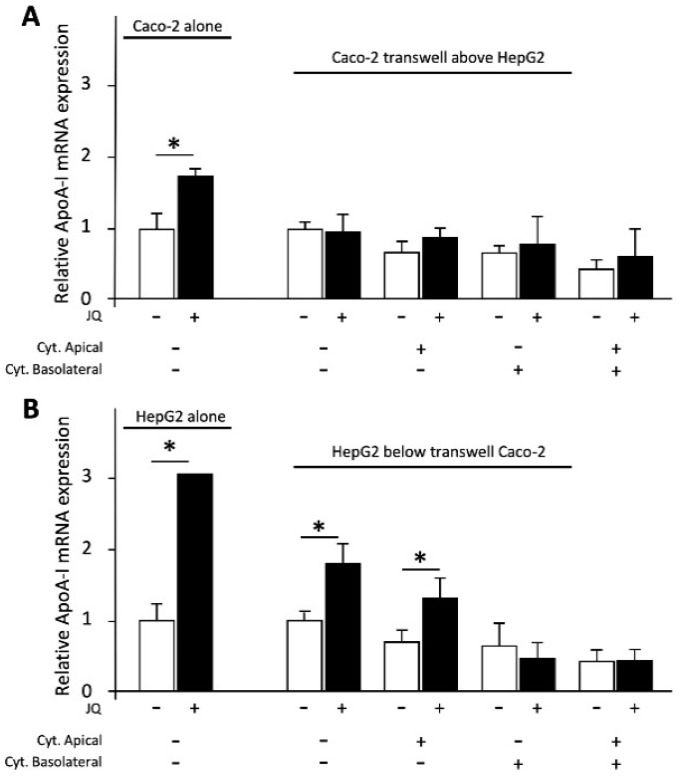
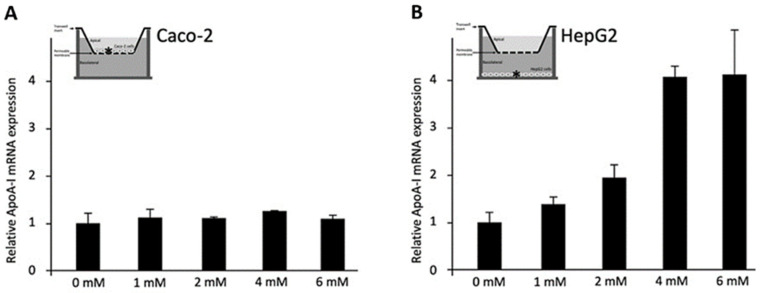
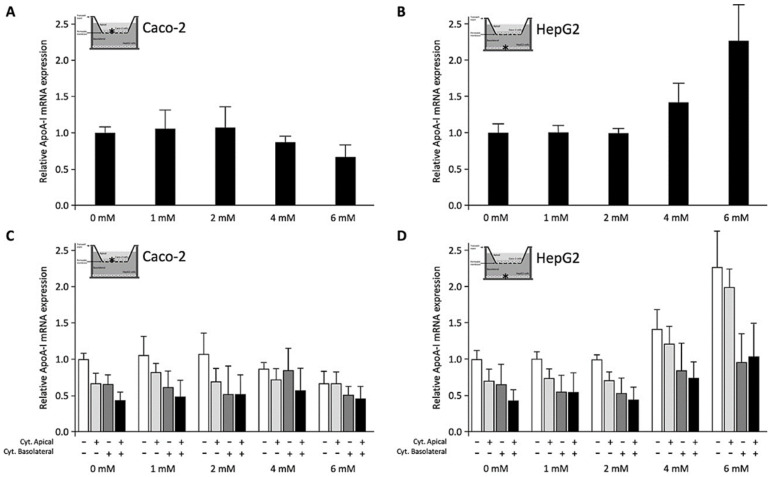
Apolipoprotein A-I (ApoA-I) concentrations are decreased during inflammation, which may reduce high-density lipoprotein (HDL) functionality. Thus, rescuing ApoA-I concentrations during inflammation might help to prevent atherosclerosis. Recent studies have shown that butyric acid (C4) has anti-inflammatory effects and rescues ApoA-I production. However, whether intestinal short chain fatty acids (SCFAs) are able to influence hepatic processes is unknown. Therefore, we investigated C4 anti-inflammatory effects on ApoA-I transcription in the intestine-liver co-culture model. C4 dose-response experiments in the presence or absence of cytokines were performed in a co-culture system including Caco-2 cells, HepG2 cells, or both. Changes in ApoA-I transcription in Caco-2 cells and HepG2 cells were analyzed using qPCR. C4 increased ApoA-I expression in HepG2 cells that cultured alone. When both cells were cultured together, C4 decreased ApoA-I expression in Caco-2 cells and increased ApoA-I expression in HepG2 cells. However, adding C4 to apical Caco-2 cells resulted in a smaller effect in HepG2 cells compared with adding C4 directly to the hepatocytes. Moreover, C4 rescued ApoA-I expression in inflamed HepG2 cells. These findings suggests that intestinal SCFAs can affect hepatic processes. However, the smaller effect in the co-culture experiment indicates cross-talk between intestine and liver.
载脂蛋白 A-I(ApoA-I)浓度在炎症期间降低,这可能降低高密度脂蛋白(HDL)的功能。因此,在炎症期间挽救 ApoA-I 浓度可能有助于预防动脉粥样硬化。最近的研究表明,丁酸(C4)具有抗炎作用,并能挽救 ApoA-I 的产生。然而,肠道短链脂肪酸(SCFAs)是否能够影响肝脏过程尚不清楚。因此,我们研究了 C4 在肠-肝共培养模型中对 ApoA-I 转录的抗炎作用。在共培养系统中,包括 Caco-2 细胞、HepG2 细胞或两者都存在的情况下,进行了 C4 剂量反应实验和细胞因子的存在与否。使用 qPCR 分析 Caco-2 细胞和 HepG2 细胞中 ApoA-I 转录的变化。C4 增加了单独培养的 HepG2 细胞中的 ApoA-I 表达。当两种细胞一起培养时,C4 降低了 Caco-2 细胞中的 ApoA-I 表达,增加了 HepG2 细胞中的 ApoA-I 表达。然而,与直接向肝细胞中添加 C4 相比,向顶端的 Caco-2 细胞中添加 C4 对 HepG2 细胞的影响较小。此外,C4 挽救了炎症 HepG2 细胞中的 ApoA-I 表达。这些发现表明肠道 SCFAs 可以影响肝脏过程。然而,共培养实验中的较小影响表明肠和肝之间存在串扰。