Ohira Hideo, Tsutsui Wao, Fujioka Yoshio
Division of Clinical Nutrition, Faculty of Nutrition, Kobe Gakuin University.
J Atheroscler Thromb. 2017 Jul 1;24(7):660-672. doi: 10.5551/jat.RV17006. Epub 2017 May 27.
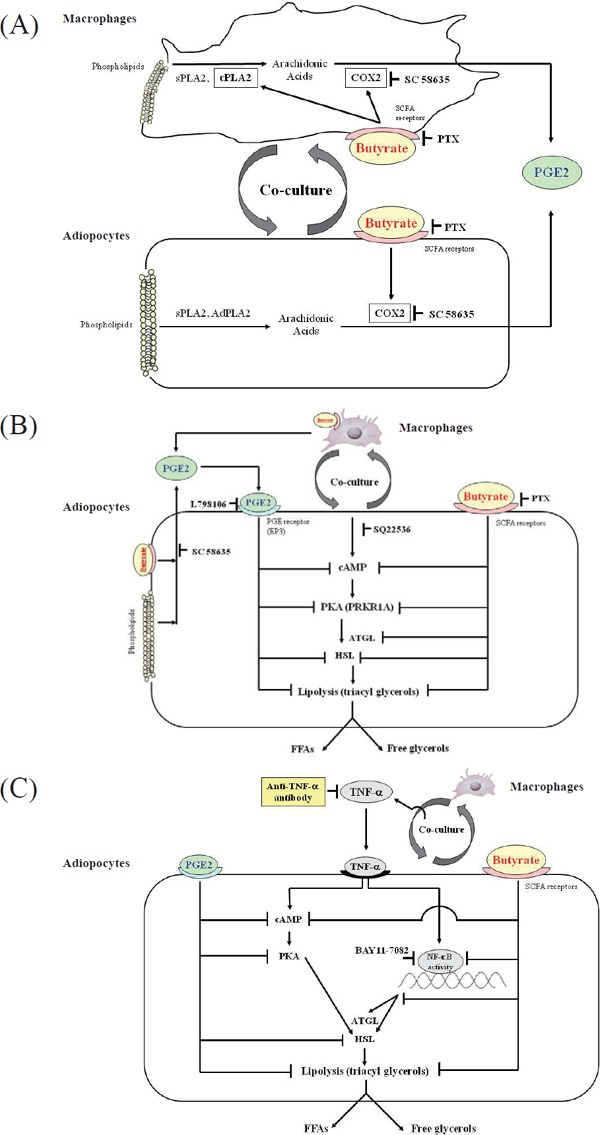
Intestinal flora (microbiota) have recently attracted attention among lipid and carbohydrate metabolism researchers. Microbiota metabolize resistant starches and dietary fibers through fermentation and decomposition, and provide short chain fatty acids (SCFAs) to the host. The major SCFAs acetates, propionate and butyrate, have different production ratios and physiological activities. Several receptors for SCFAs have been identified as the G-protein coupled receptor 41/free fatty acid receptor 3 (GPR41/FFAR3), GPR43/FFAR2, GPR109A, and olfactory receptor 78, which are present in intestinal epithelial cells, immune cells, and adipocytes, despite their expression levels differing between tissues and cell types. Many studies have indicated that SCFAs exhibit a wide range of functions from immune regulation to metabolism in a variety of tissues and organs, and therefore have both a direct and indirect influence on our bodies. This review will focus on SCFAs, especially butyrate, and their effects on various inflammatory mechanisms including atherosclerosis. In the future, SCFAs may provide new insights into understanding the pathophysiology of chronic inflammation, metabolic disorders, and atherosclerosis, and we can expect the development of novel therapeutic strategies for these diseases.
肠道菌群(微生物群)最近在脂质和碳水化合物代谢研究领域引起了关注。微生物群通过发酵和分解作用代谢抗性淀粉和膳食纤维,并为宿主提供短链脂肪酸(SCFAs)。主要的短链脂肪酸,如乙酸盐、丙酸盐和丁酸盐,具有不同的生成比例和生理活性。已确定几种短链脂肪酸受体为G蛋白偶联受体41/游离脂肪酸受体3(GPR41/FFAR3)、GPR43/FFAR2、GPR109A和嗅觉受体78,它们存在于肠道上皮细胞、免疫细胞和脂肪细胞中,尽管其在不同组织和细胞类型中的表达水平有所差异。许多研究表明,短链脂肪酸在多种组织和器官中展现出从免疫调节到代谢等广泛的功能,因此对我们的身体有着直接和间接的影响。本综述将聚焦于短链脂肪酸,尤其是丁酸盐,以及它们对包括动脉粥样硬化在内的各种炎症机制的影响。未来,短链脂肪酸可能为理解慢性炎症、代谢紊乱和动脉粥样硬化的病理生理学提供新的见解,并且我们有望开发出针对这些疾病的新型治疗策略。