Intercollege Graduate Degree Program in Ecology, Pennsylvania State University, University Park, PA, USA.
Department of Entomology, Center for Pollinator Research, Huck Institutes of the Life Sciences, Pennsylvania State University, University Park, PA, USA.
Glob Chang Biol. 2021 Mar;27(6):1250-1265. doi: 10.1111/gcb.15485. Epub 2021 Jan 12.
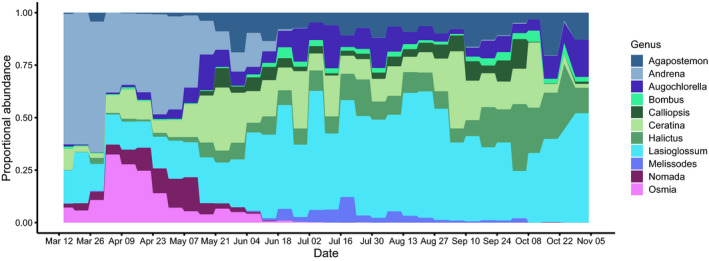
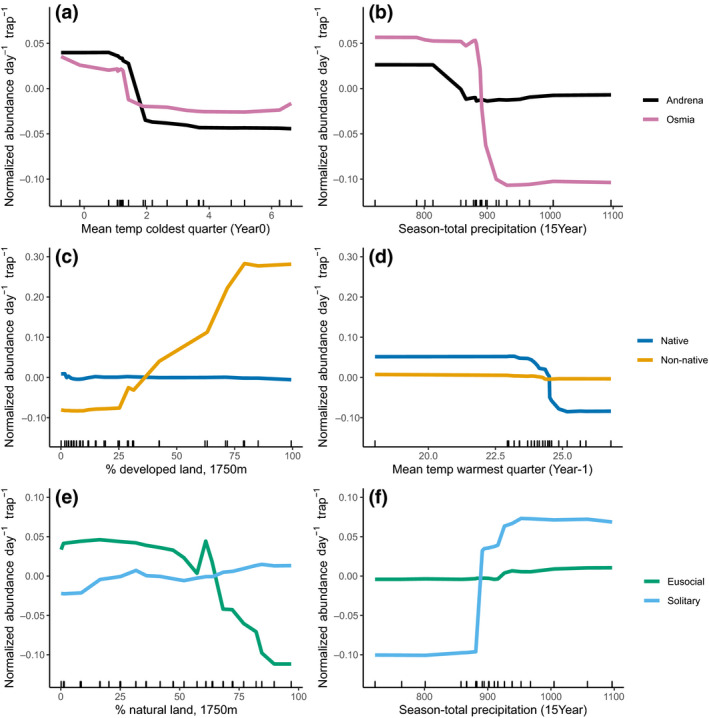
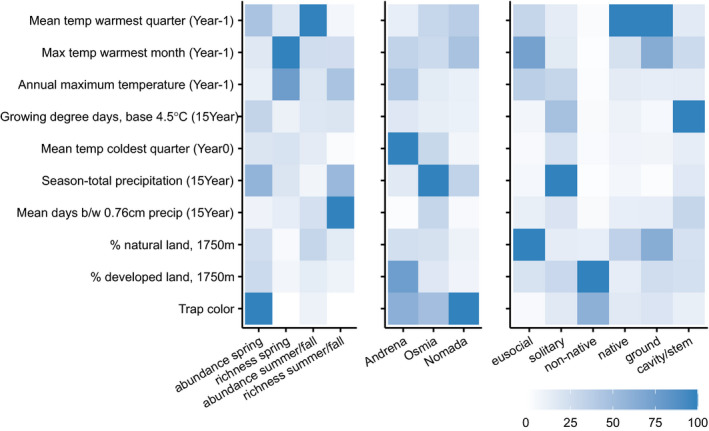
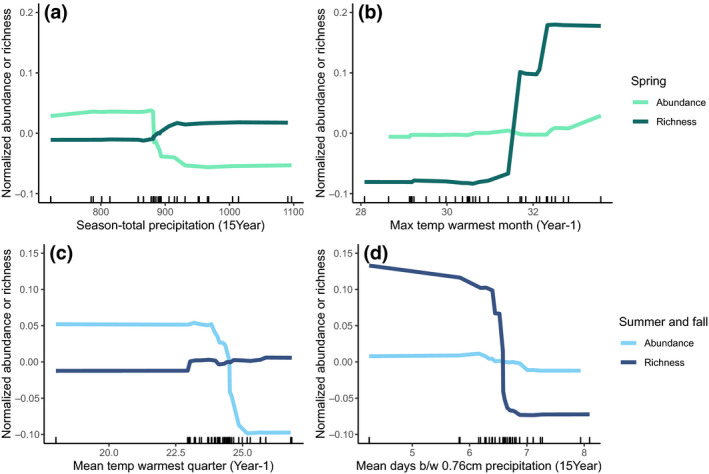
Wild bees, like many other taxa, are threatened by land-use and climate change, which, in turn, jeopardizes pollination of crops and wild plants. Understanding how land-use and climate factors interact is critical to predicting and managing pollinator populations and ensuring adequate pollination services, but most studies have evaluated either land-use or climate effects, not both. Furthermore, bee species are incredibly variable, spanning an array of behavioral, physiological, and life-history traits that can increase or decrease resilience to land-use or climate change. Thus, there are likely bee species that benefit, while others suffer, from changing climate and land use, but few studies have documented taxon-specific trends. To address these critical knowledge gaps, we analyzed a long-term dataset of wild bee occurrences from Maryland, Delaware, and Washington DC, USA, examining how different bee genera and functional groups respond to landscape composition, quality, and climate factors. Despite a large body of literature documenting land-use effects on wild bees, in this study, climate factors emerged as the main drivers of wild-bee abundance and richness. For wild-bee communities in spring and summer/fall, temperature and precipitation were more important predictors than landscape composition, landscape quality, or topography. However, relationships varied substantially between wild-bee genera and functional groups. In the Northeast USA, past trends and future predictions show a changing climate with warmer winters, more intense precipitation in winter and spring, and longer growing seasons with higher maximum temperatures. In almost all of our analyses, these conditions were associated with lower abundance of wild bees. Wild-bee richness results were more mixed, including neutral and positive relationships with predicted temperature and precipitation patterns. Thus, in this region and undoubtedly more broadly, changing climate poses a significant threat to wild-bee communities.
野生蜜蜂与许多其他类群一样,受到土地利用和气候变化的威胁,而这反过来又危及作物和野生植物的授粉。了解土地利用和气候因素如何相互作用对于预测和管理传粉媒介种群以及确保充足的授粉服务至关重要,但大多数研究仅评估了土地利用或气候的影响,而不是两者兼而有之。此外,蜜蜂物种的变化非常大,涵盖了一系列行为、生理和生活史特征,这些特征可以增加或减少对土地利用或气候变化的适应能力。因此,可能有一些蜜蜂物种从不断变化的气候和土地利用中受益,而另一些则遭受损失,但很少有研究记录了特定分类群的趋势。为了弥补这些关键的知识空白,我们分析了来自美国马里兰州、特拉华州和华盛顿特区的长期野生蜜蜂出现数据集,研究了不同的蜜蜂属和功能组如何对景观组成、质量和气候因素做出反应。尽管有大量文献记录了土地利用对野生蜜蜂的影响,但在本研究中,气候因素是野生蜜蜂丰度和丰富度的主要驱动因素。对于春季和夏季/秋季的野生蜜蜂群落,温度和降水比景观组成、景观质量或地形更重要的预测因子。然而,关系在不同的野生蜜蜂属和功能组之间存在很大差异。在美国东北部,过去的趋势和未来的预测显示出一个气候变化的趋势,冬季和春季的气温升高,降水更加集中,生长季节更长,最高温度更高。在我们的几乎所有分析中,这些条件与野生蜜蜂的丰度较低有关。野生蜜蜂丰富度的结果更加复杂,包括与预测的温度和降水模式呈中性和正相关的关系。因此,在这个地区,而且无疑在更广泛的地区,气候变化对野生蜜蜂群落构成了重大威胁。