Kendall Liam K, Rader Romina, Gagic Vesna, Cariveau Daniel P, Albrecht Matthias, Baldock Katherine C R, Freitas Breno M, Hall Mark, Holzschuh Andrea, Molina Francisco P, Morten Joanne M, Pereira Janaely S, Portman Zachary M, Roberts Stuart P M, Rodriguez Juanita, Russo Laura, Sutter Louis, Vereecken Nicolas J, Bartomeus Ignasi
School of Environmental and Rural Science University of New England Armidale New South Wales Australia.
CSIRO Agriculture Brisbane Queensland Australia.
Ecol Evol. 2019 Feb 7;9(4):1702-1714. doi: 10.1002/ece3.4835. eCollection 2019 Feb.
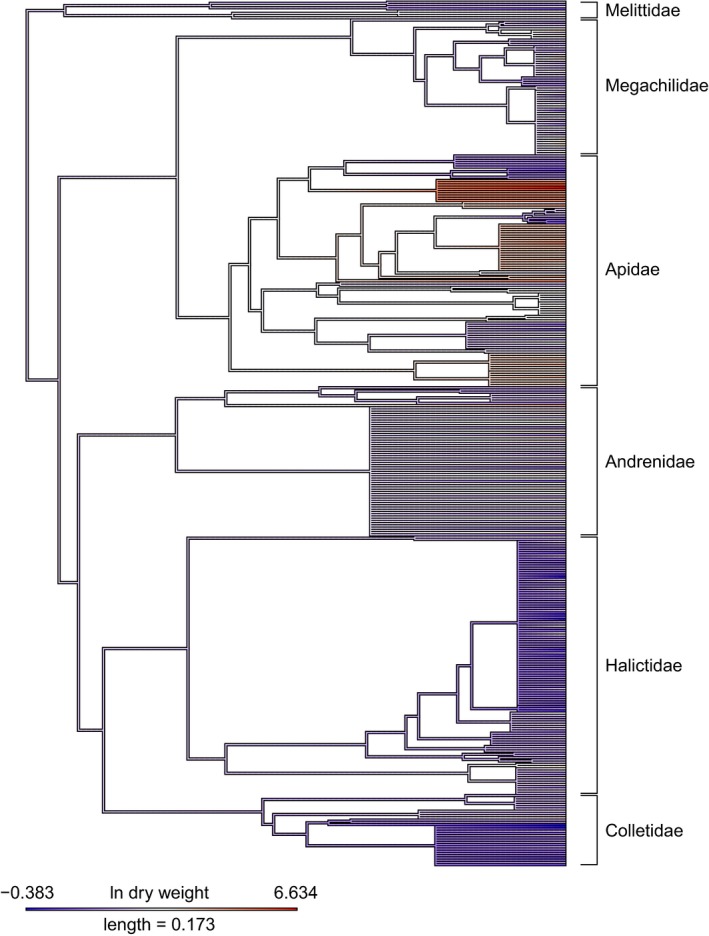
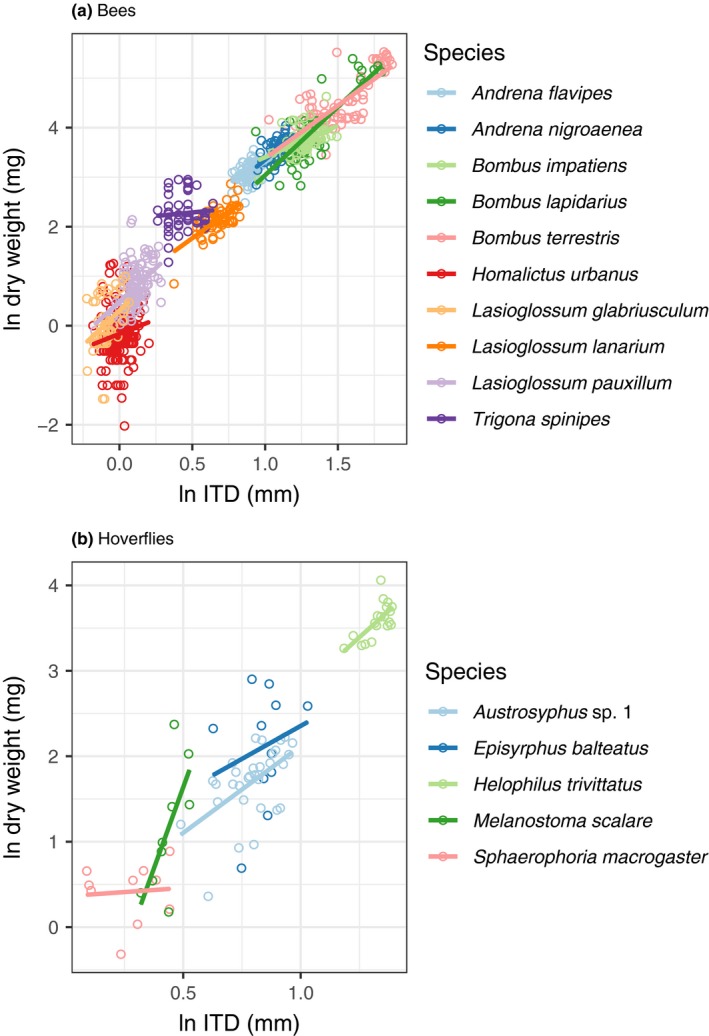
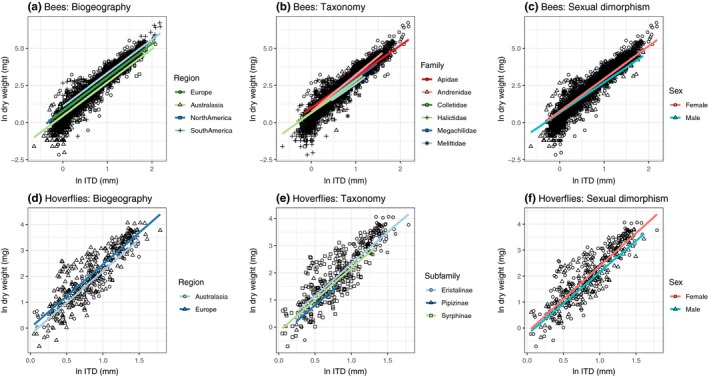
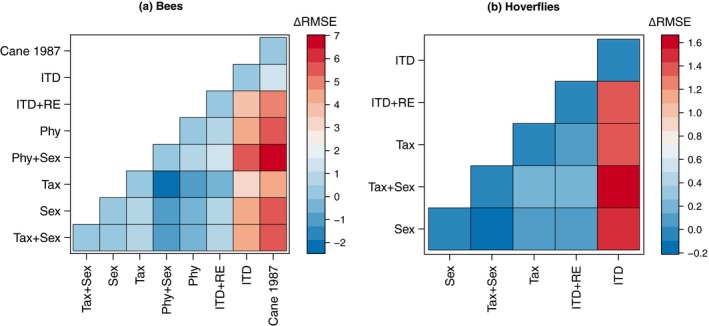
Body size is an integral functional trait that underlies pollination-related ecological processes, yet it is often impractical to measure directly. Allometric scaling laws have been used to overcome this problem. However, most existing models rely upon small sample sizes, geographically restricted sampling and have limited applicability for non-bee taxa. Allometric models that consider biogeography, phylogenetic relatedness, and intraspecific variation are urgently required to ensure greater accuracy. We measured body size as dry weight and intertegular distance (ITD) of 391 bee species (4,035 specimens) and 103 hoverfly species (399 specimens) across four biogeographic regions: Australia, Europe, North America, and South America. We updated existing models within a Bayesian mixed-model framework to test the power of ITD to predict interspecific variation in pollinator dry weight in interaction with different co-variates: phylogeny or taxonomy, sexual dimorphism, and biogeographic region. In addition, we used ordinary least squares regression to assess intraspecific dry weight ~ ITD relationships for ten bees and five hoverfly species. Including co-variates led to more robust interspecific body size predictions for both bees and hoverflies relative to models with the ITD alone. In contrast, at the intraspecific level, our results demonstrate that the ITD is an inconsistent predictor of body size for bees and hoverflies. The use of allometric scaling laws to estimate body size is more suitable for interspecific comparative analyses than assessing intraspecific variation. Collectively, these models form the basis of the dynamic package, "" which provides a comprehensive resource for allometric pollination research worldwide.
身体大小是一个不可或缺的功能性状,它是与授粉相关的生态过程的基础,但直接测量往往不切实际。异速生长比例定律已被用于克服这一问题。然而,大多数现有模型依赖于小样本量、地理范围有限的采样,并且对非蜜蜂类群的适用性有限。迫切需要考虑生物地理学、系统发育相关性和种内变异的异速生长模型,以确保更高的准确性。我们测量了来自四个生物地理区域(澳大利亚、欧洲、北美和南美)的391种蜜蜂(4035个标本)和103种食蚜蝇(399个标本)的身体大小,以干重和翅基距(ITD)表示。我们在贝叶斯混合模型框架内更新了现有模型,以测试ITD在与不同协变量(系统发育或分类学、两性异形和生物地理区域)相互作用时预测传粉者干重种间变异的能力。此外,我们使用普通最小二乘法回归来评估十种蜜蜂和五种食蚜蝇物种的种内干重~ITD关系。相对于仅使用ITD的模型,纳入协变量可使蜜蜂和食蚜蝇的种间身体大小预测更加稳健。相比之下,在种内水平上,我们的结果表明,ITD对于蜜蜂和食蚜蝇的身体大小来说是一个不一致的预测指标。使用异速生长比例定律来估计身体大小更适合于种间比较分析,而不是评估种内变异。总体而言,这些模型构成了动态包“”的基础,该包为全球异速授粉研究提供了全面的资源。