Mailloux Catherine, Beaulieu Louis-David, Wideman Timothy H, Massé-Alarie Hugo
Centre Interdisciplinaire de Recherche en Réadaptation et Intégration Sociale (CIRRIS), Université Laval, Quebec, Canada.
BioNR Research Lab, Université du Québec à Chicoutimi, Chicoutimi, Canada.
PLoS One. 2021 Jan 12;16(1):e0245278. doi: 10.1371/journal.pone.0245278. eCollection 2021.
To determine the absolute and relative intra-rater within-session test-retest reliability of pressure pain threshold (PPT) and mechanical temporal summation of pain (TSP) at the low back and the forearm in healthy participants and to test the influence of the number and sequence of measurements on reliability metrics.
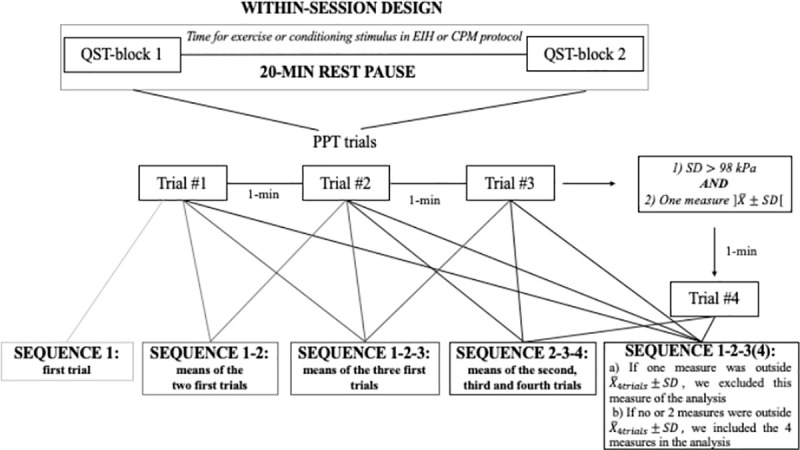
In 24 participants, three PPT and TSP measures were assessed at four sites (2 at the low back, 2 at the forearm) in two blocks of measurements separated by 20 minutes. The standard error of measurement, the minimal detectable change (MDC) and the intraclass correlation coefficient (ICC) were investigated for five different sequences of measurements (e.g. measurement 1, 1-2, 1-2-3).
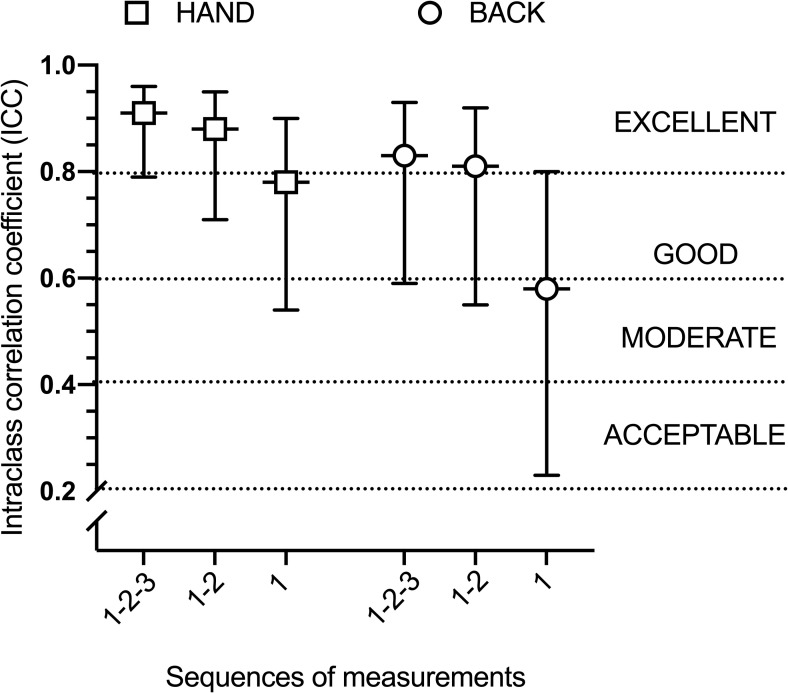
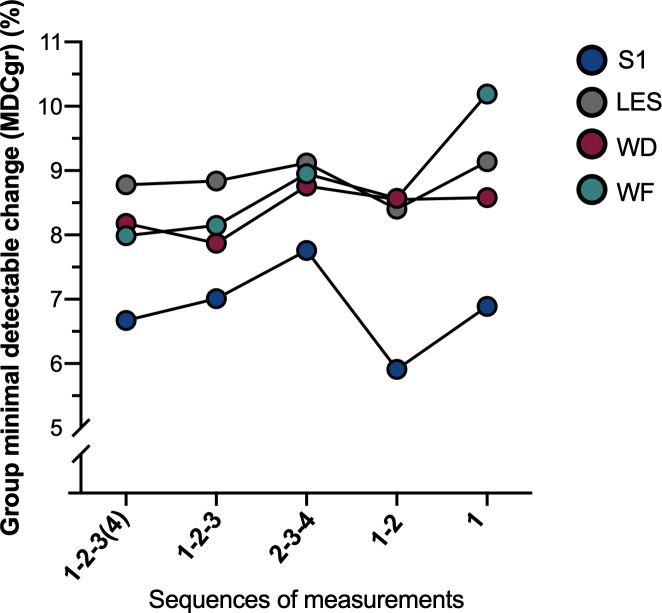
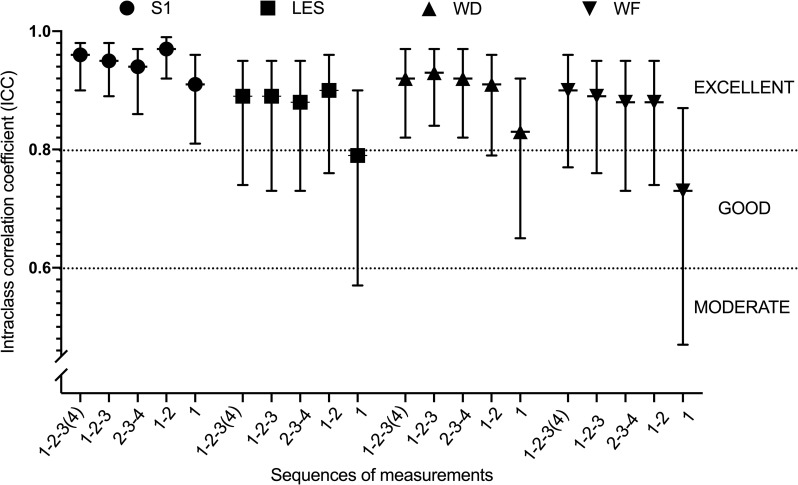
The MDC for the group (MDCgr) for PPT ranged from 28.71 to 50.56 kPa across the sites tested, whereas MDCgr for TSP varied from 0.33 to 0.57 out of 10 (numeric scale). Almost all ICC showed an excellent relative reliability (between 0.80 and 0.97), except when only the first measurement was considered (moderate). Although minimal differences in absolute PPT reliability were present between the different sequences, in general, using only the first measurement increase measurement error. Three TSP measures reduced the measurement error.
We established that two measurements of PPT and three of TSP reduced the measurement error and demonstrated an excellent relative reliability. Our results could be used in future pain research to confirm the presence of true hypo/hyperalgesia for paradigms such as conditioned pain modulation or exercise-induced hypoalgesia, indicated by a change exceeding the measurement variability.
确定健康参与者在腰部和前臂压力疼痛阈值(PPT)及疼痛的机械性时间总和(TSP)的绝对和相对评定者内组内重测信度,并测试测量次数和顺序对信度指标的影响。
对24名参与者,在四个部位(腰部2个、前臂2个)进行三次PPT和TSP测量,分两个测量块进行,中间间隔20分钟。针对五种不同的测量顺序(如测量1、1 - 2、1 - 2 - 3),研究测量标准误、最小可检测变化(MDC)和组内相关系数(ICC)。
在所测试的部位中,PPT的组MDC(MDCgr)范围为28.71至50.56 kPa,而TSP的MDCgr在数字评分10分制中为0.33至0.57。几乎所有的ICC都显示出极好的相对信度(在0.80至0.97之间),只有考虑第一次测量时除外(为中等)。虽然不同顺序之间绝对PPT信度存在最小差异,但总体而言,仅使用第一次测量会增加测量误差。三次TSP测量减少了测量误差。
我们确定两次PPT测量和三次TSP测量可减少测量误差,并显示出极好的相对信度。我们的结果可用于未来的疼痛研究,以确认在诸如条件性疼痛调制或运动诱导性痛觉减退等范式中是否存在真正的痛觉减退/过敏,其表现为变化超过测量变异性。