Population Health Sciences, Bristol Medical School, University of Bristol, Bristol, United Kingdom.
MRC Integrative Epidemiology Unit, University of Bristol, Bristol, United Kingdom.
J Womens Health (Larchmt). 2021 Aug;30(8):1171-1181. doi: 10.1089/jwh.2020.8624. Epub 2021 Jan 12.
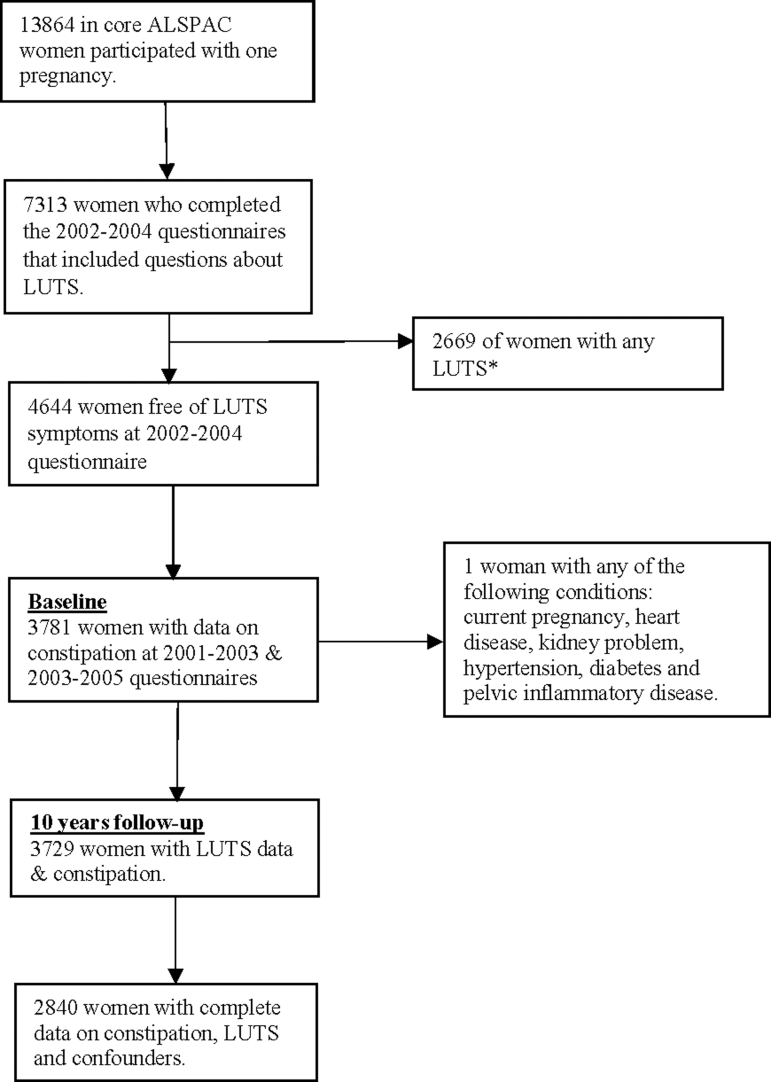
To examine the prospective association between constipation and risk of developing lower urinary tract symptoms (LUTS) in parous middle-aged women. The study uses data from 3,729 women from the Avon Longitudinal Study of Parents and Children who provided self-reports of medication intake for constipation at two time points (Baseline): 2001-2003 and 2003-2005. Women with LUTS at baseline were excluded. After 10 years of follow-up, women provided self-reports of LUTS using an adapted version of the International Consultation on Incontinence Questionnaire on Female LUTS. LUTS were categorized according to International Continence Society definitions as stress urinary incontinence (UI), urgency UI, mixed UI, nocturia, increased daytime frequency, urgency, hesitancy, and intermittency. LUTS were considered present if symptoms were reported to occur at least "sometimes" for all subtypes, except for increased daytime frequency (≥9 times) and nocturia (≥2 times nightly). At follow-up, the prevalence of any LUTS was 40%. Women (mean age 43.3 years, standard deviation 0.5), who took medication for constipation at either time point had increased risks of urgency (adjusted relative risks [RRs] = 1.35; 95% confidence interval [CI] 1.04-1.95) and hesitancy (adjusted RR = 1.72; 95% CI 1.04-3.01) compared with women who reported not using medication for constipation at either time point. The risk of urgency (adjusted RR = 1.94; 95% CI 1.15-3.29) and hesitancy (adjusted RR = 1.78; 95% CI 1.03-4.19) was greater for women who reported taking medication for constipation at both time points. There was no evidence that constipation was associated with stress UI, urgency UI, mixed UI, nocturia, increased daytime frequency, and intermittency. Constipation is prospectively associated with an increased risk of urgency and hesitancy among parous middle-aged women. If further research finds evidence that this association is causal, this implies that women should seek treatment to alleviate constipation to reduce their consequent risk of developing these LUTS.
为了研究产后中年女性便秘与下尿路症状(LUTS)发生风险的前瞻性关联。该研究使用了来自阿冯纵向研究父母和孩子的 3729 名女性的数据,这些女性在两个时间点(基线)报告了便秘药物的摄入情况:2001-2003 年和 2003-2005 年。排除基线时患有 LUTS 的女性。随访 10 年后,女性使用女性 LUTS 的国际咨询尿失禁问卷的改编版本报告了 LUTS。根据国际尿控协会的定义,LUTS 分为压力性尿失禁(UI)、急迫性 UI、混合性 UI、夜尿症、白天频率增加、急迫性、犹豫和间歇性。除了白天频率增加(≥9 次)和夜尿症(≥2 次/夜)外,如果所有亚型的症状报告至少“有时”发生,则认为存在 LUTS。在随访时,任何 LUTS 的患病率为 40%。服用便秘药物的女性(平均年龄 43.3 岁,标准差 0.5),发生急迫性(调整后的相对风险 [RR] = 1.35;95%置信区间 [CI] 1.04-1.95)和犹豫(调整后 RR = 1.72;95% CI 1.04-3.01)的风险高于任何时间点都未报告服用便秘药物的女性。与任何时间点都未报告服用便秘药物的女性相比,报告在两个时间点都服用便秘药物的女性发生急迫性(调整后的 RR = 1.94;95% CI 1.15-3.29)和犹豫(调整后的 RR = 1.78;95% CI 1.03-4.19)的风险更高。没有证据表明便秘与压力性 UI、急迫性 UI、混合性 UI、夜尿症、白天频率增加和间歇性有关。便秘与产后中年女性急迫性和犹豫的风险增加具有前瞻性关联。如果进一步的研究发现这种关联是因果关系的证据,这意味着女性应该寻求治疗便秘的方法来降低她们随后患这些 LUTS 的风险。