
分娩方式对压力性尿失禁和急迫性尿失禁的长期影响:一项系统评价和荟萃分析。
Long-term Impact of Mode of Delivery on Stress Urinary Incontinence and Urgency Urinary Incontinence: A Systematic Review and Meta-analysis.
作者信息
Tähtinen Riikka M, Cartwright Rufus, Tsui Johnson F, Aaltonen Riikka L, Aoki Yoshitaka, Cárdenas Jovita L, El Dib Regina, Joronen Kirsi M, Al Juaid Sumayyah, Kalantan Sabreen, Kochana Michal, Kopec Malgorzata, Lopes Luciane C, Mirza Enaya, Oksjoki Sanna M, Pesonen Jori S, Valpas Antti, Wang Li, Zhang Yuqing, Heels-Ansdell Diane, Guyatt Gordon H, Tikkinen Kari A O
机构信息
Department of Obstetrics and Gynecology, Kuopio University Hospital, Kuopio, Finland; Department of Obstetrics and Gynecology, Kanta-Häme Central Hospital, Hämeenlinna, Finland.
Department of Epidemiology and Biostatistics, Imperial College London, London, UK; Department of Urogynecology, Imperial College London, London, UK.
出版信息
Eur Urol. 2016 Jul;70(1):148-158. doi: 10.1016/j.eururo.2016.01.037. Epub 2016 Feb 10.
CONTEXT
Stress urinary incontinence (SUI) and urgency urinary incontinence (UUI) are associated with physical and psychological morbidity, and large societal costs. The long-term effects of delivery modes on each kind of incontinence remain uncertain.
OBJECTIVE
To investigate the long-term impact of delivery mode on SUI and UUI.
EVIDENCE ACQUISITION
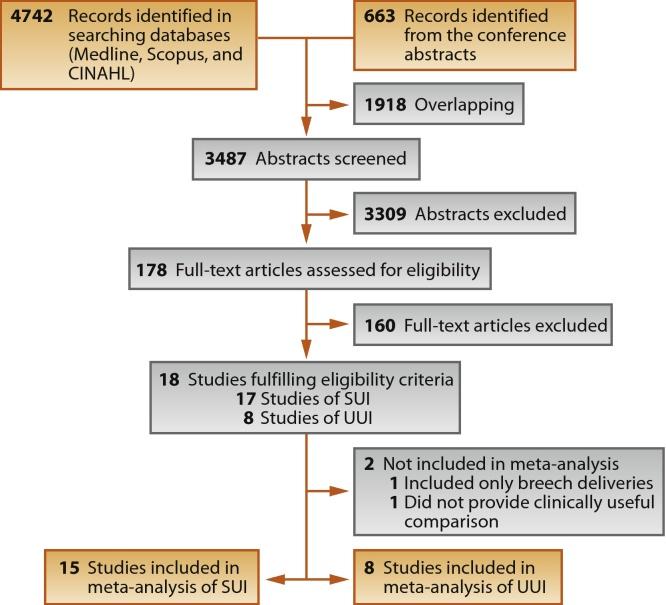
We searched Medline, Scopus, CINAHL, and relevant major conference abstracts up to October 31, 2014, including any observational study with adjusted analyses or any randomized trial addressing the association between delivery mode and SUI or UUI ≥1 yr after delivery. Two reviewers extracted data, including incidence/prevalence of SUI and UUI by delivery modes, and assessed risk of bias.
EVIDENCE SYNTHESIS
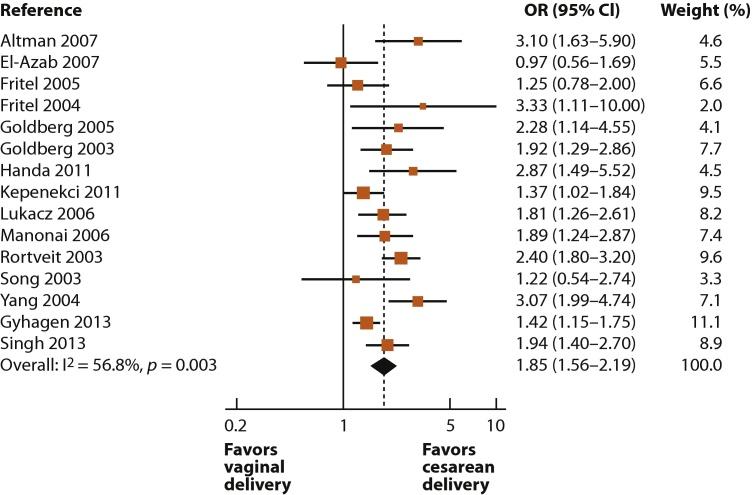
Pooled estimates from 15 eligible studies demonstrated an increased risk of SUI after vaginal delivery versus cesarean section (adjusted odds ratio [aOR]: 1.85; 95% confidence interval [CI], 1.56-2.19; I(2)=57%; risk difference: 8.2%). Metaregression demonstrated a larger effect of vaginal delivery among younger women (p=0.005). Four studies suggested no difference in the risk of SUI between spontaneous vaginal and instrumental delivery (aOR: 1.11; 95% CI, 0.84-1.45; I(2)=50%). Eight studies suggested an elevated risk of UUI after vaginal delivery versus cesarean section (aOR: 1.30; 95% CI, 1.02-1.65; I(2)=37%; risk difference: 2.6%).
CONCLUSIONS
Compared with cesarean section, vaginal delivery is associated with an almost twofold increase in the risk of long-term SUI, with an absolute increase of 8%, and an effect that is largest in younger women. There is also an increased risk of UUI, with an absolute increase of approximately 3%.
PATIENT SUMMARY
In this systematic review we looked for the long-term effects of childbirth on urinary leakage. We found that vaginal delivery is associated with an almost twofold increase in the risk of developing leakage with exertion, compared with cesarean section, with a smaller effect on leakage in association with urgency.
背景
压力性尿失禁(SUI)和急迫性尿失禁(UUI)与身体和心理疾病以及巨大的社会成本相关。分娩方式对每种尿失禁的长期影响仍不确定。
目的
研究分娩方式对SUI和UUI的长期影响。
证据获取
我们检索了截至2014年10月31日的Medline、Scopus、CINAHL以及相关主要会议摘要,包括任何进行了校正分析的观察性研究或任何探讨分娩方式与产后≥1年的SUI或UUI之间关联的随机试验。两名研究者提取数据,包括按分娩方式划分的SUI和UUI的发病率/患病率,并评估偏倚风险。
证据综合
15项符合条件的研究的汇总估计显示,与剖宫产相比,阴道分娩后发生SUI的风险增加(校正优势比[aOR]:1.85;95%置信区间[CI],1.56 - 2.19;I² = 57%;风险差异:8.2%)。Meta回归显示年轻女性中阴道分娩的影响更大(p = 0.005)。四项研究表明自然阴道分娩和器械助产分娩后SUI风险无差异(aOR:1.11;95% CI,0.84 - 1.45;I² = 50%)。八项研究表明与剖宫产相比,阴道分娩后发生UUI的风险增加(aOR:1.30;95% CI,1.02 - 1.65;I² = 37%;风险差异:2.6%)。
结论
与剖宫产相比,阴道分娩与长期SUI风险几乎增加两倍相关,绝对增加8%,且在年轻女性中影响最大。UUI风险也增加,绝对增加约3%。
患者总结
在这项系统评价中,我们研究了分娩对尿失禁的长期影响。我们发现,与剖宫产相比,阴道分娩后因用力而发生漏尿的风险几乎增加两倍,对因急迫感而导致的漏尿影响较小。


 Zotero 插件