Sung Pil Soo, Shin Eui-Cheol
Division of Gastroenterology and Hepatology, Department of Internal Medicine, College of Medicine, Seoul St. Mary's Hospital, The Catholic University of Korea, Seoul 06591, Korea.
The Catholic Liver Research Center, The Catholic University of Korea, Seoul 06591, Korea.
J Clin Med. 2021 Jan 10;10(2):221. doi: 10.3390/jcm10020221.
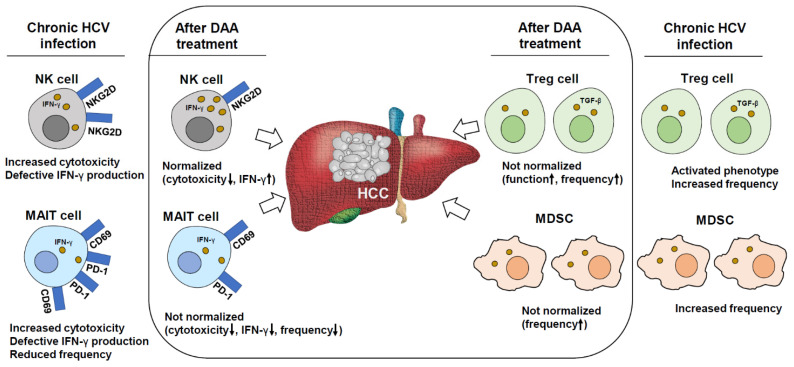
Direct-acting antiviral agents (DAAs) that allow for rapid clearance of hepatitis C virus (HCV) may evoke immunological changes. Some cases of rapid de novo hepatocellular carcinoma (HCC) development or early recurrence of HCC after DAA treatment have been reported. During chronic HCV infection, natural killer (NK) cells exhibited a deviant functional phenotype with decreased production of antiviral cytokines and increased cytotoxicity; however, DAA treatment rapidly decreased their cytotoxic function. Effective DAA therapy also suppressed the intrahepatic activation of macrophages/monocytes. This was followed by a decrease in mucosal-associated invariant T (MAIT) cell cytotoxicity without normalization of cytokine production. Rapid changes in the phenotypes of NK and MAIT cells after DAA treatment may attenuate the cytotoxicity of these cells against cancer cells. Moreover, DAA treatment did not normalize the increased frequencies of regulatory T cells even after clearance of HCV infection. Thus, the persistently increased frequency of regulatory T cells may contribute to a local immunosuppressive milieu and hamper the clearance of cancer cells. This review will focus on recent studies describing the changes in innate and adaptive immune responses after DAA treatment in patients with chronic HCV infection in the context of de novo occurrence or recurrence of HCC.
能够实现丙型肝炎病毒(HCV)快速清除的直接抗病毒药物(DAAs)可能会引发免疫变化。已有报道称,部分患者在接受DAA治疗后出现了新发肝细胞癌(HCC)快速进展或HCC早期复发的情况。在慢性HCV感染期间,自然杀伤(NK)细胞表现出功能异常的表型,抗病毒细胞因子产生减少,细胞毒性增加;然而,DAA治疗迅速降低了它们的细胞毒性功能。有效的DAA治疗还抑制了巨噬细胞/单核细胞的肝内活化。随后,黏膜相关恒定T(MAIT)细胞的细胞毒性降低,但细胞因子产生未恢复正常。DAA治疗后NK细胞和MAIT细胞表型的快速变化可能会减弱这些细胞对癌细胞的细胞毒性。此外,即使在HCV感染清除后,DAA治疗也未能使调节性T细胞增加的频率恢复正常。因此,调节性T细胞频率持续增加可能会导致局部免疫抑制环境,并阻碍癌细胞的清除。本综述将聚焦于近期的研究,这些研究描述了慢性HCV感染患者在接受DAA治疗后,在HCC新发或复发背景下固有免疫和适应性免疫反应的变化。