School of Computer, Hunan University of Technology, Zhuzhou 412007, China.
School of Automation, Central South University, Changsha 410083, China.
Sensors (Basel). 2021 Jan 8;21(2):418. doi: 10.3390/s21020418.
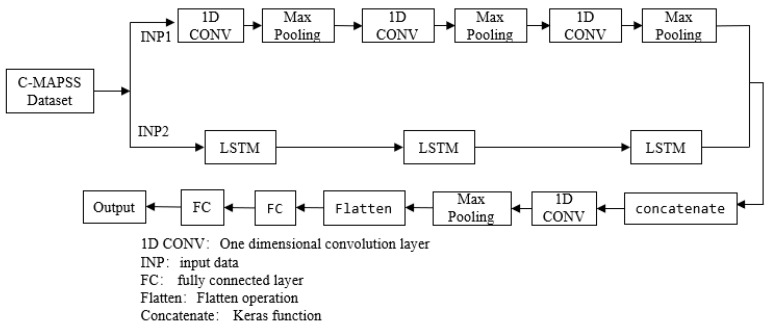
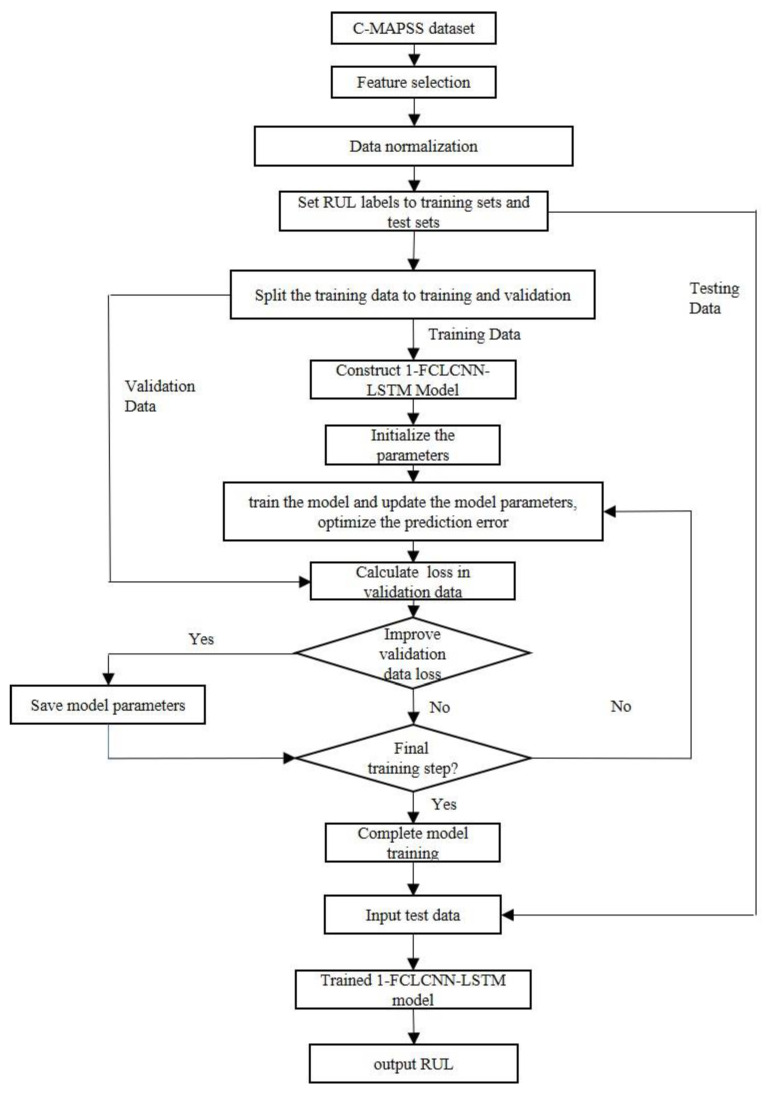
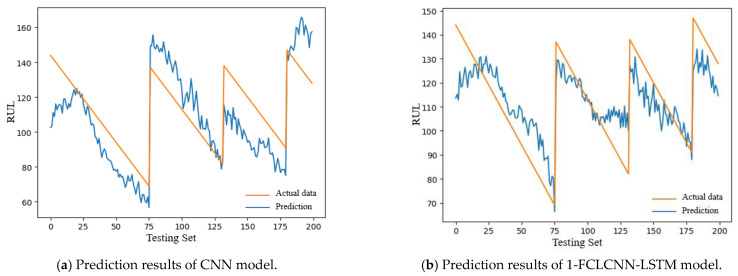
The prognosis of the remaining useful life (RUL) of turbofan engine provides an important basis for predictive maintenance and remanufacturing, and plays a major role in reducing failure rate and maintenance costs. The main problem of traditional methods based on the single neural network of shallow machine learning is the RUL prognosis based on single feature extraction, and the prediction accuracy is generally not high, a method for predicting RUL based on the combination of one-dimensional convolutional neural networks with full convolutional layer (1-FCLCNN) and long short-term memory (LSTM) is proposed. In this method, LSTM and 1- FCLCNN are adopted to extract temporal and spatial features of FD001 andFD003 datasets generated by turbofan engine respectively. The fusion of these two kinds of features is for the input of the next convolutional neural networks (CNN) to obtain the target RUL. Compared with the currently popular RUL prediction models, the results show that the model proposed has higher prediction accuracy than other models in RUL prediction. The final evaluation index also shows the effectiveness and superiority of the model.
航空发动机剩余使用寿命预测为预测性维修和再制造提供了重要依据,对降低故障率和维修成本具有重要意义。基于浅层机器学习单一神经网络的传统方法的主要问题是基于单一特征提取的 RUL 预测,预测精度普遍不高,提出了一种基于一维卷积神经网络与全卷积层(1-FCLCNN)和长短时记忆(LSTM)组合的 RUL 预测方法。在该方法中,采用 LSTM 和 1-FCLCNN 分别提取航空发动机 FD001 和 FD003 数据集的时间和空间特征,将这两种特征融合作为下一个卷积神经网络(CNN)的输入,得到目标 RUL。与目前流行的 RUL 预测模型相比,结果表明,所提出的模型在 RUL 预测方面比其他模型具有更高的预测精度。最终的评估指标也表明了该模型的有效性和优越性。