Department of Epidemiology and social medicine, Faculty of Medicine and Health Sciences, University of Antwerp, Antwerp, Belgium.
Department of Disease Control and Environmental Health, Makerere University, Kampala, Uganda.
BMC Infect Dis. 2021 Jan 13;21(1):59. doi: 10.1186/s12879-020-05732-x.
Female adolescents and young women have the highest risk of curable sexually transmitted infections (STIs) globally. Data on the prevalence of STIs among young women in Uganda are limited. In this study, we investigated the time trends and correlates of STIs among adolescent girls and young women (15-24 years) in Uganda.
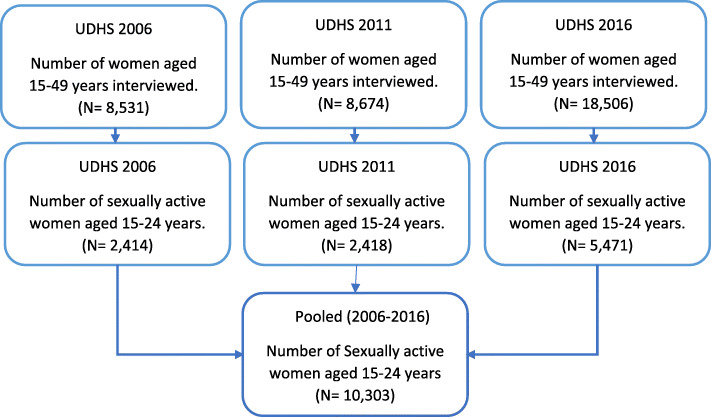
We estimated the percentage of women 15-24 years from three recent consecutive Uganda Demographic and Health Surveys (2006, 2011, and 2016), who reported suffering from genital sores, and or genital discharge or any other varginal complaints acquired after sexual intercourse within 12 months of the studies and examined the changes over time. A pooled multivariable logistic regression was used to examine the correlates of reporting an STI in the last 12 months preceding the study. Svyset command in Stata was used to cater for the survey sample design.
The pooled self-reported STI prevalence was 26.0%. Among these young women, 22.0, 36.3, and 23.1% reported a sexually transmitted infection in 2006, 2011, and 2016 respectively. Between 2006 and 2011, there was evidence of change (+ 14.3%, p < 0.001) in STI prevalence before a significant reduction (- 12.0%, p< 0.001) in 2016. Youths aged 20-24 years reported a higher STI prevalence (27.3%) compared to young participants (23.6%). Correlates of reporting an STI among rural and urban young women were: having multiple total lifetime partners (adjusted odds ratio (aOR 1.6, 95% CI 1.4-1.6), being sexually active in the last 4 weeks (aOR 1.3, 95% CI 1.1-1.6), and being affiliated to Muslim faith (aOR 1.3, 95% CI 1.1-1.6) or other religions (aOR 1.8, 95% CI 1.1-2.9) as compared to Christian were more likely to report an STI. Living in Northern Uganda compared to living in Kampala city was found protective against STIs (aOR 0.5, 95% CI 0.3-0.7).
The prevalence of STIs was high among female youths, 15-24 years. This highlights the need for a comprehensive STIs screening, surveillance, and treatment programme to potentially reduce the burden of STIs in the country.
全球范围内,青少年和年轻女性感染可治愈性性传播感染(STI)的风险最高。乌干达年轻女性感染 STI 的流行率数据有限。在这项研究中,我们调查了乌干达 15-24 岁青少年女孩和年轻女性(AGYW)中 STI 的时间趋势和相关因素。
我们估计了最近三次连续的乌干达人口与健康调查(2006 年、2011 年和 2016 年)中 15-24 岁女性的百分比,她们报告在研究前 12 个月内遭受生殖器溃疡、生殖器分泌物或任何其他性交后阴道投诉,并检查了随时间的变化。使用多变量逻辑回归分析来检查过去 12 个月内报告性传播感染的相关性。Stata 中的 Svyset 命令用于满足调查样本设计的需求。
汇总的自我报告性传播感染患病率为 26.0%。在这些年轻女性中,分别有 22.0%、36.3%和 23.1%在 2006 年、2011 年和 2016 年报告了性传播感染。2006 年至 2011 年间,STI 患病率出现变化(+14.3%,p<0.001),2016 年显著下降(-12.0%,p<0.001)。20-24 岁的年轻人报告的 STI 患病率(27.3%)高于年轻参与者(23.6%)。农村和城市年轻女性报告性传播感染的相关因素包括:有多个终生伴侣(调整优势比(aOR)1.6,95%置信区间(CI)1.4-1.6)、过去 4 周内有性行为(aOR 1.3,95%CI 1.1-1.6)、信仰穆斯林(aOR 1.3,95%CI 1.1-1.6)或其他宗教(aOR 1.8,95%CI 1.1-2.9)的参与者比基督教徒更有可能报告性传播感染。与生活在坎帕拉市相比,生活在乌干达北部被发现对 STI 有保护作用(aOR 0.5,95%CI 0.3-0.7)。
15-24 岁的女性青少年中 STI 的患病率很高。这突显了需要全面的 STI 筛查、监测和治疗计划,以潜在减少该国 STI 的负担。