Division of Biosystems & Biomedical Sciences, College of Health Sciences, Korea University, Seoul, Republic of Korea
mBio. 2021 Jan 12;12(1):e03022-20. doi: 10.1128/mBio.03022-20.
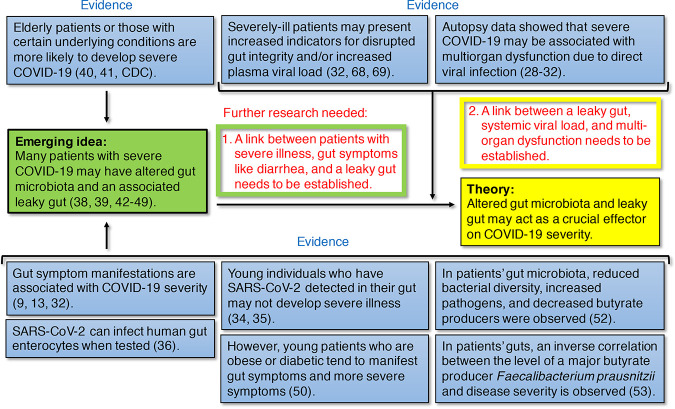
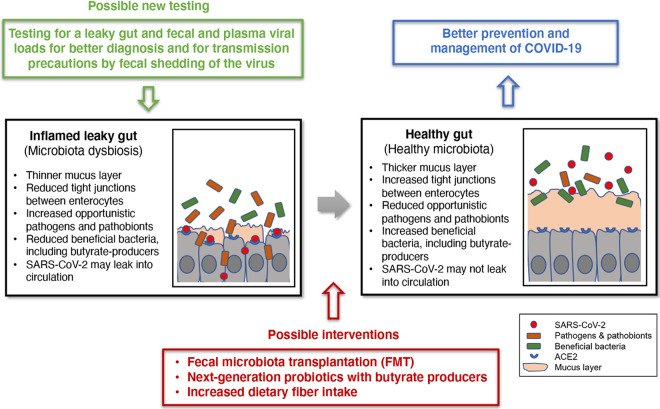
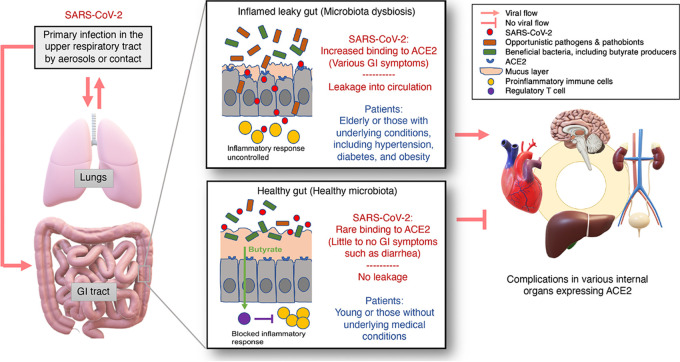
Coronavirus disease 2019 (COVID-19), which has been declared a pandemic, has exhibited a wide range of severity worldwide. Although this global variation is largely affected by socio-medical situations in each country, there is also high individual-level variation attributable to elderliness and certain underlying medical conditions, including high blood pressure, diabetes, and obesity. As both elderliness and the aforementioned chronic conditions are often associated with an altered gut microbiota, resulting in disrupted gut barrier integrity, and gut symptoms have consistently been associated with more severe illness in COVID-19 patients, it is possible that dysfunction of the gut as a whole influences COVID-19 severity. This article summarizes the accumulating evidence that supports the hypothesis that an altered gut microbiota and its associated leaky gut may contribute to the onset of gastrointestinal symptoms and occasionally to additional multiorgan complications that may lead to severe illness by allowing leakage of the causative coronavirus into the circulatory system.
2019 年冠状病毒病(COVID-19)已被宣布为大流行,在全球范围内表现出广泛的严重程度。尽管这种全球差异在很大程度上受到每个国家社会医疗状况的影响,但也存在由于高龄和某些潜在医疗状况(包括高血压、糖尿病和肥胖症)导致的个体水平的高度差异。由于高龄和上述慢性疾病通常与肠道微生物群的改变有关,导致肠道屏障完整性受损,而肠道症状与 COVID-19 患者更严重的疾病一直有关,因此,整个肠道功能障碍可能会影响 COVID-19 的严重程度。本文总结了越来越多的证据,支持这样一种假设,即肠道微生物群的改变及其相关的肠道渗漏可能导致胃肠道症状的发生,偶尔还会导致其他多器官并发症,通过允许致病冠状病毒进入循环系统,从而导致严重疾病。