Key Laboratory of Tobacco Genetic Improvement and Biotechnology, Tobacco Research Institute, Chinese Academy of Agricultural Sciences, Qingdao, 266100, China.
College of Agronomy, Qingdao Agricultural University, Qingdao, 266109, China.
Sci Rep. 2021 Jan 12;11(1):809. doi: 10.1038/s41598-020-80280-7.
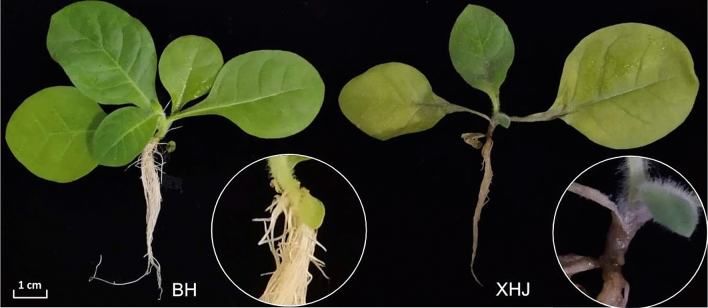
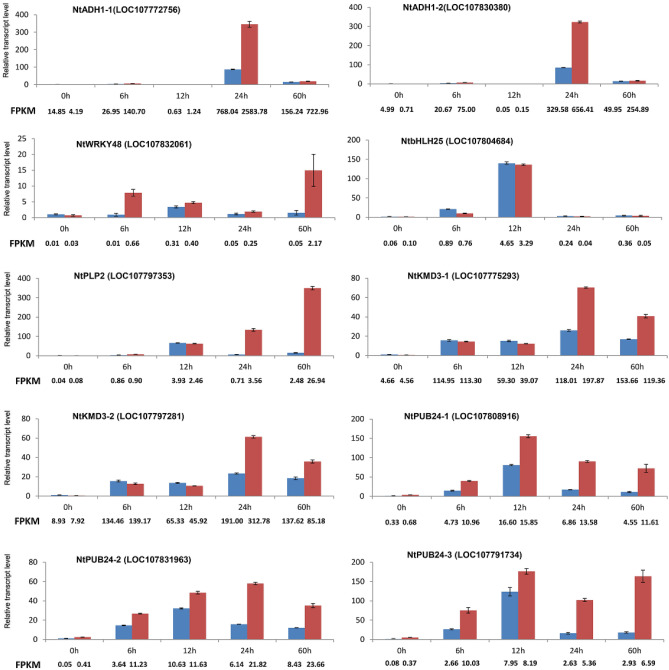
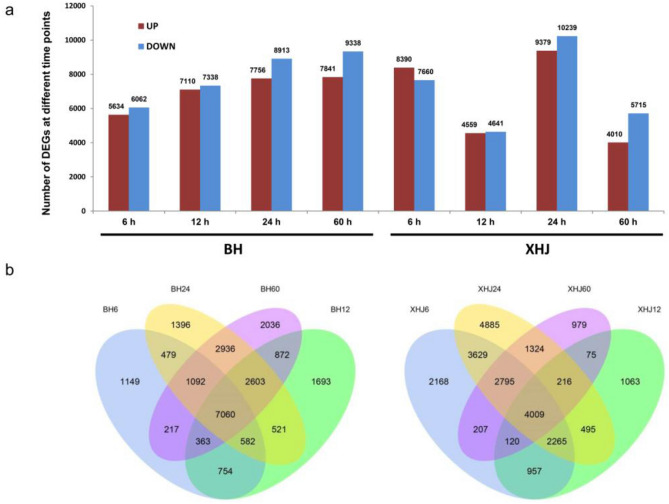
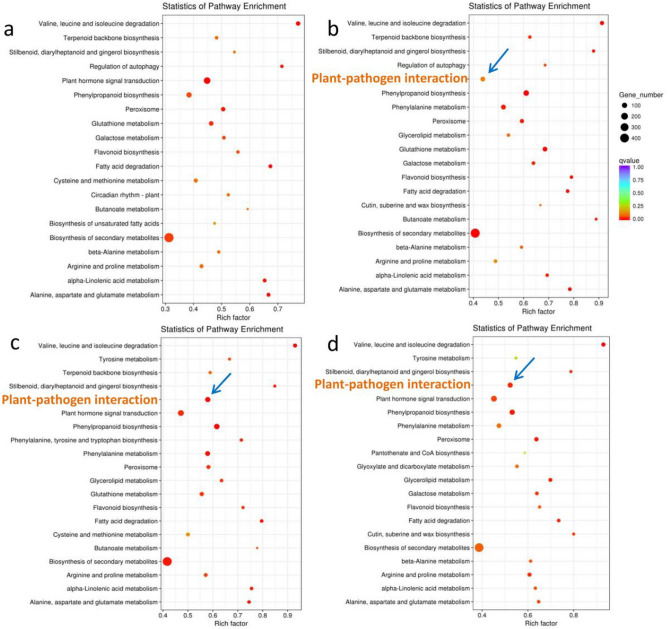
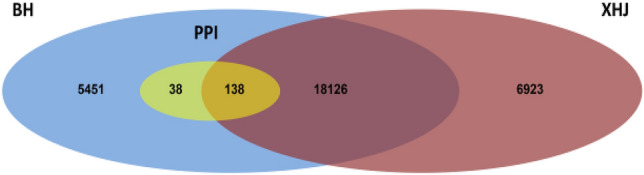
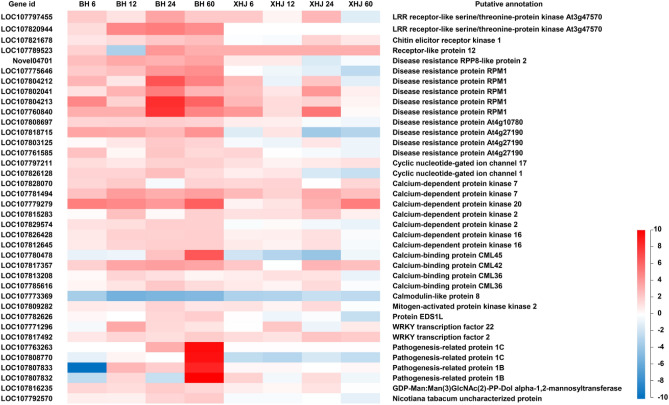
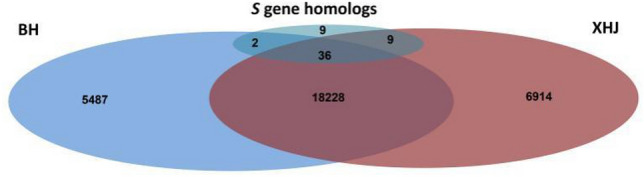
Phytophthora nicotianae is highly pathogenic to Solanaceous crops and is a major problem in tobacco production. The tobacco cultivar Beihart1000-1 (BH) is resistant, whereas the Xiaohuangjin 1025 (XHJ) cultivar is susceptible to infection. Here, BH and XHJ were used as models to identify resistant and susceptible genes using RNA sequencing (RNA-seq). Roots were sampled at 0, 6, 12, 24, and 60 h post infection. In total, 23,753 and 25,187 differentially expressed genes (DEGs) were identified in BH and XHJ, respectively. By mapping upregulated DEGs to the KEGG database, changes of the rich factor of "plant pathogen interaction pathway" were corresponded to the infection process. Of all the DEGs in this pathway, 38 were specifically regulated in BH. These genes included 11 disease-resistance proteins, 3 pathogenesis-related proteins, 4 RLP/RLKs, 2 CNGCs, 7 calcium-dependent protein kinases, 4 calcium-binding proteins, 1 mitogen-activated protein kinase kinase, 1 protein EDS1L, 2 WRKY transcription factors, 1 mannosyltransferase, and 1 calmodulin-like protein. By combining the analysis of reported susceptible (S) gene homologs and DEGs in XHJ, 9 S gene homologs were identified, which included 1 calmodulin-binding transcription activator, 1 cyclic nucleotide-gated ion channel, 1 protein trichome birefringence-like protein, 1 plant UBX domain-containing protein, 1 ADP-ribosylation factor GTPase-activating protein, 2 callose synthases, and 2 cellulose synthase A catalytic subunits. qRT-PCR was used to validate the RNA-seq data. The comprehensive transcriptome dataset described here, including candidate resistant and susceptible genes, will provide a valuable resource for breeding tobacco plants resistant to P. nicotianae infections.
烟草疫霉是茄科作物的高致病性病原菌,也是烟草生产中的主要问题。烟草品种 Beihart1000-1(BH)具有抗性,而小黄金 1025(XHJ)品种则易感染。在这里,使用 BH 和 XHJ 作为模型,通过 RNA 测序(RNA-seq)来鉴定抗性和敏感性基因。在感染后 0、6、12、24 和 60 小时分别采集根样。总共在 BH 和 XHJ 中分别鉴定出 23753 和 25187 个差异表达基因(DEGs)。通过将上调的 DEGs 映射到 KEGG 数据库,对应感染过程,“植物病原体相互作用途径”的丰富因子的变化得到了对应。在该途径的所有 DEGs 中,有 38 个基因在 BH 中特异性调控。这些基因包括 11 种抗病蛋白、3 种病程相关蛋白、4 种 RLP/RLKs、2 种 CNGCs、7 种钙依赖性蛋白激酶、4 种钙结合蛋白、1 种丝裂原激活蛋白激酶激酶、1 种蛋白 EDS1L、2 种 WRKY 转录因子、1 种甘露糖基转移酶和 1 种钙调素样蛋白。通过结合对 XHJ 中报道的敏感(S)基因同源物和 DEGs 的分析,鉴定出 9 个 S 基因同源物,包括 1 个钙调素结合转录激活因子、1 个环核苷酸门控离子通道、1 个蛋白 Trichome Birefringence-like protein、1 个植物 UBX 结构域蛋白、1 个 ADP-ribosylation factor GTPase-activating protein、2 个几丁质合酶和 2 个纤维素合酶 A 催化亚基。qRT-PCR 用于验证 RNA-seq 数据。这里描述的综合转录组数据集,包括候选抗性和敏感性基因,将为培育抗 P. nicotianae 感染的烟草植物提供有价值的资源。