Lin Chung-Ying, Potenza Mac N, Broström Anders, Pakpour Amir H
Institute of Allied Health Sciences, National Cheng Kung University Hospital, College of Medicine, National Cheng Kung University, Tainan, Taiwan.
Departments of Psychiatry and Neuroscience and the Child Study Center, School of Medicine, Yale University, New Haven, CT 06511, USA.
Addict Behav Rep. 2020 Dec 29;13:100332. doi: 10.1016/j.abrep.2020.100332. eCollection 2021 Jun.
Associations between internet gaming disorder (IGD), psychological distress, and sleep have been reported. However, little is known whether such associations exist across siblings; that is, whether adolescents' IGD symptomatology may impact their siblings' psychological distress and sleep. This study aimed to examine whether siblings' IGD symptoms may relate to depressive, anxiety symptoms or sleep quality among each other.
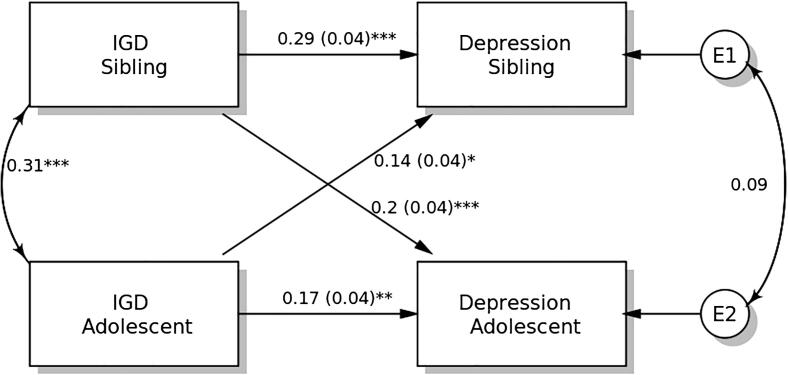
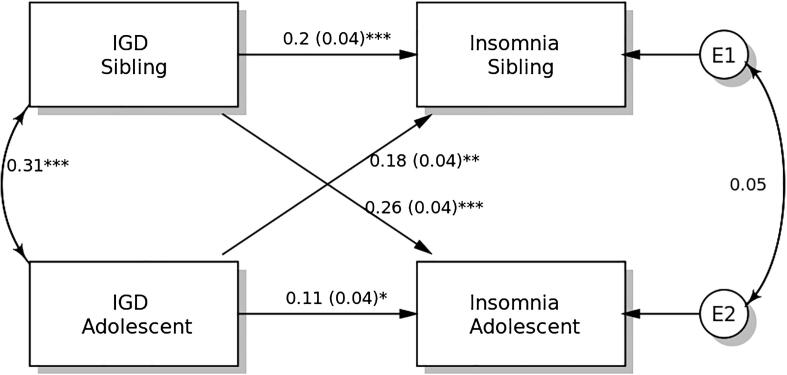
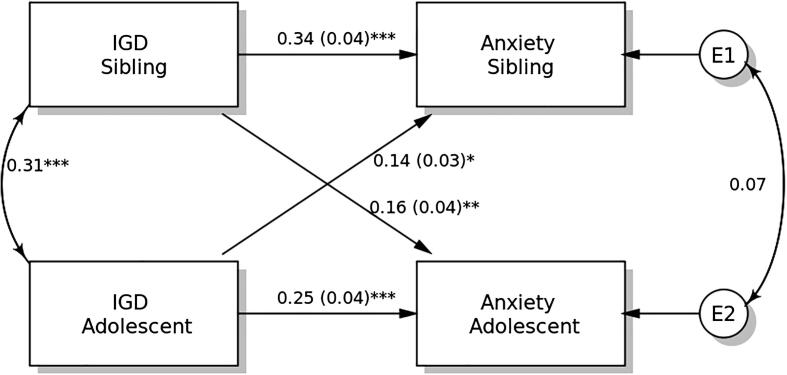
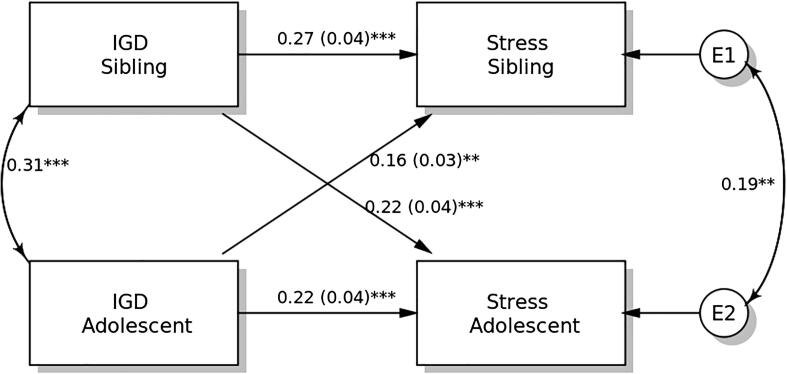
Using a cross-sectional design with two-stage cluster sampling, 320 dyads of adolescent students and their siblings participated in the study. Each dyad completed the Internet Gaming Disorder Scale-Short Form (IGDS-SF9), the Depression Anxiety Stress Scale-21 (DASS-21), and the Insomnia Severity Index (ISI). The actor-partner interdependence model (APIM) was applied to examine relationships between IGD, psychological well-being, and insomnia severity in the dyadic data.
Actor effects of IGDS-SF9 scores on depression, anxiety, stress, and insomnia severity were significant in both adolescents (e.g., adolescents' IGDS-SF9 scores on their depression scores) and their siblings (e.g., IGDS-SF9 scores of adolescents' siblings' scores on their depression scores). Partner effects of IGDS-SF9 scores on depression, anxiety, stress, and insomnia severity were significant in both adolescents (e.g., adolescents' IGDS-SF9 scores on their siblings' depression scores) and their siblings (e.g., IGDS-SF9 scores of adolescents' siblings on adolescents' depression scores).
The present study demonstrated that adolescent students and their siblings had mutual impacts of IGD on psychological health and sleep. Thus, healthcare providers may consider involving siblings when they design programs reducing IGD-related problems or improving psychological health and sleep for adolescents.
已有报道称网络成瘾障碍(IGD)、心理困扰和睡眠之间存在关联。然而,对于这种关联是否存在于兄弟姐妹之间,即青少年的IGD症状是否会影响其兄弟姐妹的心理困扰和睡眠,人们所知甚少。本研究旨在探讨兄弟姐妹的IGD症状是否相互关联,以及是否与抑郁、焦虑症状或睡眠质量有关。
采用两阶段整群抽样的横断面设计,320对青少年学生及其兄弟姐妹参与了本研究。每对参与者都完成了网络成瘾障碍量表简版(IGDS-SF9)、抑郁焦虑压力量表-21(DASS-21)和失眠严重程度指数(ISI)。采用actor-partner相互依赖模型(APIM)来检验二元数据中IGD、心理健康和失眠严重程度之间的关系。
IGDS-SF9得分对抑郁、焦虑、压力和失眠严重程度的actor效应在青少年(例如,青少年的IGDS-SF9得分对其抑郁得分的影响)及其兄弟姐妹(例如,青少年兄弟姐妹的IGDS-SF9得分对其抑郁得分的影响)中均显著。IGDS-SF9得分对抑郁、焦虑、压力和失眠严重程度的partner效应在青少年(例如,青少年的IGDS-SF9得分对其兄弟姐妹抑郁得分的影响)及其兄弟姐妹(例如,青少年兄弟姐妹的IGDS-SF9得分对青少年抑郁得分的影响)中均显著。
本研究表明,青少年学生及其兄弟姐妹之间存在IGD对心理健康和睡眠的相互影响。因此,医疗保健提供者在设计减少与IGD相关问题或改善青少年心理健康和睡眠的项目时,可能会考虑让兄弟姐妹参与进来。