Londono Tobon Amalia, Flores José M, Taylor Jerome H, Johnson Isaac, Landeros-Weisenberger Angeli, Aboiralor Okoduwa, Avila-Quintero Victor J, Bloch Michael H
Yale University School of Medicine, New Haven, CT, USA.
Children's Hospital of Philadelphia & University of Pennsylvania School of Medicine, Philadelphia, PA, USA.
Acad Psychiatry. 2021 Feb;45(1):23-33. doi: 10.1007/s40596-020-01370-2. Epub 2021 Jan 12.
Racial and ethnic disparities are well documented in psychiatry, yet suboptimal understanding of underlying mechanisms of these disparities undermines diversity, inclusion, and education efforts. Prior research suggests that implicit associations can affect human behavior, which may ultimately influence healthcare disparities. This study investigated whether racial implicit associations exist among medical students and psychiatric physicians and whether race/ethnicity, training level, age, and gender predicted racial implicit associations.
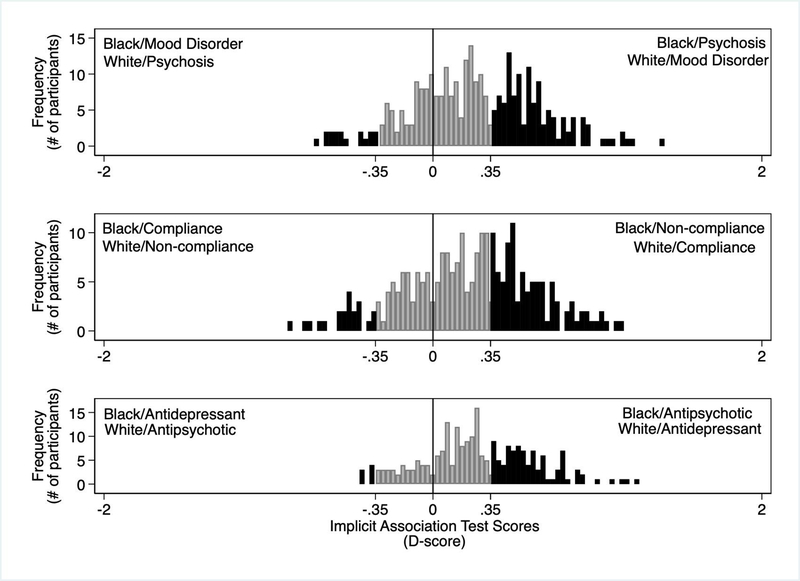
Participants completed online demographic questions and 3 race Implicit Association Tests (IATs) related to psychiatric diagnosis (psychosis vs. mood disorders), patient compliance (compliance vs. non-compliance), and psychiatric medications (antipsychotics vs. antidepressants). Linear and logistic regression models were used to identify demographic predictors of racial implicit associations.
The authors analyzed data from 294 medical students and psychiatric physicians. Participants were more likely to pair faces of Black individuals with words related to psychotic disorders (as opposed to mood disorders), non-compliance (as opposed to compliance), and antipsychotic medications (as opposed to antidepressant medications). Among participants, self-reported White race and higher level of training were the strongest predictors of associating faces of Black individuals with psychotic disorders, even after adjusting for participant's age.
Racial implicit associations were measurable among medical students and psychiatric physicians. Future research should examine (1) the relationship between implicit associations and clinician behavior and (2) the ability of interventions to reduce racial implicit associations in mental healthcare.
种族和民族差异在精神病学领域有充分记载,但对这些差异潜在机制的理解不足,不利于多元化、包容性和教育工作。先前的研究表明,内隐联想会影响人类行为,这可能最终影响医疗保健差异。本研究调查了医学生和精神科医生中是否存在种族内隐联想,以及种族/民族、培训水平、年龄和性别是否能预测种族内隐联想。
参与者完成了在线人口统计学问题以及3项与精神科诊断(精神病与情绪障碍)、患者依从性(依从与不依从)和精神科药物(抗精神病药物与抗抑郁药物)相关的种族内隐联想测验(IAT)。使用线性和逻辑回归模型来确定种族内隐联想的人口统计学预测因素。
作者分析了294名医学生和精神科医生的数据。参与者更倾向于将黑人面孔与与精神障碍(而非情绪障碍)、不依从(而非依从)和抗精神病药物(而非抗抑郁药物)相关的词汇配对。在参与者中,自我报告的白人种族和更高的培训水平是将黑人面孔与精神障碍联系起来的最强预测因素,即使在调整了参与者的年龄之后。
医学生和精神科医生中种族内隐联想是可测量的。未来的研究应探讨(1)内隐联想与临床医生行为之间的关系,以及(2)干预措施减少精神卫生保健中种族内隐联想的能力。