King Abdullah University of Science and Technology, Thuwal, 23955, Kingdom of Saudi Arabia.
Neurochem Res. 2021 Jan;46(1):77-87. doi: 10.1007/s11064-020-03208-7. Epub 2021 Jan 13.
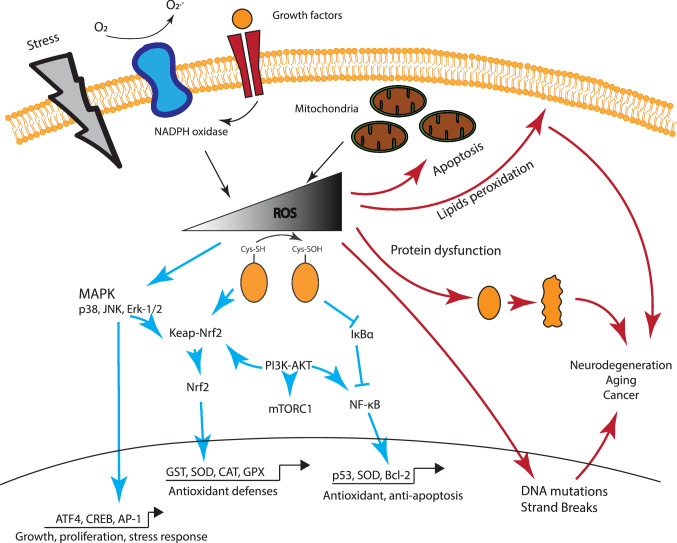
Cellular homeostasis plays a critical role in how an organism will develop and age. Disruption of this fragile equilibrium is often associated with health degradation and ultimately, death. Reactive oxygen species (ROS) have been closely associated with health decline and neurological disorders, such as Alzheimer's disease or Parkinson's disease. ROS were first identified as by-products of the cellular activity, mainly mitochondrial respiration, and their high reactivity is linked to a disruption of macromolecules such as proteins, lipids and DNA. More recent research suggests more complex function of ROS, reaching far beyond the cellular dysfunction. ROS are active actors in most of the signaling cascades involved in cell development, proliferation and survival, constituting important second messengers. In the brain, their impact on neurons and astrocytes has been associated with synaptic plasticity and neuron survival. This review provides an overview of ROS function in cell signaling in the context of aging and degeneration in the brain and guarding the fragile balance between health and disease.
细胞内稳态在生物体的发育和衰老过程中起着至关重要的作用。这种脆弱平衡的破坏通常与健康恶化,最终导致死亡有关。活性氧(ROS)与健康衰退和神经退行性疾病密切相关,如阿尔茨海默病或帕金森病。ROS 最初被认为是细胞活动的副产品,主要是线粒体呼吸,其高反应性与蛋白质、脂质和 DNA 等大分子的破坏有关。最近的研究表明,ROS 具有更复杂的功能,远远超出了细胞功能障碍的范围。ROS 是参与细胞发育、增殖和存活的大多数信号级联反应中的活跃参与者,构成了重要的第二信使。在大脑中,它们对神经元和星形胶质细胞的影响与突触可塑性和神经元存活有关。这篇综述概述了 ROS 在大脑衰老和退化以及维持健康与疾病之间脆弱平衡的背景下,在细胞信号转导中的功能。