Department of Mechanical Engineering, University of Michigan, Ann Arbor, Michigan, United States of America.
Department of Mechanical Engineering, University of Wisconsin, Madison, Wisconsin, United States of America.
PLoS One. 2021 Jan 13;16(1):e0228682. doi: 10.1371/journal.pone.0228682. eCollection 2021.
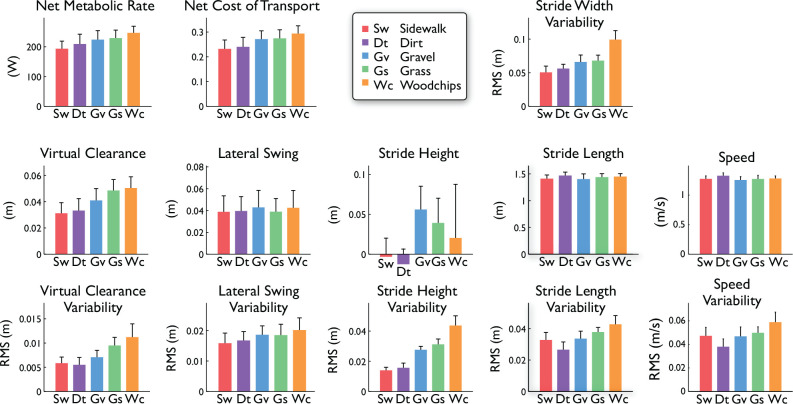
Humans often traverse real-world environments with a variety of surface irregularities and inconsistencies, which can disrupt steady gait and require additional effort. Such effects have, however, scarcely been demonstrated quantitatively, because few laboratory biomechanical measures apply outdoors. Walking can nevertheless be quantified by other means. In particular, the foot's trajectory in space can be reconstructed from foot-mounted inertial measurement units (IMUs), to yield measures of stride and associated variabilities. But it remains unknown whether such measures are related to metabolic energy expenditure. We therefore quantified the effect of five different outdoor terrains on foot motion (from IMUs) and net metabolic rate (from oxygen consumption) in healthy adults (N = 10; walking at 1.25 m/s). Energy expenditure increased significantly (P < 0.05) in the order Sidewalk, Dirt, Gravel, Grass, and Woodchips, with Woodchips about 27% costlier than Sidewalk. Terrain type also affected measures, particularly stride variability and virtual foot clearance (swing foot's lowest height above consecutive footfalls). In combination, such measures can also roughly predict metabolic cost (adjusted R2 = 0.52, partial least squares regression), and even discriminate between terrain types (10% reclassification error). Body-worn sensors can characterize how uneven terrain affects gait, gait variability, and metabolic cost in the real world.
人类在真实环境中行走时会遇到各种表面不平整和不一致的情况,这可能会破坏稳定的步态并需要额外的努力。然而,这些影响很少被定量证明,因为很少有实验室生物力学测量方法适用于户外。尽管如此,行走仍然可以通过其他方式进行量化。特别是,脚部在空间中的轨迹可以通过脚部安装的惯性测量单元 (IMU) 来重建,以得出步幅和相关变异性的测量值。但目前尚不清楚这些测量值是否与代谢能量消耗有关。因此,我们定量研究了五种不同户外地形对健康成年人(N = 10;以 1.25 m/s 的速度行走)脚部运动(来自 IMU)和净代谢率(来自耗氧量)的影响。能量消耗按以下顺序显著增加(P < 0.05):人行道、泥土、砾石、草地和木屑,木屑比人行道贵约 27%。地形类型也会影响测量值,特别是步幅变异性和虚拟足廓清(摆动脚在连续脚落后的最低点)。这些措施结合起来,也可以大致预测代谢成本(调整后的 R2 = 0.52,偏最小二乘回归),甚至可以区分地形类型(10%的重新分类错误)。佩戴在身体上的传感器可以描述不平坦的地形如何影响真实世界中的步态、步态变异性和代谢成本。