Pollock Nira R, Savage Timothy J, Wardell Hanna, Lee Rose A, Mathew Anu, Stengelin Martin, Sigal George B
Department of Laboratory Medicine, Boston Children's Hospital, Boston, Massachusetts, USA
Division of Infectious Diseases, Department of Pediatrics, Boston Children's Hospital, Boston, Massachusetts, USA.
J Clin Microbiol. 2021 Mar 19;59(4). doi: 10.1128/JCM.03077-20.
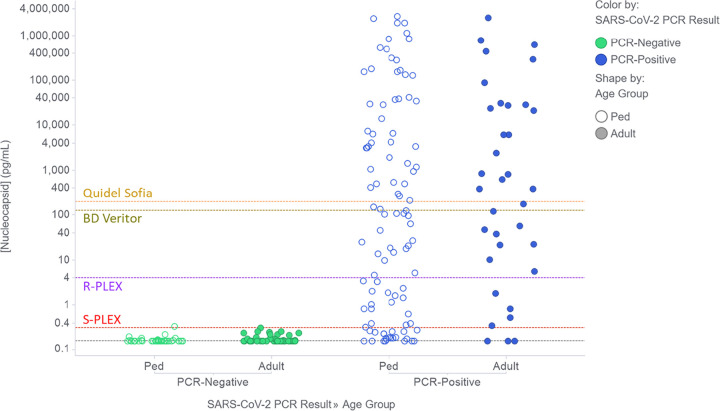
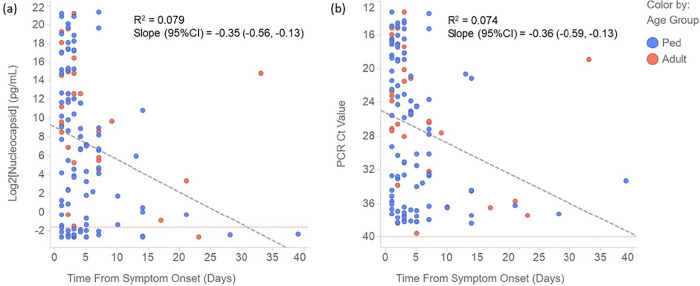
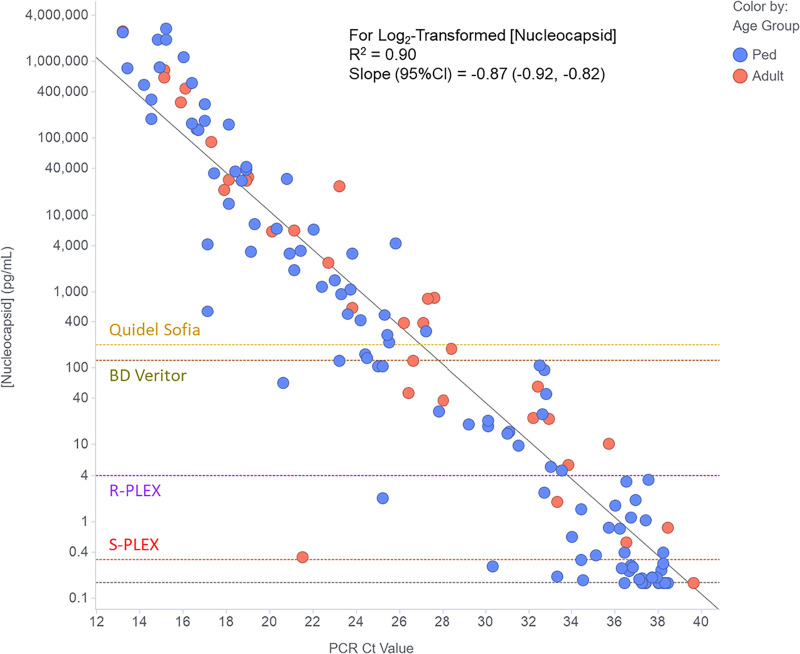
Diagnosis of COVID-19 by PCR offers high sensitivity, but the utility of detecting samples with high cycle threshold ( ) values remains controversial. Currently available rapid diagnostic tests (RDTs) for SARS-CoV-2 nucleocapsid antigens (Ag) have sensitivity well below PCR. The correlation of Ag and RNA quantities in clinical nasopharyngeal (NP) samples is unknown. An ultrasensitive, quantitative electrochemiluminescence immunoassay for SARS-CoV-2 nucleocapsid (the MSD S-PLEX SARS-CoV-2 N assay) was used to measure Ag in clinical NP samples from adults and children previously tested by PCR. The S-PLEX Ag assay had a limit of detection (LOD) of 0.16 pg/ml and a cutoff of 0.32 pg/ml. Ag concentrations measured in clinical NP samples (collected in 3.0 ml of media) ranged from less than 160 fg/ml to 2.7 μg/ml. Log-transformed Ag concentrations correlated tightly with values. In 35 adult and 101 pediatric PCR-positive samples, the sensitivities were 91% (95% confidence interval, 77 to 98%) and 79% (70 to 87%), respectively. In samples with a of ≤35, the sensitivities were 100% (88 to 100%) and 96% (88 to 99%), respectively. In 50 adult and 40 pediatric PCR-negative specimens, the specificities were 100% (93 to 100%) and 98% (87 to 100%), respectively. Nucleocapsid concentrations in clinical NP samples span 8 orders of magnitude and correlate closely with RNA concentrations ( values). The S-PLEX Ag assay showed 96 to 100% sensitivity in samples from children and adults with values of ≤35, and a specificity of 98 to 100%. These results clarify Ag concentration distributions in clinical samples, providing insight into the performance of Ag RDTs and offering a new approach to diagnosis of COVID-19.
通过聚合酶链反应(PCR)诊断新型冠状病毒肺炎(COVID-19)具有高灵敏度,但检测高循环阈值( )值样本的效用仍存在争议。目前可用的针对严重急性呼吸综合征冠状病毒2(SARS-CoV-2)核衣壳抗原(Ag)的快速诊断测试(RDT)灵敏度远低于PCR。临床鼻咽(NP)样本中Ag与RNA数量的相关性尚不清楚。一种用于SARS-CoV-2核衣壳的超灵敏定量电化学发光免疫测定法(MSD S-PLEX SARS-CoV-2 N测定法)用于测量先前经PCR检测的成人和儿童临床NP样本中的Ag。S-PLEX Ag测定法的检测限(LOD)为0.16 pg/ml,临界值为0.32 pg/ml。在临床NP样本(收集于3.0 ml培养基中)中测得的Ag浓度范围为低于160 fg/ml至2.7 μg/ml。经对数转换的Ag浓度与 值紧密相关。在35份成人和(101)份儿科PCR阳性样本中,灵敏度分别为91%(95%置信区间,77%至98%)和79%(70%至87%)。在 ≤35的样本中,灵敏度分别为100%(88%至100%)和96%(88%至99%)。在50份成人和40份儿科PCR阴性标本中,特异性分别为100%(93%至100%)和98%(87%至100%)。临床NP样本中的核衣壳浓度跨越8个数量级,且与RNA浓度( 值)密切相关。S-PLEX Ag测定法在 ≤35的儿童和成人样本中显示出96%至100%的灵敏度,以及98%至100%的特异性。这些结果阐明了临床样本中Ag浓度分布,深入了解了Ag RDTs的性能,并为COVID-19诊断提供了一种新方法。