CNRS, IRD, EPHE, Institut des Sciences de l'Evolution de Montpellier, Université de Montpellier, Place Eugène Bataillon, 34095, Montpellier, France.
Institut für Botanik, Technische Universität Dresden, Zellescher Weg 20b, 01062, Dresden, Germany.
Nat Commun. 2021 Jan 13;12(1):354. doi: 10.1038/s41467-020-20507-3.
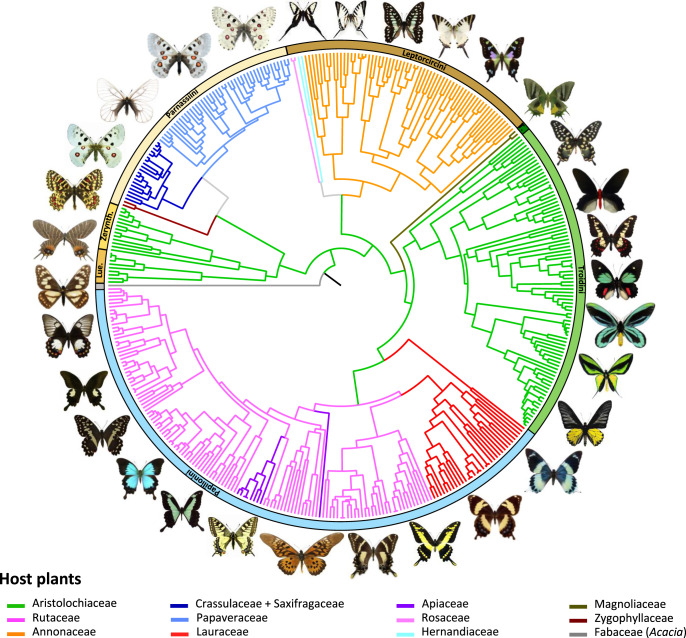
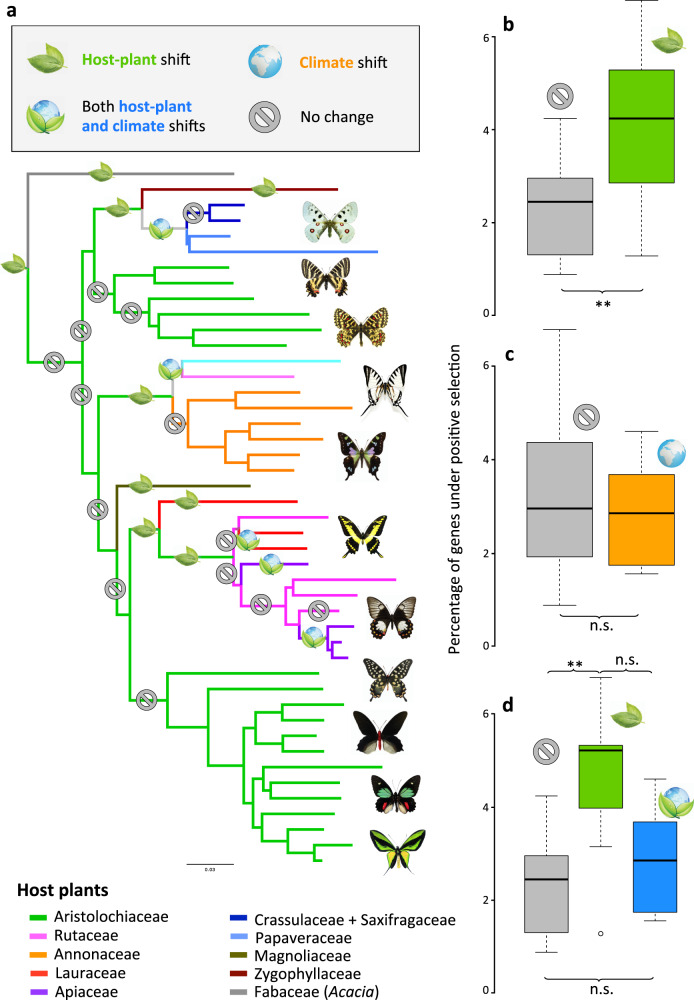
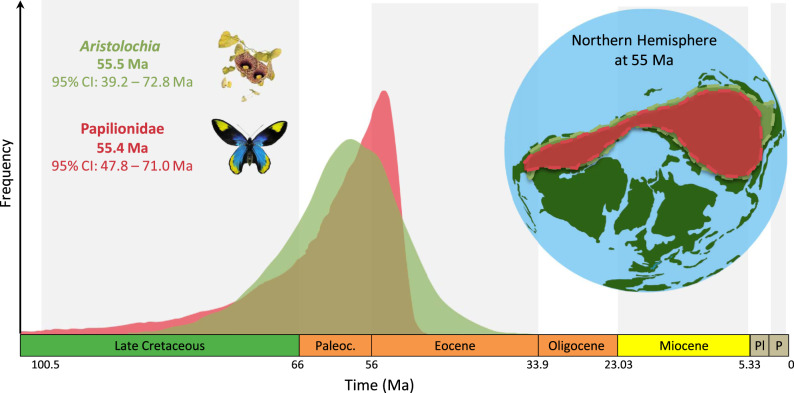
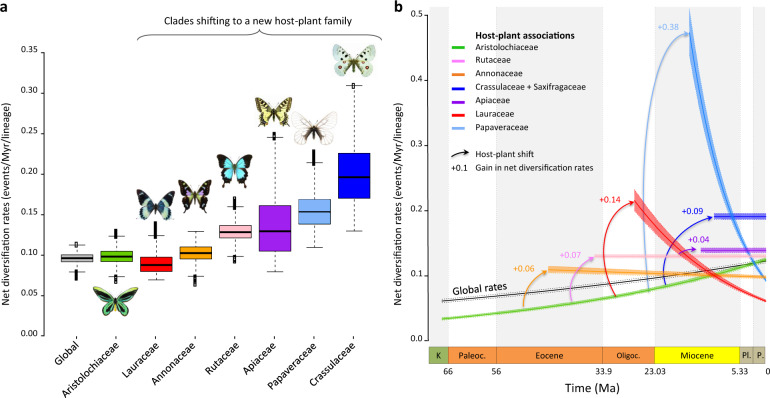
The mega-diversity of herbivorous insects is attributed to their co-evolutionary associations with plants. Despite abundant studies on insect-plant interactions, we do not know whether host-plant shifts have impacted both genomic adaptation and species diversification over geological times. We show that the antagonistic insect-plant interaction between swallowtail butterflies and the highly toxic birthworts began 55 million years ago in Beringia, followed by several major ancient host-plant shifts. This evolutionary framework provides a valuable opportunity for repeated tests of genomic signatures of macroevolutionary changes and estimation of diversification rates across their phylogeny. We find that host-plant shifts in butterflies are associated with both genome-wide adaptive molecular evolution (more genes under positive selection) and repeated bursts of speciation rates, contributing to an increase in global diversification through time. Our study links ecological changes, genome-wide adaptations and macroevolutionary consequences, lending support to the importance of ecological interactions as evolutionary drivers over long time periods.
食草昆虫的巨型多样性归因于它们与植物的共同进化关系。尽管对昆虫与植物的相互作用进行了大量研究,但我们并不知道在地质时期,宿主植物的转变是否会影响基因组的适应和物种多样化。我们表明,燕尾蝶与剧毒的车前草之间的拮抗昆虫-植物相互作用始于 5500 万年前的白令地区,随后发生了几次主要的古代宿主植物转变。这一进化框架为重复测试宏观进化变化的基因组特征和估计它们的系统发育多样性率提供了宝贵的机会。我们发现,蝴蝶的宿主植物转变与全基因组适应性分子进化(更多受正选择影响的基因)和物种形成率的反复爆发有关,这有助于随着时间的推移增加全球多样性。我们的研究将生态变化、全基因组适应和宏观进化后果联系起来,支持了生态相互作用作为长期进化驱动力的重要性。