Department of Public Health, MaddaWalabu University Goba Referral Hospital, Bale Goba, Ethiopia.
PLoS One. 2021 Jan 14;16(1):e0245469. doi: 10.1371/journal.pone.0245469. eCollection 2021.
Effective infection prevention and control measures, such as proper hand hygiene, the use of personal protective equipment, instrument processing, and safe injection practicein the healthcare facilitiesare essential elements of patient safety and lead to optimal patient outcomes. In Ethiopia, findings regarding infection prevention practices among healthcare workers have been highly variable and uncertain. This systematic review and meta-analysis estimates the pooled prevalence of safe infection prevention practices and summarizesthe associated factors among healthcare workers in Ethiopia.
PubMed, Science Direct, Google Scholar, and the Cochran library were systematically searched. We included all observational studies reporting the prevalence of safe infection prevention practices among healthcare workers in Ethiopia. Two authors independently extracted all necessary data using a standardized data extraction format. Qualitative and quantitative analyseswere employed. The Cochran Q test statistics and I2 tests were used to assess the heterogeneity of the studies. A random-effects meta-analysis model was used to estimate the pooled prevalence of safe infection prevention practice.
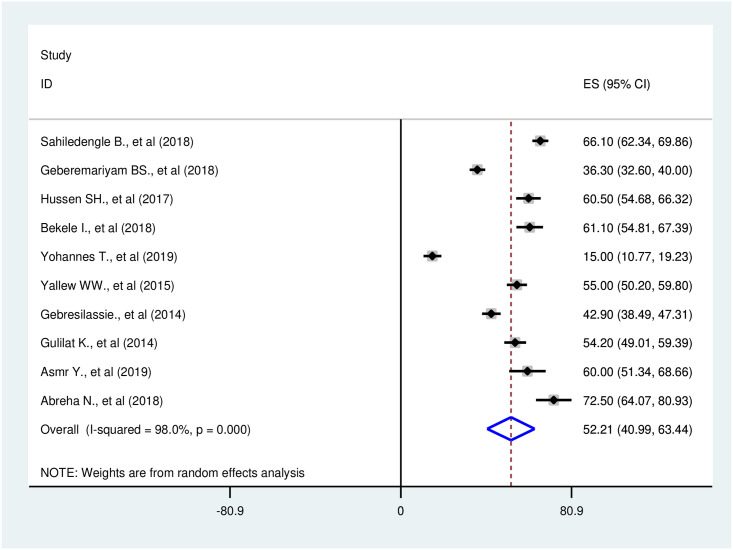
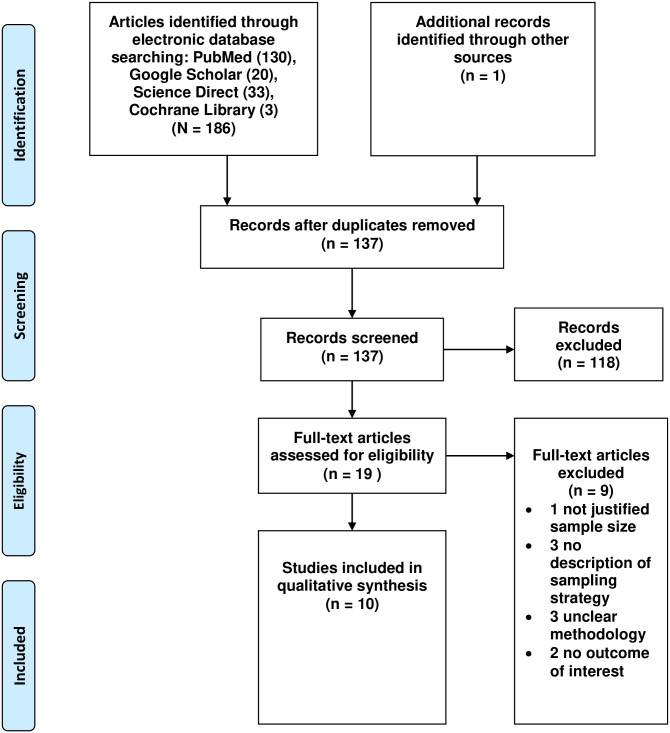
Of the 187 articles identified through our search, 10 studies fulfilled the inclusion criteria and were included in the meta-analysis. The pooled prevalence of safe infection prevention practice in Ethiopia was 52.2% (95%CI: 40.9-63.4). The highest prevalence of safe practice was observed in Addis Ababa (capital city) 66.2% (95%CI: 60.6-71.8), followed by Amhara region 54.6% (95%CI: 51.1-58.1), and then Oromia region 48.5% (95%CI: 24.2-72.8), and the least safe practices were reported from South Nation Nationalities and People (SNNP) and Tigray regions with a pooled prevalence of 39.4% (95%CI: 13.9-64.8). In our qualitative syntheses, the odds of safe infection prevention practice were higher among healthcare workers who had good knowledge and a positive attitude towards infection prevention. Also, healthcare workers working in facilities with continuous running water supply, having infection prevention guideline, and those received training were significantly associated withhigher odds of safe infection prevention practice.
Infection prevention practices in Ethiopia was poor, with only half of the healthcare workers reporting safe practices. Further, the study found out that there were regional and professional variations in the prevalence of safe infection prevention practices. Therefore, the need to step-up efforts to intensify the current national infection prevention and patient safety initiative as key policy direction is strongly recommended, along with more attempts to increase healthcare worker's adherence towards infection prevention guidelines.
有效的感染预防和控制措施,如适当的手部卫生、个人防护设备的使用、器械处理和安全注射实践,是患者安全的重要组成部分,可带来最佳的患者结局。在埃塞俄比亚,医护人员的感染预防措施实施情况的发现结果差异极大且不确定。本系统评价和荟萃分析评估了埃塞俄比亚医护人员安全感染预防措施的综合流行率,并总结了相关因素。
我们系统地检索了 PubMed、Science Direct、Google Scholar 和 Cochrane 图书馆。我们纳入了所有报告埃塞俄比亚医护人员安全感染预防措施流行率的观察性研究。两位作者使用标准化数据提取格式独立提取所有必要数据。采用定性和定量分析。使用 Cochran Q 检验统计量和 I2 检验来评估研究的异质性。采用随机效应荟萃分析模型来估计安全感染预防措施的综合流行率。
通过检索,我们共识别出 187 篇文章,其中 10 项研究符合纳入标准并纳入荟萃分析。埃塞俄比亚安全感染预防措施的综合流行率为 52.2%(95%CI:40.9-63.4)。安全实践的最高流行率出现在亚的斯亚贝巴(首都)66.2%(95%CI:60.6-71.8),其次是阿姆哈拉地区 54.6%(95%CI:51.1-58.1),然后是奥罗米亚地区 48.5%(95%CI:24.2-72.8),而最不安全的实践报告来自南埃塞俄比亚民族和人民地区(SNNP)和提格雷地区,综合流行率为 39.4%(95%CI:13.9-64.8)。在我们的定性综合分析中,具有良好的感染预防知识和积极的感染预防态度的医护人员更有可能实施安全的感染预防措施。此外,在具有持续自来水供应、有感染预防指南以及接受过培训的医疗机构工作的医护人员,其实施安全感染预防措施的可能性显著更高。
埃塞俄比亚的感染预防措施实施情况较差,只有一半的医护人员报告实施了安全措施。此外,研究发现安全感染预防措施的流行率存在地区和专业差异。因此,强烈建议加强当前国家感染预防和患者安全倡议,将其作为主要政策方向,并进一步努力提高医护人员对感染预防指南的遵守程度。