Facultad de Ciencias Exactas, Químicas y Naturales (FCEQyN), Departamento de Microbiología, Universidad Nacional de Misiones (UNaM), Consejo Nacional de Investigaciones Científicas y Técnicas (CONICET), Posadas, Argentina.
Facultad de Ciencias Exactas, Químicas y Naturales (FCEQyN), Instituto de Biotecnología de Misiones (InBioMis), Universidad Nacional de Misiones (UNaM), Consejo Nacional de Investigaciones Científicas y Técnicas (CONICET), Posadas, Argentina.
BMC Infect Dis. 2021 Jan 14;21(1):73. doi: 10.1186/s12879-020-05603-5.
In pregnant women Streptococcus agalactiae (GBS) can be transmitted to newborn causing severe infections. It is classified into 10 serotypes (Ia, Ib, II-IX). The severity of neonatal disease is determined by the capsular serotype and virulence factors such as the polysaccharide capsule, encoded by the cps gene, protein C, which includes the Cα surface proteins (bca gene), Rib (rib gene) and Cβ (bac gene); the proteins Lmb (lmb gene), FbsB (fbsB gene), FbsA (fbsA gene), the cyl operon encoding a β-hemolysin (hylB gene), the CAMP factor (cfb gene) and the C5a peptidase (scpB gene). The aim of this work was to determine the degree of GBS colonization in pregnant women, the serotypes distribution and to investigate virulence-associated genes.
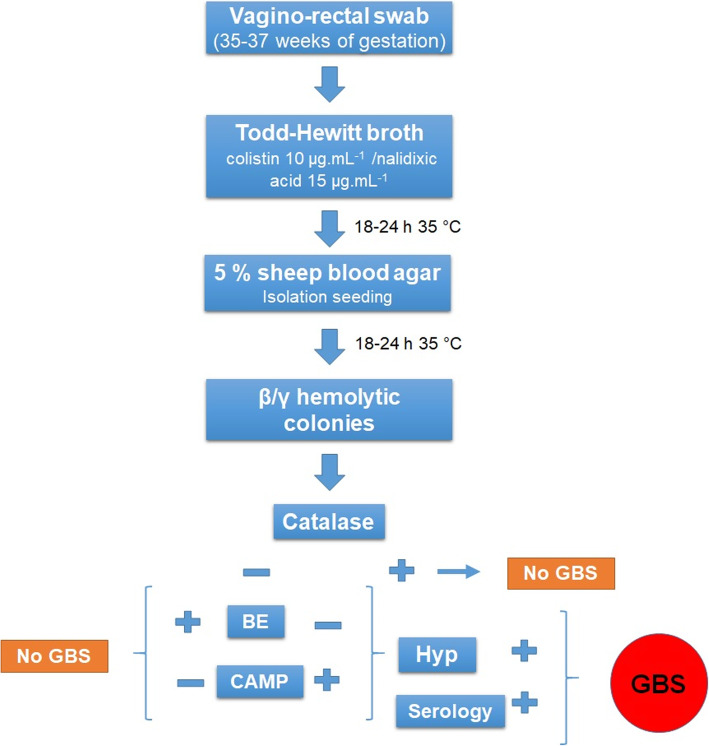
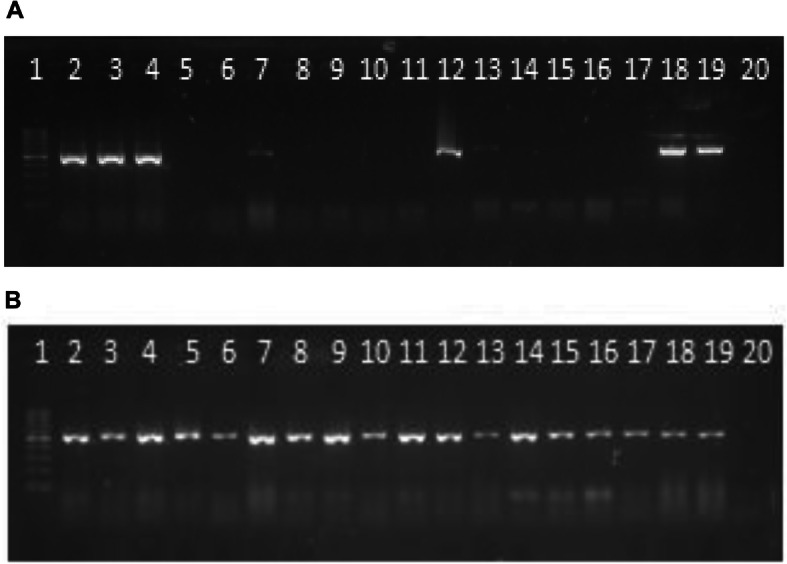
We worked with 3480 samples of vagino-rectal swabs of women with 35-37 weeks of gestation. The identification of the strains was carried out using conventional biochemical tests and group confirmatory serology using a commercial latex particle agglutination kit. Two hundred GBS strains were selected. Their serotype was determined by agglutination tests. The monoplex PCR technique was used to investigate nine virulence-associated genes (cps, bca, rib, bac, lmb, fbsB, fbsA, hylB and scpB).
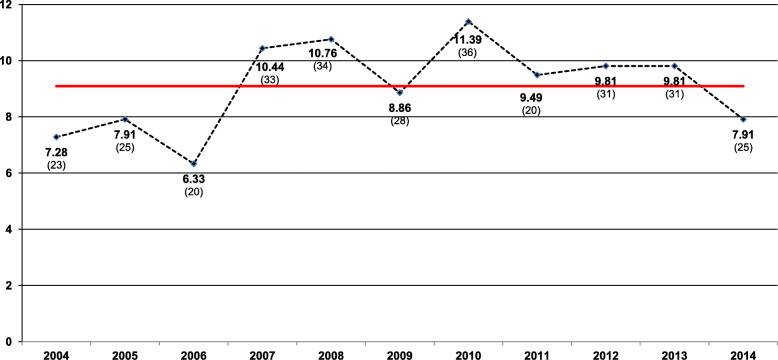
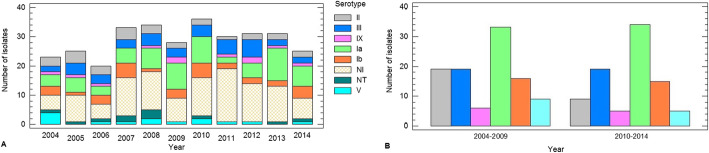
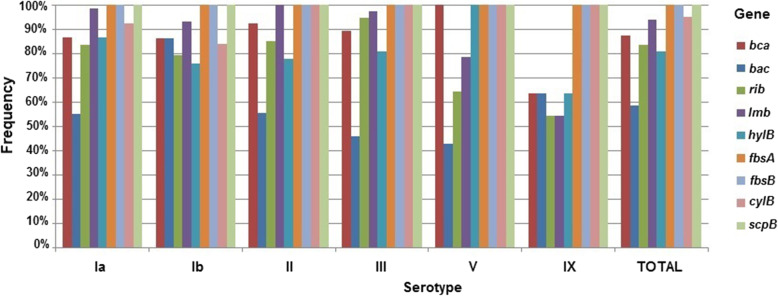
The maternal colonization was 9.09%. The serotypes found were: Ia (33.50%), III (19.00%), Ib (15.50%), II (14.00%), V (7.00%) and IX (5.50%). 5.50% of strains were found to be non-serotypeable (NT). The nine virulence genes investigated were detected simultaneously in 36.50% of the strains. The genes that were most frequently detected were scpB (100.00%), fbsA (100.00%), fbsB (100.00%), cylB (95.00%), lmb (94.00%) and bca (87.50%). We found associations between serotype and genes bac (p = 0.003), cylB (p = 0.02), rib (p = 0.01) and lmb (p < 0.001).
The frequency of vaginal-rectal colonization, serotypes distribution and associated virulence genes, varies widely among geographical areas. Therefore, epidemiological surveillance is necessary to provide data to guide decision-making and planning of prevention and control strategies.
在孕妇中,酿脓链球菌(GBS)可传播给新生儿,导致严重感染。它分为 10 个血清型(Ia、Ib、II-IX)。新生儿疾病的严重程度取决于荚膜血清型和毒力因子,如多糖荚膜,由 cps 基因编码,蛋白 C,包括 Cα 表面蛋白(bca 基因)、Rib(rib 基因)和 Cβ(bac 基因);蛋白 Lmb(lmb 基因)、FbsB(fbsB 基因)、FbsA(fbsA 基因)、编码β-溶血素的 cyl 操纵子(hylB 基因)、CAMP 因子(cfb 基因)和 C5a 肽酶(scpB 基因)。这项工作的目的是确定孕妇中 GBS 定植的程度、血清型分布,并调查与毒力相关的基因。
我们对 35-37 周妊娠的 3480 名女性的阴道直肠拭子样本进行了研究。使用常规生化试验和商业乳胶粒子凝集试剂盒进行的组确认血清学鉴定菌株。选择了 200 株 GBS 株。通过凝集试验确定其血清型。使用单重 PCR 技术调查了 9 个与毒力相关的基因(cps、bca、rib、bac、lmb、fbsB、fbsA、hylB 和 scpB)。
母体定植率为 9.09%。发现的血清型有:Ia(33.50%)、III(19.00%)、Ib(15.50%)、II(14.00%)、V(7.00%)和 IX(5.50%)。5.50%的菌株为非血清型(NT)。同时检测到调查的 9 个毒力基因,发现 36.50%的菌株存在。最常检测到的基因是 scpB(100.00%)、fbsA(100.00%)、fbsB(100.00%)、cylB(95.00%)、lmb(94.00%)和 bca(87.50%)。我们发现血清型与 bac(p=0.003)、cylB(p=0.02)、rib(p=0.01)和 lmb(p<0.001)基因之间存在关联。
阴道直肠定植率、血清型分布及相关毒力基因在不同地区差异很大。因此,需要进行流行病学监测,提供数据,为决策和规划预防控制策略提供依据。