Departamento de Microbiologia Médica, Instituto de Microbiologia Paulo de Góes, Universidade Federal do Rio de Janeiro, Rio de Janeiro, Brazil.
BMC Infect Dis. 2014 Jun 12;14:323. doi: 10.1186/1471-2334-14-323.
Group B Streptococcus (GBS) remains a major cause of neonatal sepsis and is also associated with invasive and noninvasive infections in pregnant women and non-pregnant adults, elderly and patients with underlying medical conditions. Ten capsular serotypes have been recognized, and determination of their distribution within a specific population or geographical region is important as they are major targets for the development of vaccine strategies. We have evaluated the characteristics of GBS isolates recovered from individuals with infections or colonization by this microorganism, living in different geographic regions of Brazil.
A total of 434 isolates were identified and serotyped by conventional phenotypic tests. The determination of antimicrobial susceptibility was performed by the disk diffusion method. Genes associated with resistance to erythromycin (ermA, ermB, mefA) and tetracycline (tetK, tetL, tetM, tetO) as well as virulence-associated genes (bac, bca, lmb, scpB) were investigated using PCR. Pulsed-field gel electrophoresis (PFGE) was used to examine the genetic diversity of macrolide-resistant and of a number of selected macrolide-susceptible isolates.
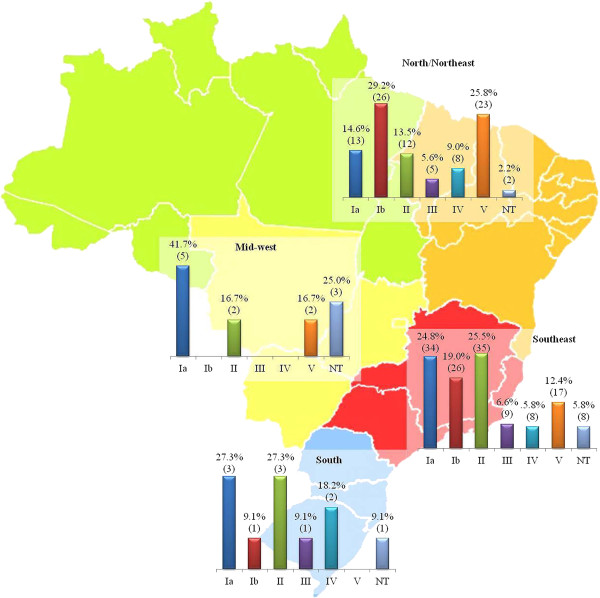
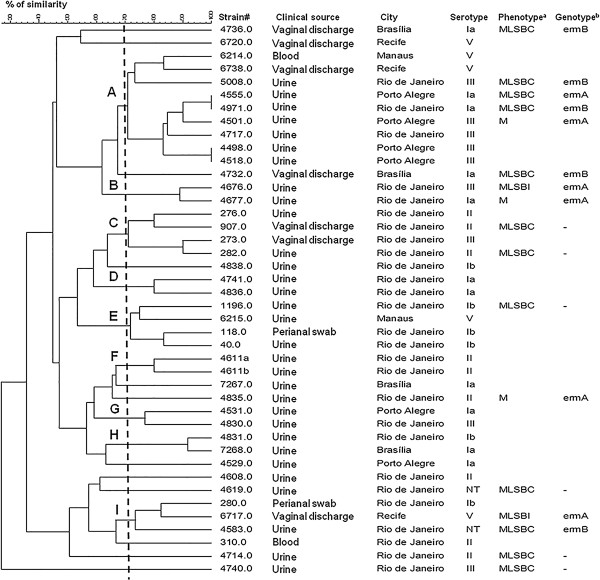
Overall, serotypes Ia (27.6%), II (19.1%), Ib (18.7%) and V (13.6%) were the most predominant, followed by serotypes IV (8.1%) and III (6.7%). All the isolates were susceptible to the beta-lactam antimicrobials tested and 97% were resistant to tetracycline. Resistance to erythromycin and clindamycin were found in 4.1% and 3% of the isolates, respectively. Among the resistance genes investigated, tetM (99.3%) and tetO (1.8%) were detected among tetracycline-resistant isolates and ermA (39%) and ermB (27.6%) were found among macrolide-resistant isolates. The lmb and scpB virulence genes were detected in all isolates, while bac and bca were detected in 57 (13.1%) and 237 (54.6%) isolates, respectively. Molecular typing by PFGE showed that resistance to erythromycin was associated with a variety of clones.
These findings indicate that GBS isolates circulating in Brazil have a variety of phenotypic and genotypic characteristics, and suggest that macrolide-resistant isolates may arise by both clonal spread and independent acquisition of resistance genes.
B 群链球菌(GBS)仍然是新生儿败血症的主要原因,也与孕妇和非孕妇成年人、老年人和有潜在医疗条件的患者的侵袭性和非侵袭性感染有关。已经确定了 10 种荚膜血清型,确定它们在特定人群或地理区域内的分布情况非常重要,因为它们是疫苗策略的主要目标。我们评估了生活在巴西不同地理区域的感染或定植该微生物的个体中分离的 GBS 菌株的特征。
通过传统表型试验鉴定并血清分型了 434 株分离株。通过纸片扩散法测定抗菌药物敏感性。使用 PCR 检测与红霉素(ermA、ermB、mefA)和四环素(tetK、tetL、tetM、tetO)耐药相关的基因以及与毒力相关的基因(bac、bca、lmb、scpB)。使用脉冲场凝胶电泳(PFGE)检测大环内酯类耐药和一些选定的大环内酯类敏感分离株的遗传多样性。
总体而言,血清型 Ia(27.6%)、II(19.1%)、Ib(18.7%)和 V(13.6%)最为常见,其次是 IV(8.1%)和 III(6.7%)。所有分离株均对所测试的β-内酰胺类抗菌药物敏感,97%对四环素耐药。红霉素和克林霉素耐药率分别为 4.1%和 3%。在所研究的耐药基因中,四环素耐药株中检测到 tetM(99.3%)和 tetO(1.8%),大环内酯类耐药株中检测到 ermA(39%)和 ermB(27.6%)。所有分离株均检测到 lmb 和 scpB 毒力基因,57(13.1%)和 237(54.6%)分离株分别检测到 bac 和 bca 基因。PFGE 分子分型表明,红霉素耐药与多种克隆有关。
这些发现表明,巴西流行的 GBS 分离株具有多种表型和基因型特征,表明大环内酯类耐药分离株可能通过克隆传播和独立获得耐药基因而产生。