Discipline of Life Sciences, School of Science, Psychology and Sport, Federation University Australia, Ballarat, VIC, 3350, Australia.
Department of Gerontology, The First Affiliated Hospital of Shandong First Medical University, 16766 Jingshi Road, Jinan, 250014, Shandong Province, China.
Sci Rep. 2021 Jan 14;11(1):1302. doi: 10.1038/s41598-020-80250-z.
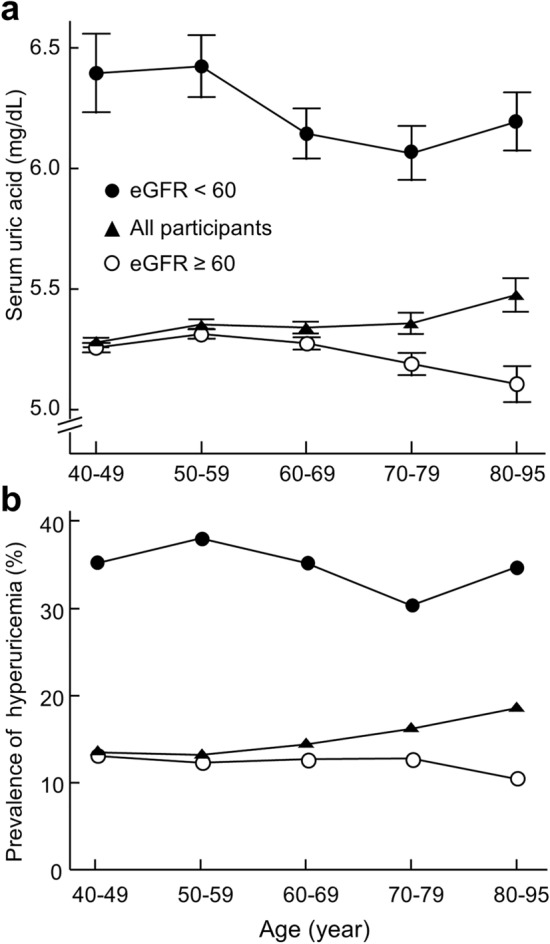
This study aimed to investigate the contribution of renal dysfunction to enhanced hyperuricemia prevalence in older people. A cohort of 13,288 Chinese people aged between 40 and 95 years were recruited from January to May 2019. Serum uric acid concentration and estimated glomerular filtration rate [eGFR] were measured. The associations between age or eGFR and serum uric acid or hyperuricemia were analyzed using linear or binary logistic regression adjusting for risk factors. Uric acid concentration and prevalence of hyperuricemia were greater in older participants. Adjustment for reduced renal function (eGFR < 60 mL/min/1.73 m) eliminated the associations between older age and higher uric acid concentration and between older age and higher prevalence of hyperuricemia diagnosis, whereas adjustment for other risk factors did not change those associations. Lower eGFR was associated with higher uric acid concentration both before (β = - 0.296, P < 0.001) and after adjustment for age (β = - 0.313, P < 0.001). Reduced renal function was associated with hyperuricemia diagnosis both before (odds ratio, OR, 3.64; 95% CI 3.10-4.28; P < 0.001) and after adjustment for age (adjusted OR, 3.82; 95% CI 3.22-4.54; P < 0.001). Mean serum uric acid and prevalence of hyperuricemia were higher in people with eGFR < 60 mL/min/1.73 m than those with eGFR ≥ 60 mL/min/1.73 m. The prevalence of reduced renal function increased with older age (P < 0.001). This study suggests that reduced renal function can explain the increased uric acid levels and hyperuricemia diagnoses in older people.
本研究旨在探讨肾功能障碍对老年人高尿酸血症患病率增加的影响。研究纳入了 2019 年 1 月至 5 月期间年龄在 40 至 95 岁之间的 13288 名中国人。测量了血清尿酸浓度和估计肾小球滤过率[eGFR]。使用线性或二元逻辑回归分析,在调整危险因素后,分析年龄或 eGFR 与血清尿酸或高尿酸血症之间的关系。结果显示,年龄较大的参与者血清尿酸浓度和高尿酸血症患病率较高。调整肾功能降低(eGFR<60mL/min/1.73m)后,年龄与较高的尿酸浓度以及年龄与高尿酸血症诊断之间的相关性消除,而调整其他危险因素后,这种相关性并未改变。eGFR 降低与尿酸浓度升高相关,无论是在调整前(β=-0.296,P<0.001)还是调整后(β=-0.313,P<0.001)。肾功能降低与高尿酸血症诊断相关,无论是在调整前(比值比,OR,3.64;95%置信区间,3.10-4.28;P<0.001)还是调整后(调整 OR,3.82;95%置信区间,3.22-4.54;P<0.001)。eGFR<60mL/min/1.73m 的人群的平均血清尿酸和高尿酸血症患病率高于 eGFR≥60mL/min/1.73m 的人群。肾功能降低的患病率随年龄增长而增加(P<0.001)。本研究表明,肾功能降低可以解释老年人尿酸水平升高和高尿酸血症诊断的增加。