Japan Agency for Marine-Earth Science and Technology (JAMSTEC), Yokohama, Japan.
Laboratoire de Physique et Mécanique des Milieux Hétérogènes (PMMH), CNRS UMR 7636, ESPCI Paris-PSL University, Sorbonne Université, Université de Paris, 75005, Paris, France.
Commun Biol. 2021 Jan 14;4(1):40. doi: 10.1038/s42003-020-01521-z.
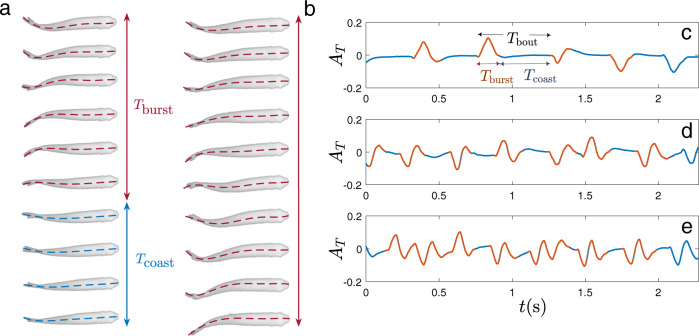
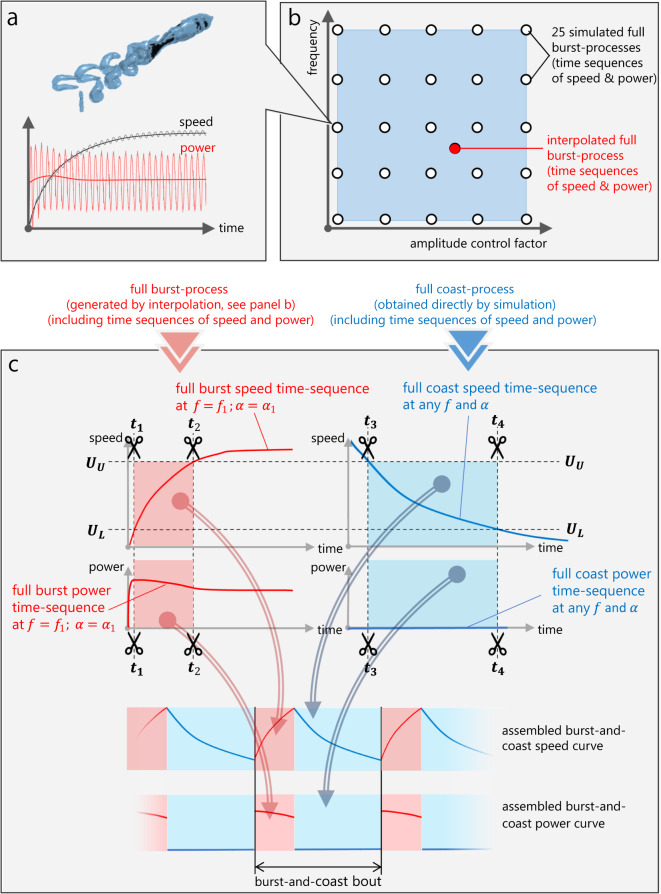
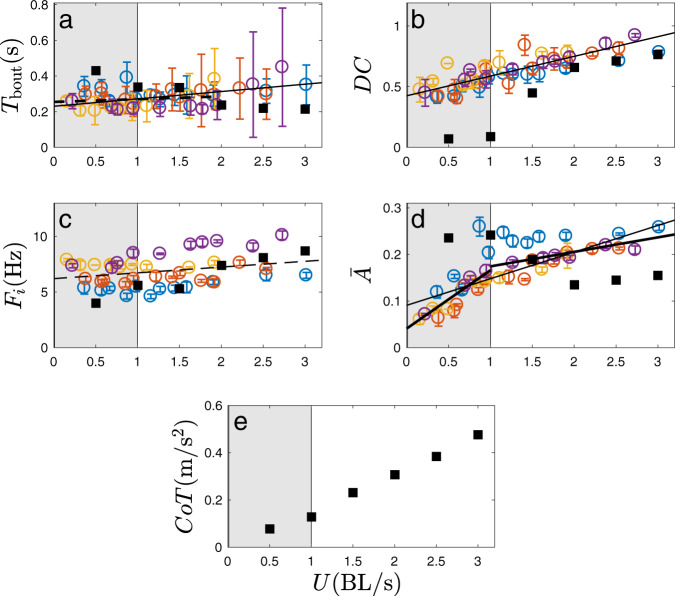
This paper addresses the physical mechanism of intermittent swimming by considering the burst-and-coast regime of fish swimming at different speeds. The burst-and-coast regime consists of a cycle with two successive phases, i.e., a phase of active undulation powered by the fish muscles followed by a passive gliding phase. Observations of real fish whose swimming gait is forced in a water flume from low to high speed regimes are performed, using a full description of the fish kinematics and mechanics. We first show that fish modulate a unique intrinsic cycle to sustain the demanded speed by modifying the bursting to coasting ratio while maintaining the duration of the cycle nearly constant. Secondly, we show using numerical simulations that the chosen kinematics by correspond to optimized gaits for swimming speeds larger than 1 body length per second.
本文通过考虑鱼类在不同速度下的爆发-滑行模式,研究了间歇游泳的物理机制。爆发-滑行模式由一个连续的两个阶段组成,即由鱼肌肉驱动的主动波动阶段和被动滑行阶段。通过在水槽中从低到高速度强迫鱼类游动步态的观察,使用鱼类运动学和力学的完整描述进行了研究。我们首先表明,鱼类通过改变爆发到滑行的比例来调节独特的固有周期,以维持所需的速度,同时保持周期的持续时间几乎不变。其次,我们通过数值模拟表明,所选运动学对应于大于 1 个体长/秒的游泳速度的优化步态。