Department of Mathematics, Uppsala University, Uppsala, Sweden.
RITMO Centre for Interdisciplinary Studies in Rhythm, Time and Motion, University of Oslo, Oslo, Norway.
J R Soc Interface. 2023 Jul;20(204):20230212. doi: 10.1098/rsif.2023.0212. Epub 2023 Jul 19.
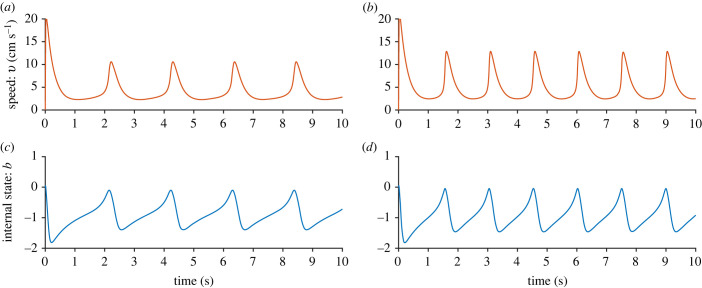
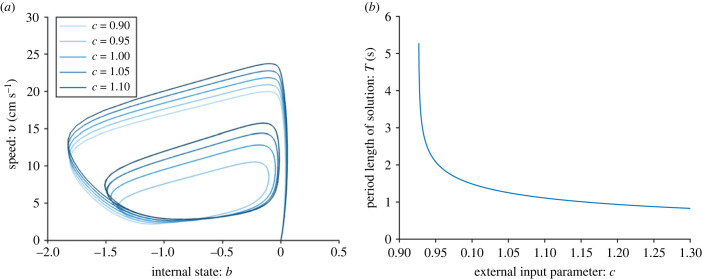
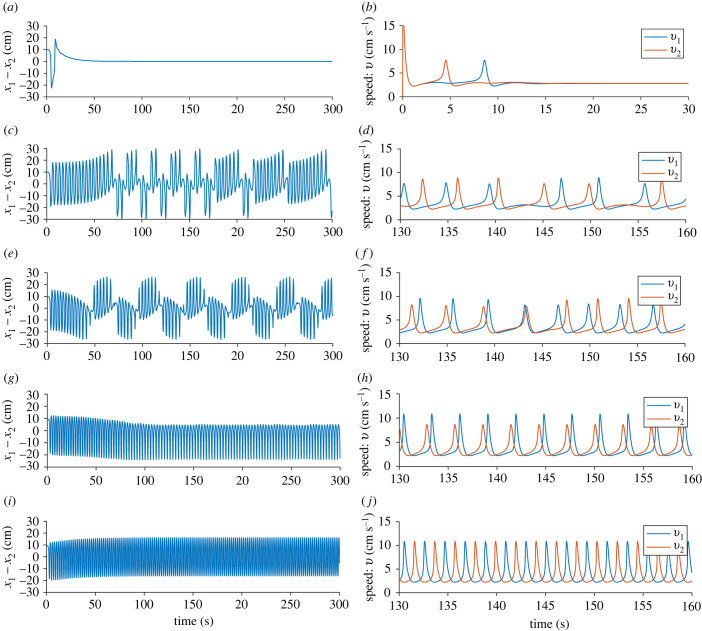
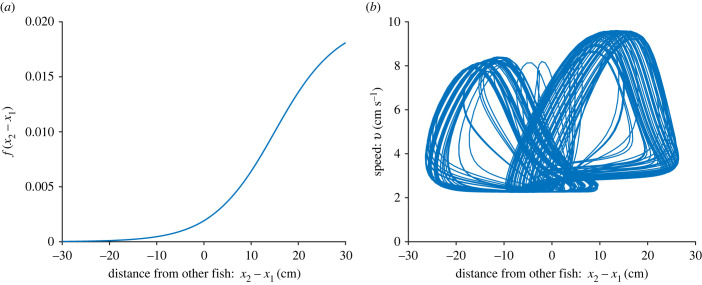
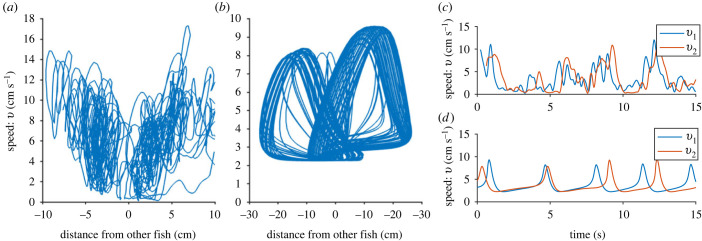
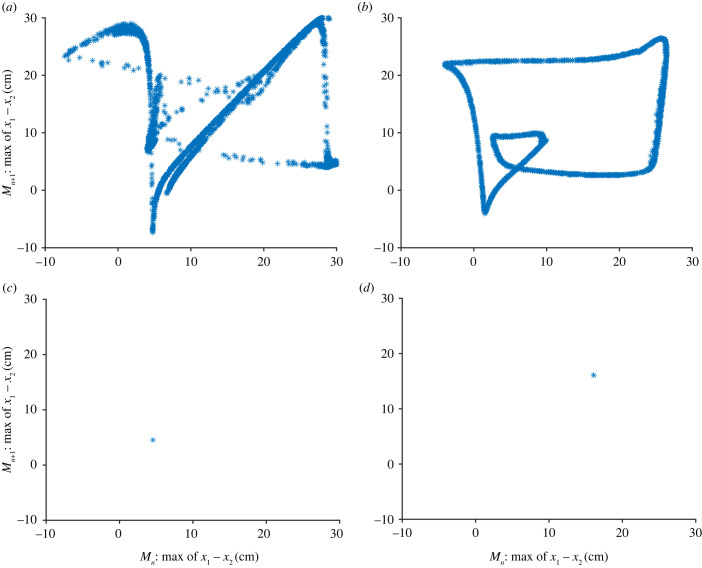
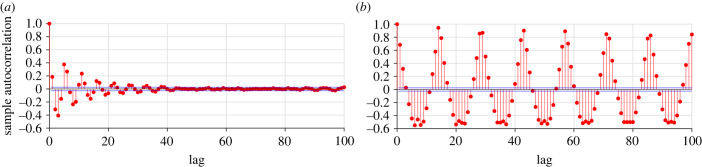
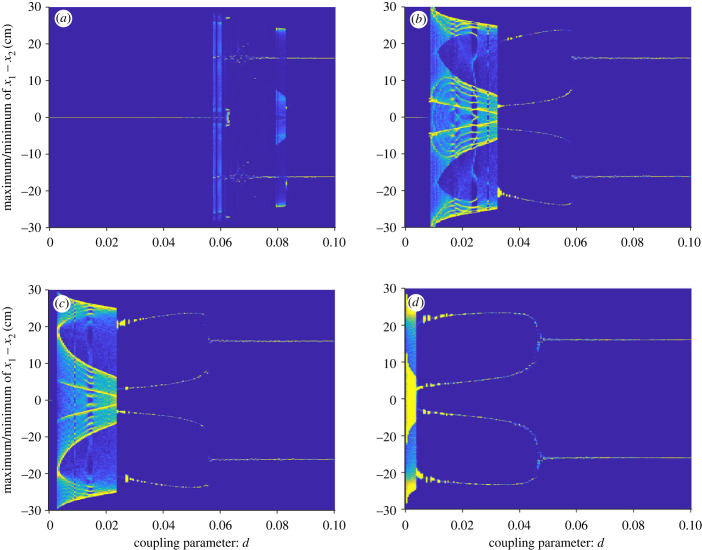
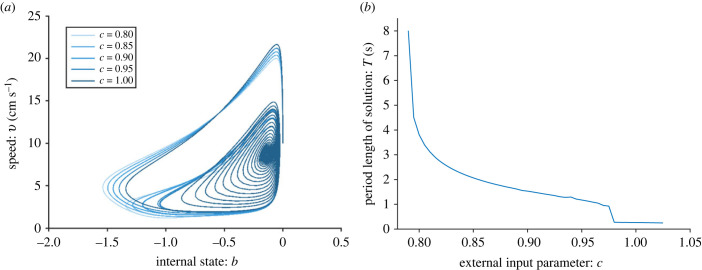
While mathematical models, in particular self-propelled particle models, capture many properties of large fish schools, they do not always capture the interactions of smaller shoals. Nor do these models tend to account for the use of intermittent locomotion, often referred to as burst-and-glide, by many species. In this paper, we propose a model of social burst-and-glide motion by combining a well-studied model of neuronal dynamics, the FitzHugh-Nagumo model, with a model of fish motion. We first show that our model can capture the motion of a single fish swimming down a channel. Extending to a two-fish model, where visual stimulus of a neighbour affects the internal burst or glide state of the fish, we observe a rich set of dynamics found in many species. These include: leader-follower behaviour; periodic changes in leadership; apparently random (i.e. chaotic) leadership change; and tit-for-tat turn taking. Moreover, unlike previous studies where a randomness is required for leadership switching to occur, we show that this can instead be the result of deterministic interactions. We give several empirically testable predictions for how bursting fish interact and discuss our results in light of recently established correlations between fish locomotion and brain activity.
虽然数学模型(特别是自推进粒子模型)可以捕捉到大型鱼群的许多特性,但它们并不总是能捕捉到较小鱼群的相互作用。这些模型也往往没有考虑到许多物种经常采用的间歇运动,通常称为爆发-滑翔。在本文中,我们提出了一种社会爆发-滑翔运动模型,将一个经过充分研究的神经元动力学模型(菲茨霍格-纳格蒙模型)与鱼类运动模型相结合。我们首先展示了我们的模型可以捕捉到在通道中游泳的单个鱼类的运动。将其扩展到两条鱼的模型中,即邻居的视觉刺激会影响鱼类的内部爆发或滑翔状态,我们观察到了许多物种中存在的丰富的动力学行为。这些行为包括:领导-跟随行为;领导地位的周期性变化;看似随机(即混沌)的领导权变更;以及以牙还牙的轮流制。此外,与之前的研究不同,之前的研究需要随机性才能发生领导权切换,我们表明,这种切换也可以是确定性相互作用的结果。我们给出了一些关于爆发鱼类如何相互作用的可通过实验验证的预测,并根据最近在鱼类运动和大脑活动之间建立的相关性来讨论我们的结果。