Sugihara Shigetaka, Kikuchi Toru, Urakami Tatsuhiko, Yokota Ichiro, Kikuchi Nobuyuki, Kawamura Tomoyuki, Amemiya Shin
Department of Pediatrics, Tokyo Women's Medical University Medical Center East, Tokyo, Japan.
The Japanese Study Group of Insulin Therapy for Childhood and Adolescent Diabetes.
Clin Pediatr Endocrinol. 2021;30(1):27-33. doi: 10.1297/cpe.30.27. Epub 2021 Jan 5.
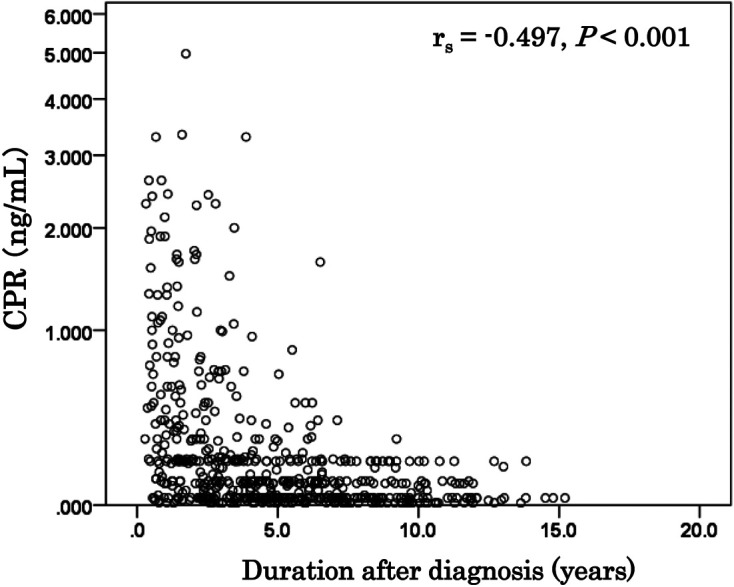
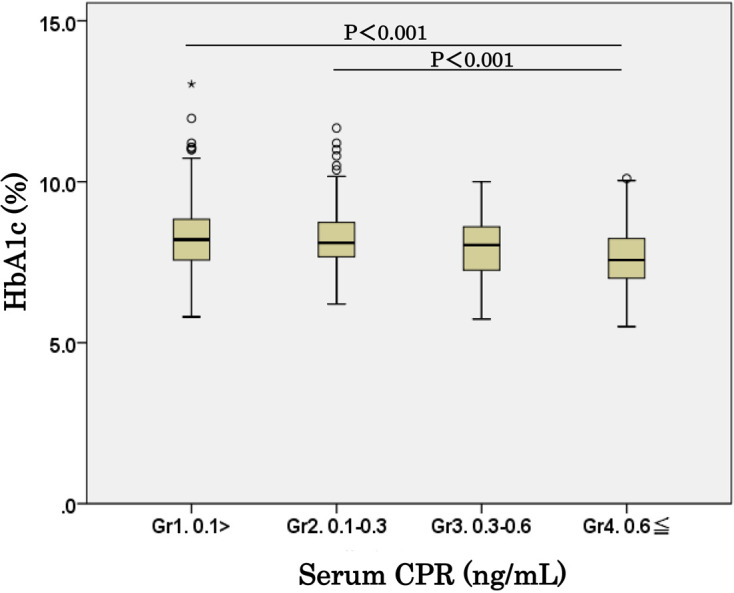
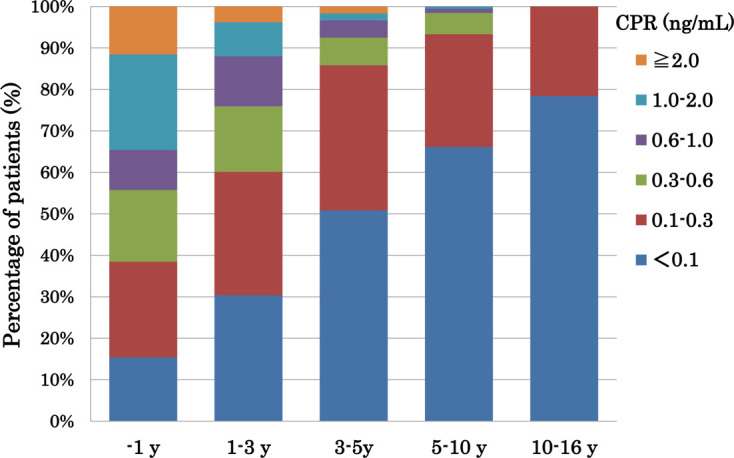
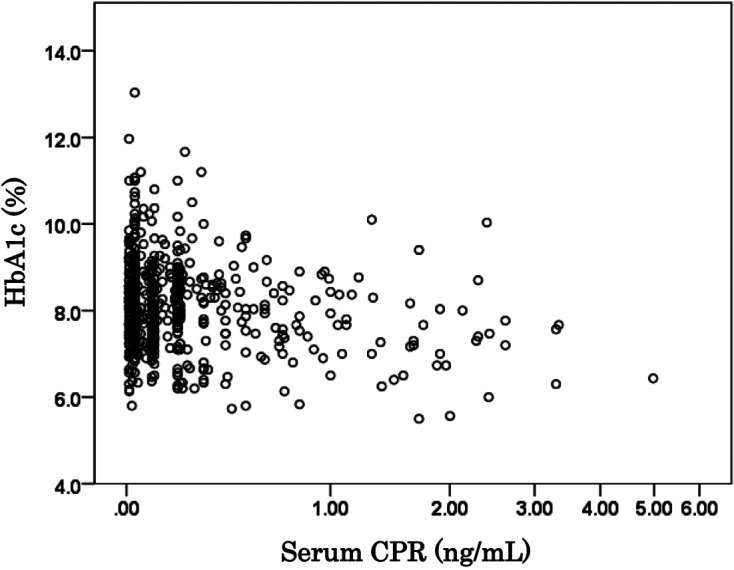
We investigated serum C-peptide immunoreactivity (CPR) levels in registered data from a multi-center collaborative nationwide type 1 diabetes study. The CPR levels were obtained from 576 and 409 children during the early registration (2013/2014) and late observation (2016/2017) periods, respectively. The percentages of children with a CPR < 0.1 or < 0.3 ng/mL increased according to the duration since diagnosis. Among patients with 5 or more years since diagnosis, 69% had a CPR < 0.1 and 95% had a CPR < 0.3 in the early registration period. A significant negative correlation was observed between the HbA1c and the CPR levels, and the HbA1c levels were significantly higher among children with a CPR < 0.1 or < 0.3 than among those with a CPR ≥ 0.6 ng/mL. During the late observation period, the prevalence of a CPR < 0.1 ng/mL was 88% among long-standing patients and 77% among patients aged 18-20 yr. Regarding the characteristics of "Responders" with a sustained CPR ≥ 0.6 ng/mL at 5 or more years since diagnosis, six of the seven were adolescent females; five of the seven had an HLA DR4-DQ4 haplotype. When type 1A diabetes mellitus (T1AD) children transit to adult care centers, most of them may have some difficulty in glycemic control because of the depleted endogenous insulin.
我们在一项全国多中心协作的1型糖尿病研究的注册数据中调查了血清C肽免疫反应性(CPR)水平。分别在早期注册(2013/2014)和后期观察(2016/2017)阶段从576名和409名儿童中获取了CPR水平。CPR<0.1或<0.3 ng/mL的儿童百分比根据诊断后的病程而增加。在诊断后5年或更长时间的患者中,早期注册阶段69%的患者CPR<0.1,95%的患者CPR<0.3。观察到糖化血红蛋白(HbA1c)与CPR水平之间存在显著负相关,CPR<0.1或<0.3的儿童的HbA1c水平显著高于CPR≥0.6 ng/mL的儿童。在后期观察阶段,长期患者中CPR<0.1 ng/mL的患病率为88%,18 - 20岁患者中为77%。关于诊断后5年或更长时间CPR持续≥0.6 ng/mL的“反应者”的特征,7名中有6名是青春期女性;7名中有5名具有HLA DR4 - DQ4单倍型。当1型自身免疫性糖尿病(T1AD)儿童转诊至成人护理中心时,由于内源性胰岛素耗竭,他们中的大多数在血糖控制方面可能会有一些困难。