Sodhi Kanwalpreet, Chanchalani Gunjan
Department of Critical Care, Deep Hospital, Ludhiana, India.
Department of Critical Care Medicine, Bhatia Hospital, Mumbai, Maharashtra, India.
Indian J Crit Care Med. 2020 Dec;24(12):1236-1241. doi: 10.5005/jp-journals-10071-23684.
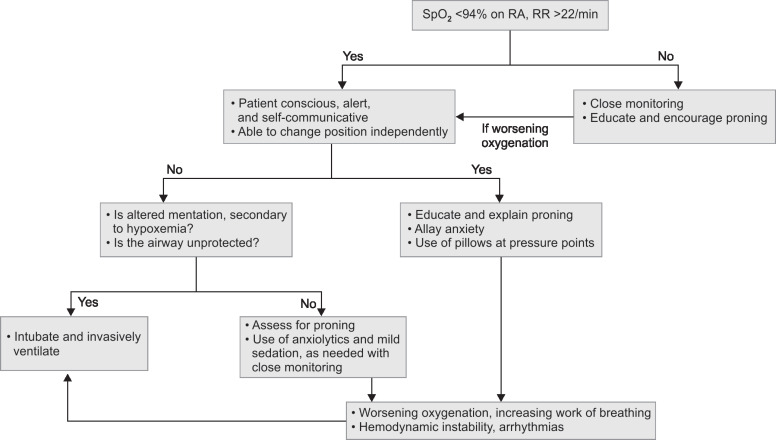
Prone positioning has been shown to improve oxygenation for decades. However, proning in awake, non-intubated patients gained acceptance in the last few months since the onset of coronavirus (COVID-19) pandemic. To overcome the shortage of ventilators, to decrease the overwhelming burden on intensive care beds in the pandemic era, and also as invasive ventilation was associated with poor outcomes, proning of awake, spontaneously breathing patients gathered momentum. Being an intervention with minimal risk and requiring minimum assistance, it is now a globally accepted therapy to improve oxygenation in acute hypoxemic respiratory failure in COVID-19 patients. We thus reviewed the literature of awake proning in non-intubated patients and described a safe protocol to practice the same. Sodhi K, Chanchalani G. Awake Proning: Current Evidence and Practical Considerations. Indian J Crit Care Med 2020;24(12):1236-1241.
几十年来,俯卧位通气已被证明可改善氧合。然而,自冠状病毒(COVID-19)大流行开始以来,清醒、未插管患者的俯卧位通气在过去几个月中得到了认可。为了克服呼吸机短缺的问题,减轻大流行时代重症监护床位的巨大负担,同时由于有创通气与不良预后相关,清醒、自主呼吸患者的俯卧位通气逐渐兴起。作为一种风险最小且所需辅助最少的干预措施,它现在已成为全球公认的改善COVID-19患者急性低氧性呼吸衰竭氧合的治疗方法。因此,我们回顾了非插管患者清醒俯卧位通气的文献,并描述了一种安全的实施方案。索迪·K,钱查拉尼·G。清醒俯卧位通气:当前证据与实际考量。《印度重症监护医学杂志》2020年;24(12):1236 - 1241。