Bruni Alessio, Stefani Alessandro, Perna Marco, Borghetti Paolo, Giaj Levra Niccolò, D'Angelo Elisa, D'Onofrio Alessandra, Rubino Laura, Frassinelli Luca, Salvestrini Viola, Mariotti Matteo, Alongi Filippo, Gonfiotti Alessandro, Livi Lorenzo, Scotti Vieri
Radiotherapy Unit, Hematology and Oncology Department, University Hospital of Modena, Modena, Italy.
Division of Thoracic Surgery, Department of Medical and Surgical Sciences for Children & Adults, University of Modena and Reggio Emilia, Modena, Italy.
J Thorac Dis. 2020 Dec;12(12):7518-7530. doi: 10.21037/jtd-2019-thym-09.
Thymoma is a rare mediastinal neoplasia. Surgery is the backbone of the treatment, but the role of postoperative radiotherapy (PORT) remains controversial. We aimed to obtain data on survival and safety in patients treated with PORT in three different Italian institutions.
We retrospectively analyzed 183 consecutive patients who underwent surgery from 1981 to 2015. According to the Masaoka-Koga staging system, 39.3%, 32.7%, 18.6% and 9.8% patients were in stage I, II, III and IV of disease, respectively. PORT was indicated in 114 patients (62.3%), while 69 subjects underwent surgery alone. Complete resection was obtained in 68 patients who underwent PORT. Adverse events (AEs) were graded according to CTCAE v4.0. We analyzed the recent literature to describe the current reports on PORT for resected thymoma.
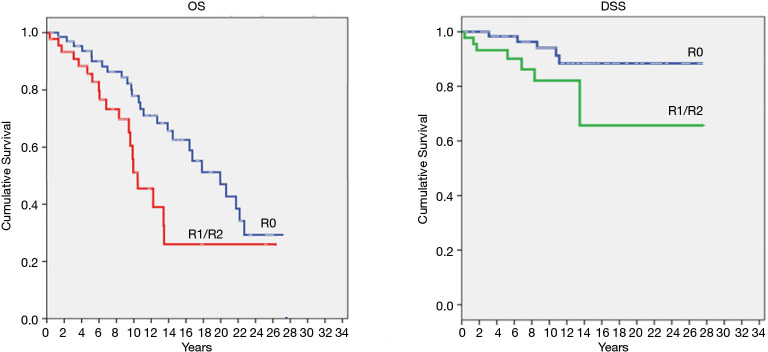
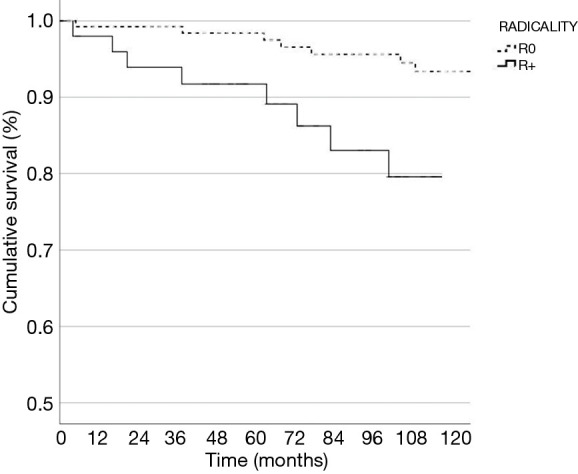
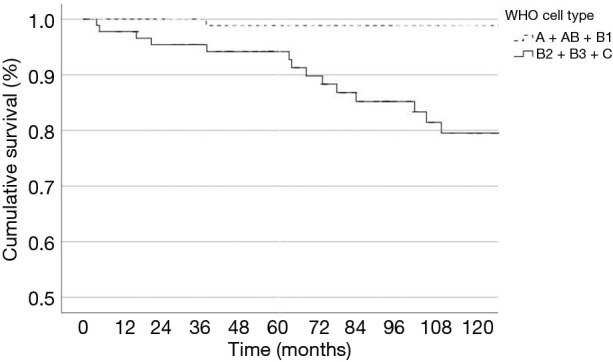
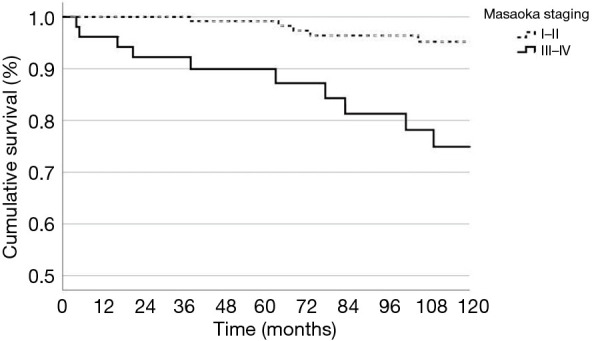
Mean follow-up was 130 months (range, 3-417 months). Overall survival (OS) at 1-, 5- and 10-year from surgery was 98.3%, 90.2% and 69.7% respectively. One-, 5- and 10-year disease specific survival (DSS) was 98.9%, 92.3% and 89.8% respectively. Disease free survival (DFS) at 1, 5 and 10 years from surgery was 96.7%, 88.3% and 82.8% respectively. Univariate analysis showed that complete resection, cell histology A-AB-B1 and stages I-II were significant predictors of better DSS and DFS. Multivariate analysis showed that sex, R0 margins and WHO histology was independent prognostic factors. Among patients treated with PORT, a trend towards better OS was evident with Masaoka stage I-II (P=0.09). Patients with R0 margins treated with PORT showed better OS and DSS (P=0.05). No differences in DSS for performance status (P=0.70), WHO histology (P=0.19), paraneoplastic syndrome (P=0.23) and surgical procedure (P=0.53) were evident. Patients treated with PORT had a higher level of acute AEs compared to surgery alone, but none of these was graded ≥3.
Our results confirmed that patients with incompletely resected thymoma had the worst OS and DSS. High grade acute toxicity was not different between PORT and surgery alone. Other trials reported a significant benefit in OS, DSS and DFS in stage IIb-IV thymoma treated with PORT.
胸腺瘤是一种罕见的纵隔肿瘤。手术是治疗的主要手段,但术后放疗(PORT)的作用仍存在争议。我们旨在获取意大利三个不同机构接受PORT治疗患者的生存和安全性数据。
我们回顾性分析了1981年至2015年连续接受手术的183例患者。根据Masaoka-Koga分期系统,分别有39.3%、32.7%、18.6%和9.8%的患者处于疾病的I、II、III和IV期。114例患者(62.3%)接受了PORT,而69例患者仅接受了手术。接受PORT的68例患者实现了完全切除。不良事件(AE)根据CTCAE v4.0分级。我们分析了近期文献以描述目前关于PORT治疗切除性胸腺瘤的报道。
平均随访时间为130个月(范围3 - 417个月)。术后1年、5年和10年的总生存率(OS)分别为98.3%、90.2%和69.7%。1年、5年和10年的疾病特异性生存率(DSS)分别为98.9%、92.3%和89.8%。术后1年、5年和10年的无病生存率(DFS)分别为96.7%、88.3%和82.8%。单因素分析显示,完全切除、细胞组织学A - AB - B1以及I - II期是更好的DSS和DFS的显著预测因素。多因素分析显示,性别、R0切缘和世界卫生组织(WHO)组织学是独立的预后因素。在接受PORT治疗的患者中,Masaoka I - II期患者的OS有改善趋势(P = 0.09)。接受PORT且切缘为R0的患者显示出更好的OS和DSS(P = 0.05)。在DSS方面,功能状态(P = 0.70)、WHO组织学(P = 0.19)、副肿瘤综合征(P = 0.23)和手术方式(P = 0.53)之间无明显差异。与仅接受手术的患者相比,接受PORT治疗的患者急性AE水平更高,但均未达到≥3级。
我们的结果证实,胸腺瘤切除不完全的患者OS和DSS最差。PORT和仅接受手术治疗的患者之间高级别急性毒性无差异。其他试验报告称,PORT治疗IIb - IV期胸腺瘤在OS、DSS和DFS方面有显著益处。