Complex Tissue Regeneration Department, MERLN Institute for Technology-Inspired Regenerative Medicine, Maastricht University, Universiteitssingel 40, 6229 ER Maastricht, The Netherlands.
Nadir S.r.l., Via Torino, 155/b, 30172 Venice, Italy.
ACS Appl Mater Interfaces. 2021 Jan 27;13(3):3631-3644. doi: 10.1021/acsami.0c19687. Epub 2021 Jan 15.
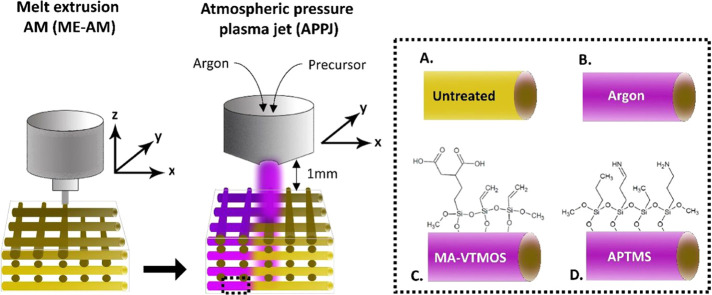
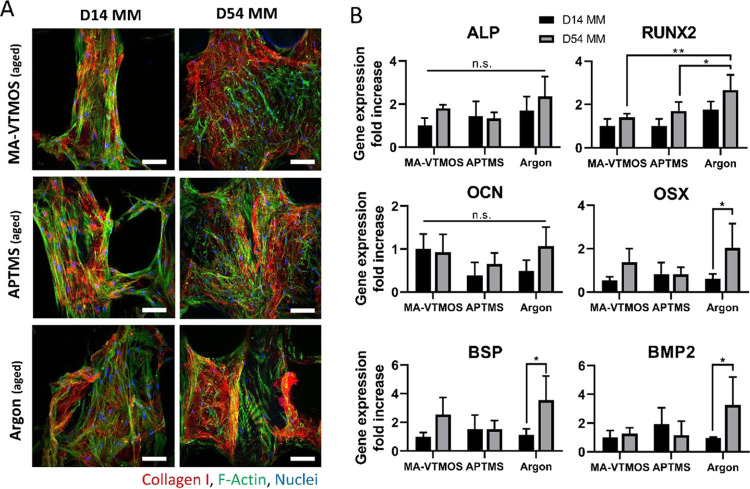
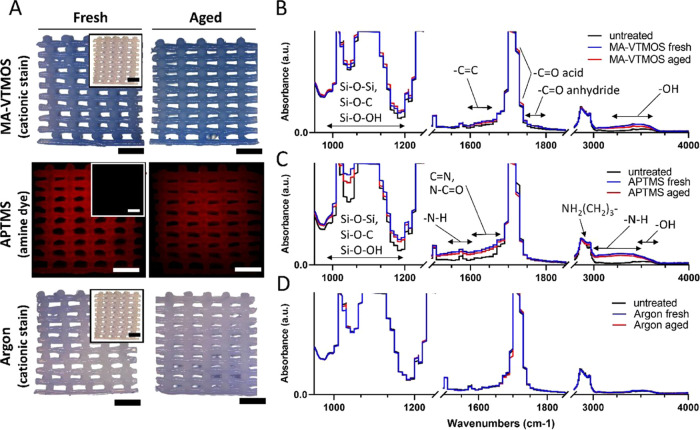
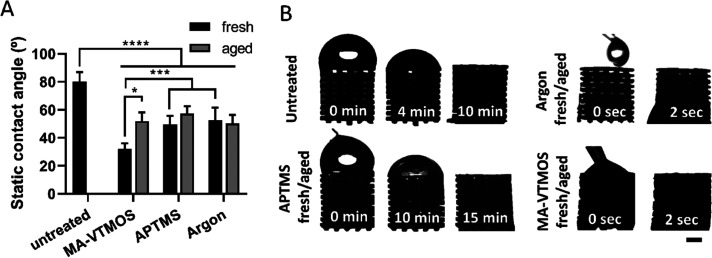
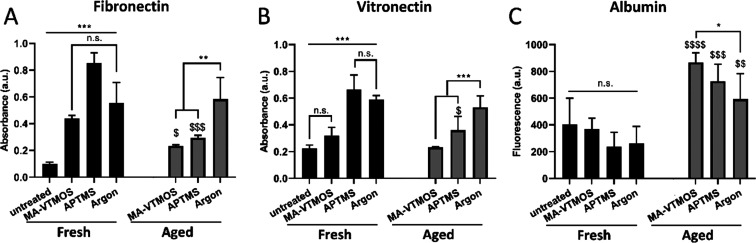
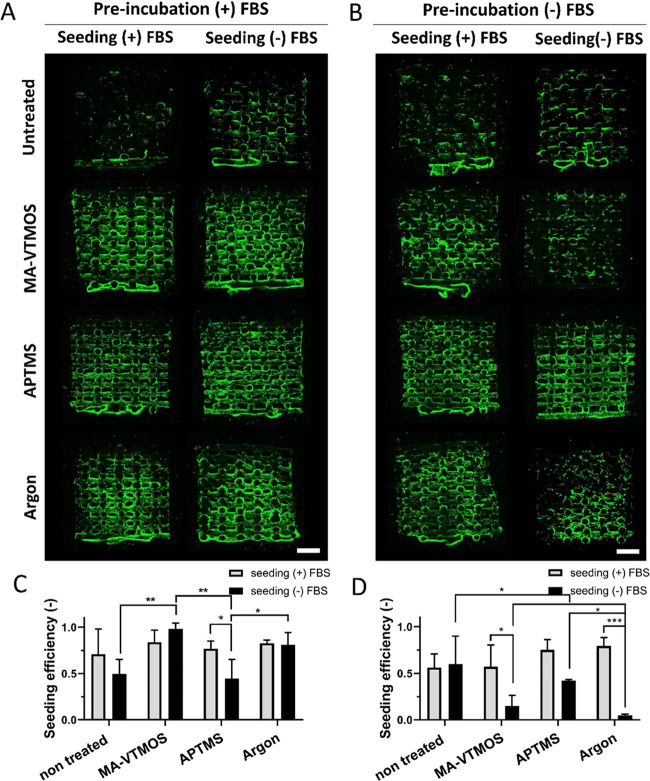
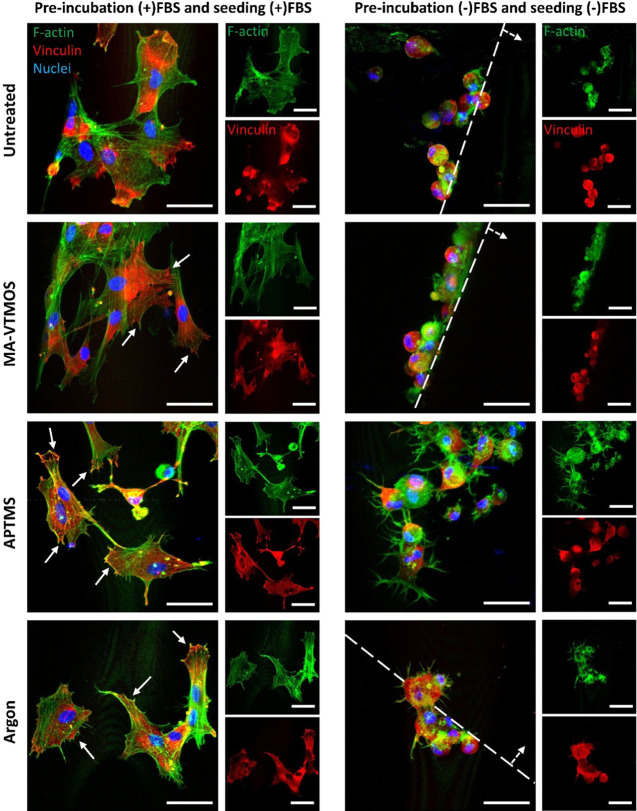
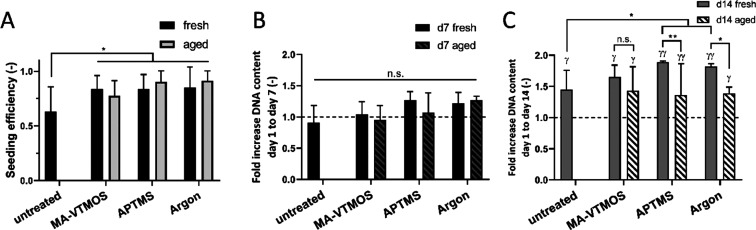
Three-dimensional (3D) scaffolds with optimum physicochemical properties are able to elicit specific cellular behaviors and guide tissue formation. However, cell-material interactions are limited in scaffolds fabricated by melt extrusion additive manufacturing (ME-AM) of synthetic polymers, and plasma treatment can be used to render the surface of the scaffolds more cell adhesive. In this study, a hybrid AM technology, which combines a ME-AM technique with an atmospheric pressure plasma jet, was employed to fabricate and plasma treat scaffolds in a single process. The organosilane monomer (3-aminopropyl)trimethoxysilane (APTMS) and a mixture of maleic anhydride and vinyltrimethoxysilane (MA-VTMOS) were used for the first time to plasma treat 3D scaffolds. APTMS treatment deposited plasma-polymerized films containing positively charged amine functional groups, while MA-VTMOS introduced negatively charged carboxyl groups on the 3D scaffolds' surface. Argon plasma activation was used as a control. All plasma treatments increased the surface wettability and protein adsorption to the surface of the scaffolds and improved cell distribution and proliferation. Notably, APTMS-treated scaffolds also allowed cell attachment by electrostatic interactions in the absence of serum. Interestingly, cell attachment and proliferation were not significantly affected by plasma treatment-induced aging. Also, while no significant differences were observed between plasma treatments in terms of gene expression, human mesenchymal stromal cells (hMSCs) could undergo osteogenic differentiation on aged scaffolds. This is probably because osteogenic differentiation is rather dependent on initial cell confluency and surface chemistry might play a secondary role.
具有最佳物理化学性能的三维(3D)支架能够引发特定的细胞行为并指导组织形成。然而,在熔融挤出增材制造(ME-AM)合成聚合物制造的支架中,细胞与材料的相互作用是有限的,而等离子体处理可以使支架表面更具细胞黏附性。在这项研究中,采用一种混合增材制造技术,将 ME-AM 技术与大气压等离子射流相结合,在单一工艺中制造和等离子体处理支架。首次使用有机硅烷单体(3-氨丙基)三甲氧基硅烷(APTMS)和马来酸酐与乙烯基三甲氧基硅烷(MA-VTMOS)混合物对 3D 支架进行等离子体处理。APTMS 处理沉积了含有正电荷胺官能团的等离子体聚合膜,而 MA-VTMOS 在 3D 支架表面引入了负电荷羧基。氩等离子体激活用作对照。所有等离子体处理都增加了支架表面的润湿性和蛋白质吸附,并改善了细胞的分布和增殖。值得注意的是,APTMS 处理的支架在没有血清的情况下也可以通过静电相互作用附着细胞。有趣的是,细胞附着和增殖不受等离子体处理诱导老化的显著影响。此外,尽管等离子体处理在基因表达方面没有观察到显著差异,但人骨髓基质细胞(hMSCs)可以在老化的支架上进行成骨分化。这可能是因为成骨分化相当依赖于初始细胞的融合度,而表面化学可能起次要作用。