Francis I Proctor Foundation, University of California, San Francisco, San Francisco, CA, USA.
University of Oxford, Oxford, UK.
Trans R Soc Trop Med Hyg. 2021 Mar 6;115(3):222-228. doi: 10.1093/trstmh/traa170.
Progress towards elimination of trachoma as a public health problem has been substantial, but the coronavirus disease 2019 (COVID-19) pandemic has disrupted community-based control efforts.
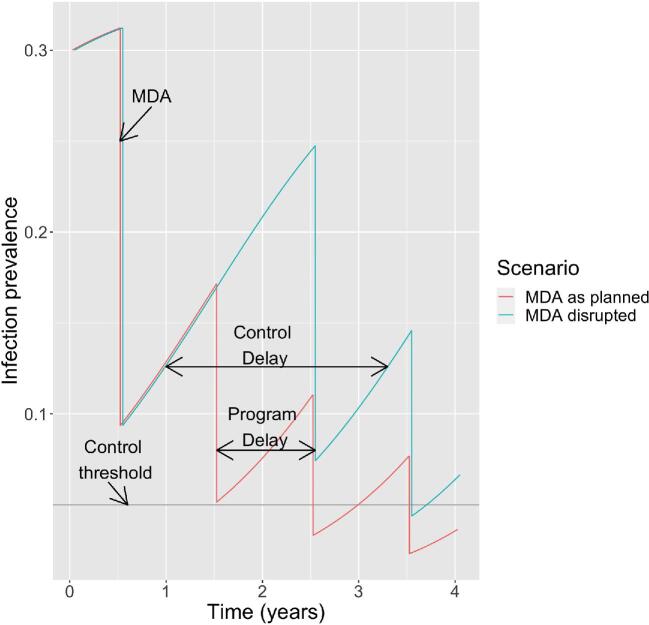
We use a susceptible-infected model to estimate the impact of delayed distribution of azithromycin treatment on the prevalence of active trachoma.
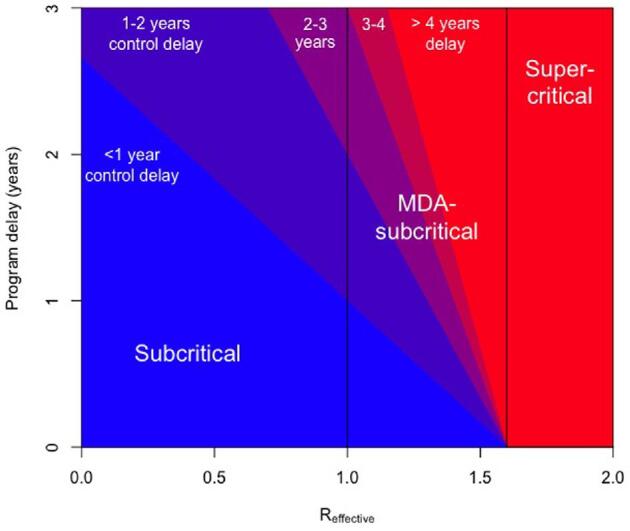
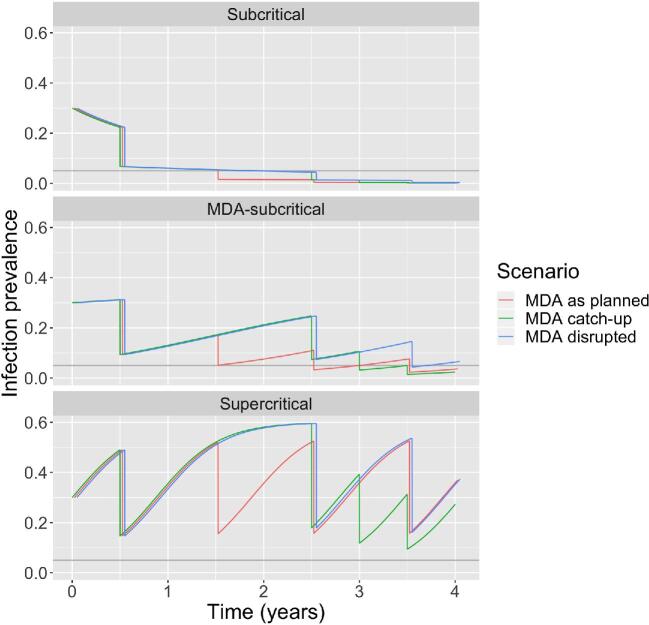
We identify three distinct scenarios for geographic districts depending on whether the basic reproduction number and the treatment-associated reproduction number are above or below a value of 1. We find that when the basic reproduction number is <1, no significant delays in disease control will be caused. However, when the basic reproduction number is >1, significant delays can occur. In most districts, 1 y of COVID-related delay can be mitigated by a single extra round of mass drug administration. However, supercritical districts require a new paradigm of infection control because the current strategies will not eliminate disease.
If the pandemic can motivate judicious, community-specific implementation of control strategies, global elimination of trachoma as a public health problem could be accelerated.
在消除沙眼这一公共卫生问题方面已经取得了重大进展,但 2019 年冠状病毒病(COVID-19)大流行打乱了以社区为基础的控制工作。
我们使用易感染-感染模型来估计延迟阿奇霉素治疗对活动性沙眼流行率的影响。
我们根据基本繁殖数和治疗相关繁殖数是否大于或小于 1 值,确定了地理区域的三种不同情况。我们发现,当基本繁殖数 <1 时,不会导致疾病控制的显著延迟。但是,当基本繁殖数 >1 时,可能会出现显著的延迟。在大多数地区,COVID 相关的 1 年延迟可以通过单次额外的大规模药物治疗来缓解。然而,超临界地区需要新的感染控制模式,因为目前的策略无法消除疾病。
如果大流行能够促使明智、具体的社区实施控制策略,那么全球消除沙眼这一公共卫生问题的进程可能会加快。