Department of Biology and Biotechnology "L. Spallanzani", University of Pavia, 27100, Pavia, Italy.
Department of Plant Sciences, Seed Biotechnology Center, University of California, Davis, USA.
Plant Reprod. 2021 Mar;34(1):21-36. doi: 10.1007/s00497-020-00402-z. Epub 2021 Jan 15.
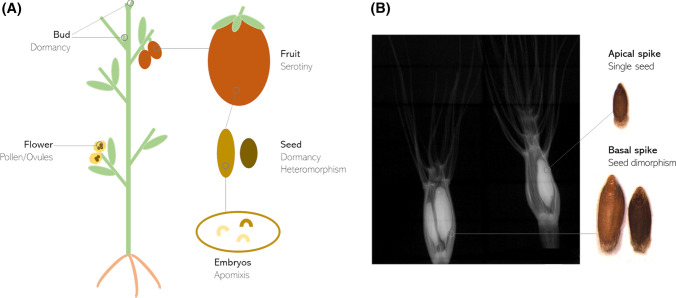
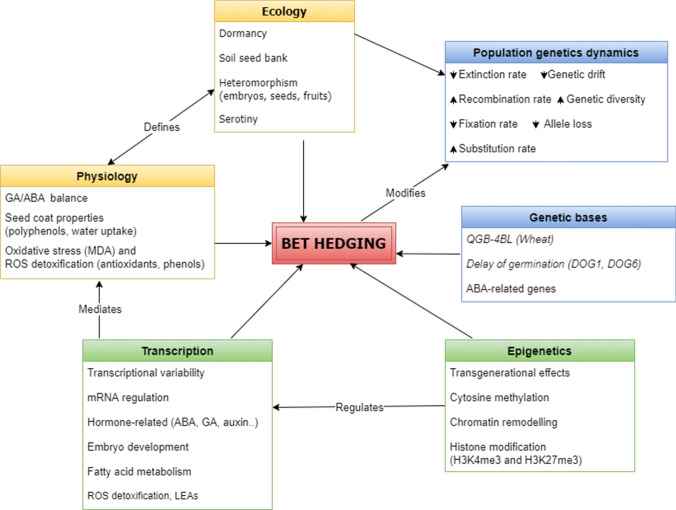
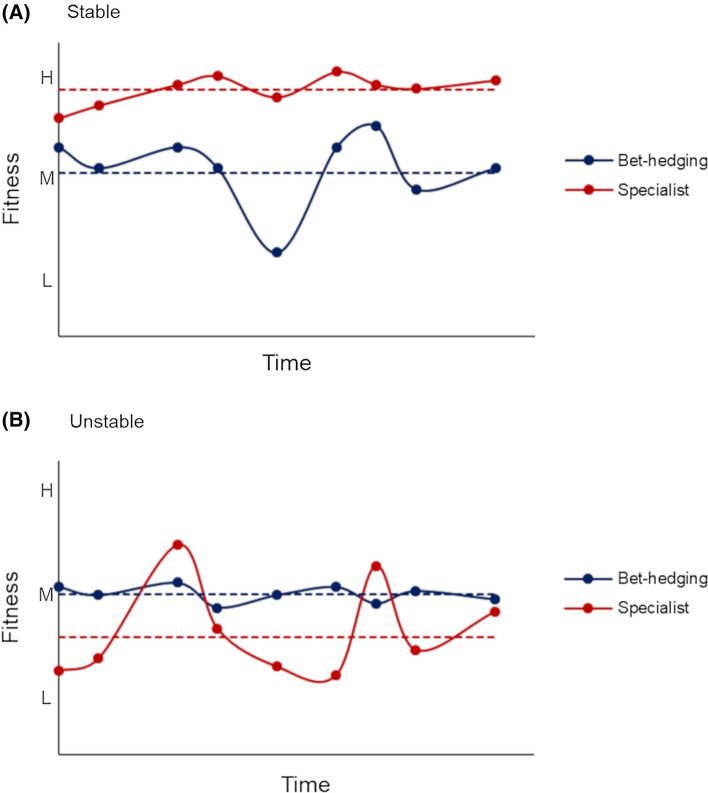
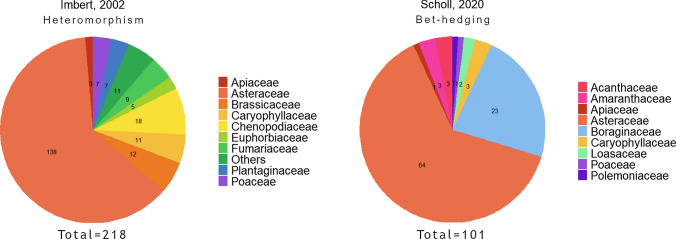
Bet-hedging is a complex evolutionary strategy involving morphological, eco-physiological, (epi)genetic and population dynamics aspects. We review these aspects in flowering plants and propose further research needed for this topic. Bet-hedging is an evolutionary strategy that reduces the temporal variance in fitness at the expense of a lowered arithmetic mean fitness. It has evolved in organisms subjected to variable cues from the external environment, be they abiotic or biotic stresses such as irregular rainfall or predation. In flowering plants, bet-hedging is exhibited by hundreds of species and is mainly exerted by reproductive organs, in particular seeds but also embryos and fruits. The main example of bet-hedging in angiosperms is diaspore heteromorphism in which the same individual produces different seed/fruit morphs in terms of morphology, dormancy, eco-physiology and/or tolerance to biotic and abiotic stresses in order to 'hedge its bets' in unpredictable environments. The objective of this review is to provide a comprehensive overview of the ecological, genetic, epigenetic and physiological aspects involved in shaping bet-hedging strategies, and how these can affect population dynamics. We identify several open research questions about bet-hedging strategies in plants: 1) understanding ecological trade-offs among different traits; 2) producing more comprehensive phylogenetic analyses to understand the diffusion and evolutionary implications of this strategy; 3) clarifying epigenetic mechanisms related to bet-hedging and plant responses to environmental cues; and 4) applying multi-omics approaches to study bet-hedging at different levels of detail. Clarifying those aspects of bet-hedging will deepen our understanding of this fascinating evolutionary strategy.
套期保值是一种复杂的进化策略,涉及形态、生态生理、(表观)遗传学和种群动态等方面。我们综述了开花植物中的这些方面,并提出了该主题进一步研究所需的内容。套期保值是一种进化策略,它以降低算术平均适应度为代价,减少适应度在时间上的方差。它在生物体中进化而来,这些生物体受到来自外部环境的可变线索的影响,无论是生物或非生物胁迫,如不规则降雨或捕食。在开花植物中,数以百计的物种表现出套期保值,主要由生殖器官表现出来,特别是种子,但也包括胚胎和果实。被子植物中套期保值的主要例子是 Diaspore 异型,其中同一个体产生不同的种子/果实形态,在形态、休眠、生态生理和/或对生物和非生物胁迫的耐受性方面存在差异,以便在不可预测的环境中“对冲其赌注”。本综述的目的是提供一个全面的概述,涉及形成套期保值策略的生态、遗传、表观遗传和生理方面,以及这些方面如何影响种群动态。我们确定了植物套期保值策略的几个开放性研究问题:1)理解不同特征之间的生态权衡;2)进行更全面的系统发育分析,以了解这种策略的扩散和进化意义;3)阐明与套期保值和植物对环境线索反应相关的表观遗传机制;4)应用多组学方法研究不同细节水平的套期保值。阐明套期保值的这些方面将加深我们对这种迷人进化策略的理解。