EaStCHEM, School of Chemistry, University of St Andrews, North Haugh, St Andrews, Fife, KY16 9ST, UK.
GlaxoSmithKline, Medicines Research Centre, Gunnels Wood Road, Stevenage, Hertfordshire, SG1 2NY, UK.
Angew Chem Int Ed Engl. 2021 Mar 29;60(14):7935-7940. doi: 10.1002/anie.202016811. Epub 2021 Feb 26.
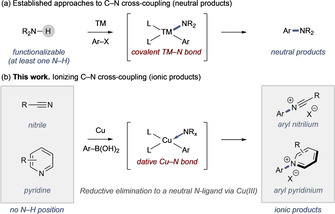
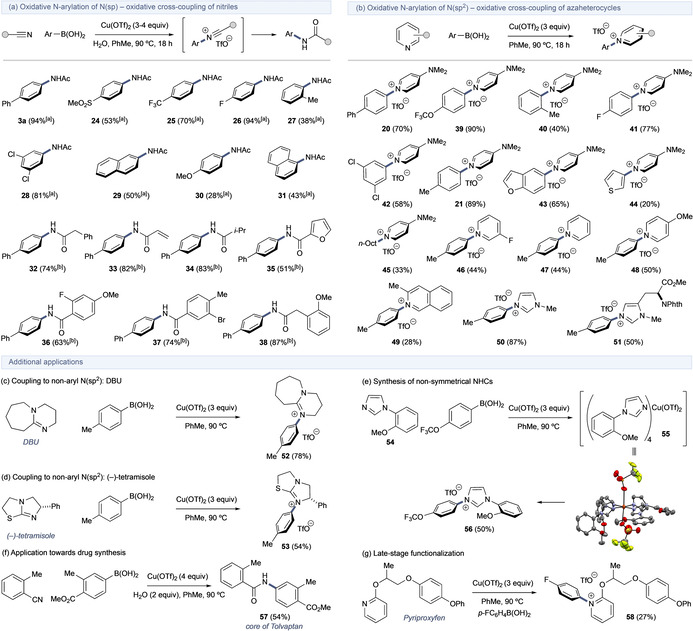
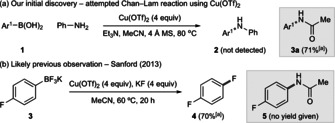
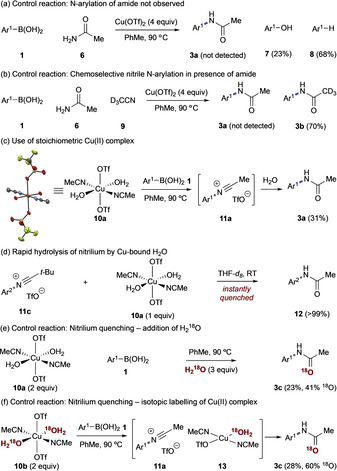
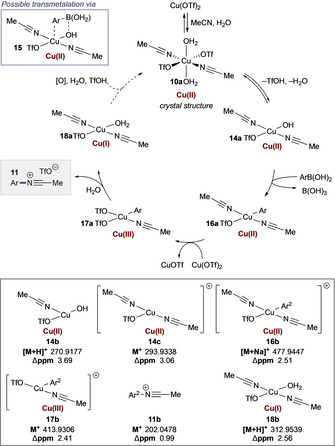
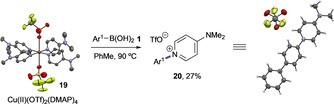
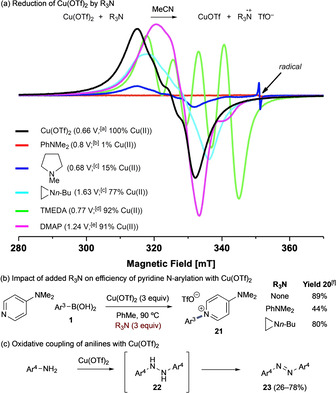
Metal-catalyzed C-N cross-coupling generally forms C-N bonds by reductive elimination from metal complexes bearing covalent C- and N-ligands. We have identified a Cu-mediated C-N cross-coupling that uses a dative N-ligand in the bond-forming event, which, in contrast to conventional methods, generates reactive cationic products. Mechanistic studies suggest the process operates via transmetalation of an aryl organoboron to a Cu complex bearing neutral N-ligands, such as nitriles or N-heterocycles. Subsequent generation of a putative Cu complex enables the oxidative C-N coupling to take place, delivering nitrilium intermediates and pyridinium products. The reaction is general for a range of N(sp) and N(sp ) precursors and can be applied to drug synthesis and late-stage N-arylation, and the limitations in the methodology are mechanistically evidenced.
金属催化的 C-N 交叉偶联通常通过还原消除来形成 C-N 键,其中金属配合物带有共价的 C-和 N-配体。我们已经确定了一种铜介导的 C-N 交叉偶联反应,该反应在键形成过程中使用了配位 N-配体,与传统方法相比,它生成了反应性的阳离子产物。机理研究表明,该过程通过芳基有机硼向带有中性 N-配体(如腈或 N-杂环)的 Cu 配合物的转金属化来进行。随后生成的假定的 Cu 配合物使氧化 C-N 偶联能够发生,生成亚硝鎓中间体和吡啶鎓产物。该反应对一系列 N(sp)和 N(sp2)前体具有普遍性,并可应用于药物合成和晚期 N-芳基化,并且该方法的局限性在机理上得到了证明。