Paris School of Economics and Université Paris 1 Panthéon-Sorbonne, CES, Paris, France.
Department of Economics, University of Alaska Anchorage, Anchorage, Alaska, United States of America.
PLoS One. 2021 Jan 15;16(1):e0244958. doi: 10.1371/journal.pone.0244958. eCollection 2021.
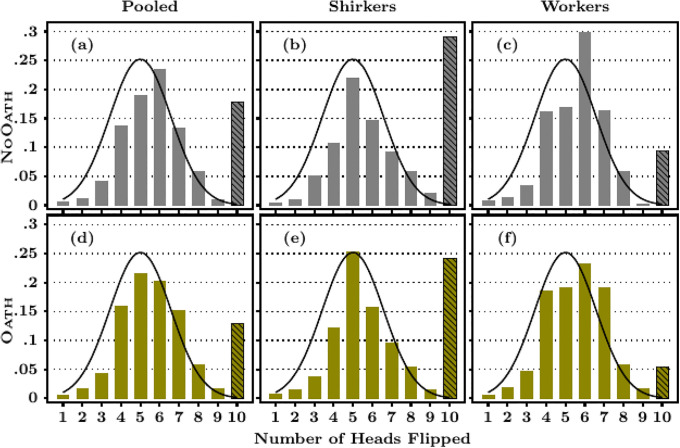
This study explores whether an oath to honesty can reduce both shirking and lying among crowd-sourced internet workers. Using a classic coin-flip experiment, we first confirm that a substantial majority of Mechanical Turk workers both shirk and lie when reporting the number of heads flipped. We then demonstrate that lying can be reduced by first asking each worker to swear voluntarily on his or her honor to tell the truth in subsequent economic decisions. Even in this online, purely anonymous environment, the oath significantly reduced the percent of subjects telling "big" lies (by roughly 27%), but did not affect shirking. We also explore whether a truth-telling oath can be used as a screening device if implemented after decisions have been made. Conditional on flipping response, MTurk shirkers and workers who lied were significantly less likely to agree to an ex-post honesty oath. Our results suggest oaths may help elicit more truthful behavior, even in online crowd-sourced environments.
本研究探讨了宣誓诚实是否可以减少众包互联网工作者的逃避责任和撒谎行为。我们使用经典的抛硬币实验,首先证实大多数 Mechanical Turk 工人在报告抛硬币出现正面的次数时都会逃避责任和撒谎。然后我们证明,通过首先要求每个工人自愿宣誓以诚信为本,在后续的经济决策中说实话,可以减少撒谎行为。即使在这种纯匿名的在线环境中,宣誓也显著降低了说“大”谎的受试者比例(约 27%),但并没有影响逃避责任。我们还探讨了如果在决策后实施,是否可以使用如实宣誓作为筛选工具。在翻转响应的条件下,MTurk 逃避责任者和撒谎者不太可能同意事后诚实宣誓。我们的结果表明,宣誓可能有助于引出更真实的行为,即使是在在线众包环境中。