Center for Outcomes Research and Evaluation, Yale - New Haven Hospital New Haven CT.
Department of Emergency Medicine Yale School of Medicine New Haven CT.
J Am Heart Assoc. 2021 Sep 21;10(18):e021047. doi: 10.1161/JAHA.121.021047. Epub 2021 Sep 13.
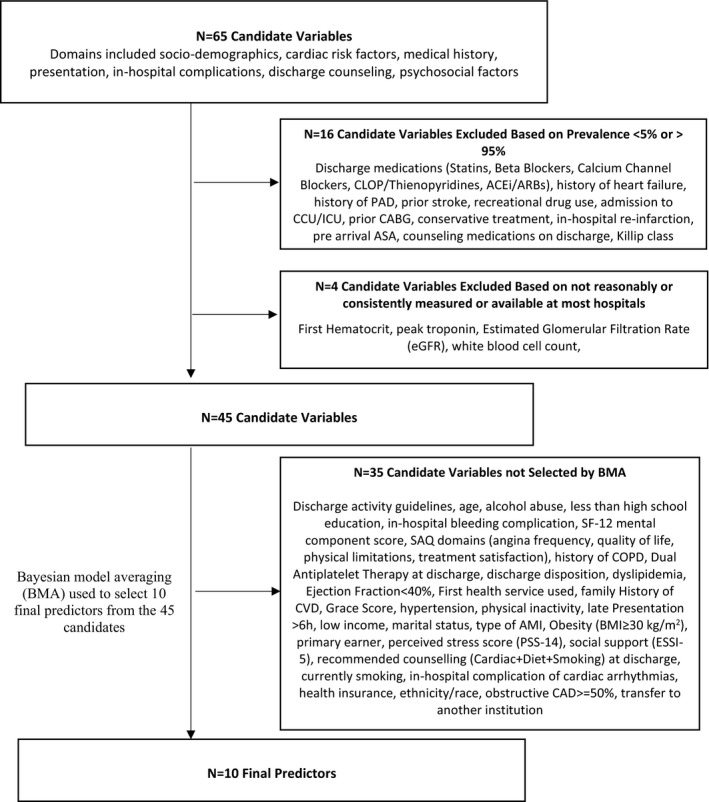
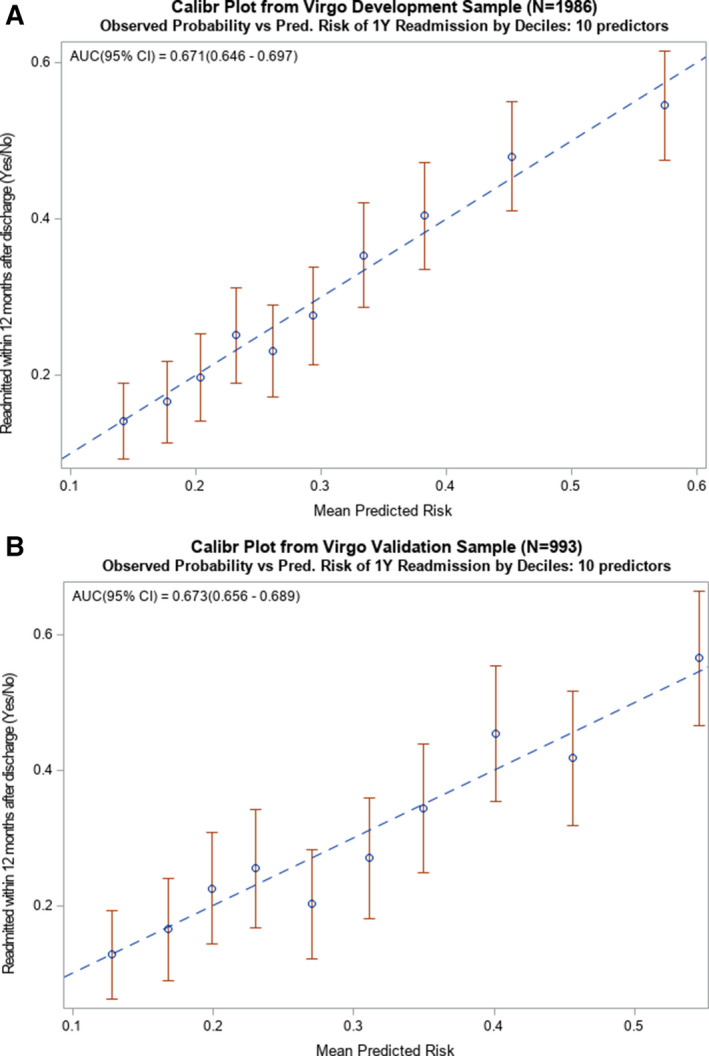
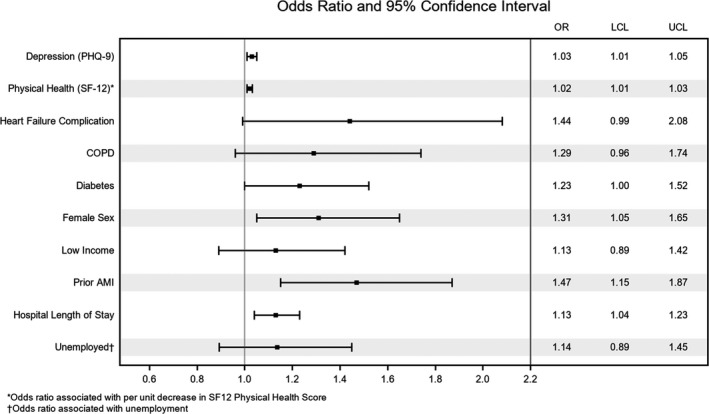
Background Readmission over the first year following hospitalization for acute myocardial infarction (AMI) is common among younger adults (≤55 years). Our aim was to develop/validate a risk prediction model that considered a broad range of factors for readmission within 1 year. Methods and Results We used data from the VIRGO (Variation in Recovery: Role of Gender on Outcomes of Young AMI Patients) study, which enrolled young adults aged 18 to 55 years hospitalized with AMI across 103 US hospitals (N=2979). The primary outcome was ≥1 all-cause readmissions within 1 year of hospital discharge. Bayesian model averaging was used to select the risk model. The mean age of participants was 47.1 years, 67.4% were women, and 23.2% were Black. Within 1 year of discharge for AMI, 905 (30.4%) of participants were readmitted and were more likely to be female, Black, and nonmarried. The final risk model consisted of 10 predictors: depressive symptoms (odds ratio [OR], 1.03; 95% CI, 1.01-1.05), better physical health (OR, 0.98; 95% CI, 0.97-0.99), in-hospital complication of heart failure (OR, 1.44; 95% CI, 0.99-2.08), chronic obstructive pulmomary disease (OR, 1.29; 95% CI, 0.96-1.74), diabetes mellitus (OR, 1.23; 95% CI, 1.00-1.52), female sex (OR, 1.31; 95% CI, 1.05-1.65), low income (OR, 1.13; 95% CI, 0.89-1.42), prior AMI (OR, 1.47; 95% CI, 1.15-1.87), in-hospital length of stay (OR, 1.13; 95% CI, 1.04-1.23), and being employed (OR, 0.88; 95% CI, 0.69-1.12). The model had excellent calibration and modest discrimination (C statistic=0.67 in development/validation cohorts). Conclusions Women and those with a prior AMI, increased depressive symptoms, longer inpatient length of stay and diabetes may be more likely to be readmitted. Notably, several predictors of readmission were psychosocial characteristics rather than markers of AMI severity. This finding may inform the development of interventions to reduce readmissions in young patients with AMI.
背景 在因急性心肌梗死(AMI)住院后的第一年,年轻成年人(≤55 岁)再次入院的情况很常见。我们的目的是开发/验证一种风险预测模型,该模型考虑了一年内再次入院的广泛因素。
方法和结果 我们使用了来自 VIRGO(年轻 AMI 患者的恢复差异:性别对结局的影响)研究的数据,该研究在 103 家美国医院中招募了年龄在 18 至 55 岁之间因 AMI 住院的年轻成年人(N=2979)。主要结局是出院后 1 年内≥1 次全因再次入院。贝叶斯模型平均用于选择风险模型。参与者的平均年龄为 47.1 岁,67.4%为女性,23.2%为黑人。在 AMI 出院后 1 年内,905 名(30.4%)参与者再次入院,且更有可能为女性、黑人且未婚。最终的风险模型由 10 个预测因素组成:抑郁症状(比值比 [OR],1.03;95%置信区间 [CI],1.01-1.05)、更好的身体健康(OR,0.98;95%CI,0.97-0.99)、心力衰竭住院并发症(OR,1.44;95%CI,0.99-2.08)、慢性阻塞性肺疾病(OR,1.29;95%CI,0.96-1.74)、糖尿病(OR,1.23;95%CI,1.00-1.52)、女性(OR,1.31;95%CI,1.05-1.65)、低收入(OR,1.13;95%CI,0.89-1.42)、既往 AMI(OR,1.47;95%CI,1.15-1.87)、住院时间(OR,1.13;95%CI,1.04-1.23)和就业(OR,0.88;95%CI,0.69-1.12)。该模型具有出色的校准度和适度的区分度(开发/验证队列中的 C 统计量为 0.67)。
结论 女性和有既往 AMI、抑郁症状加重、住院时间延长以及糖尿病的患者更有可能再次入院。值得注意的是,再次入院的几个预测因素是社会心理特征,而不是 AMI 严重程度的标志物。这一发现可能为减少年轻 AMI 患者的再入院提供干预措施。