Endocrinology and Nutrition Department, University Hospital Mutua de Terrassa, Terrassa, Spain.
Obstetrics and Gynecology Department, University Hospital Mutua de Terrassa, Terrassa, Spain.
Diabetes Metab J. 2022 Nov;46(6):912-922. doi: 10.4093/dmj.2021.0340. Epub 2022 Apr 29.
This study aimed to evaluate the influence of maternal diabetes in the risk of neurodevelopmental disorders in offspring in the prenatal and postnatal periods.
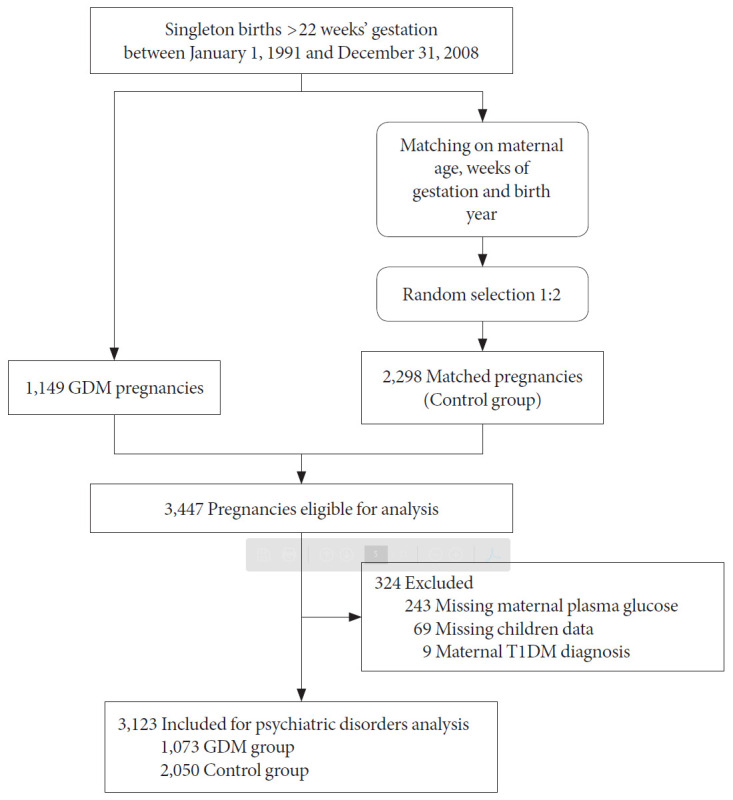
This cohort study included singleton gestational diabetes mellitus (GDM) pregnancies >22 weeks' gestation with live newborns between 1991 and 2008. The control group was randomly selected and matched (1:2) for maternal age, weeks of gestation and birth year. Cox regression models estimated the effect of GDM on the risk of attention-deficit/hyperactivity disorder (ADHD), autism spectrum disorder (ASD), and maternal type 2 diabetes mellitus (T2DM). Moreover, interaction between maternal T2DM and GDM-ADHD relationship was evaluated.
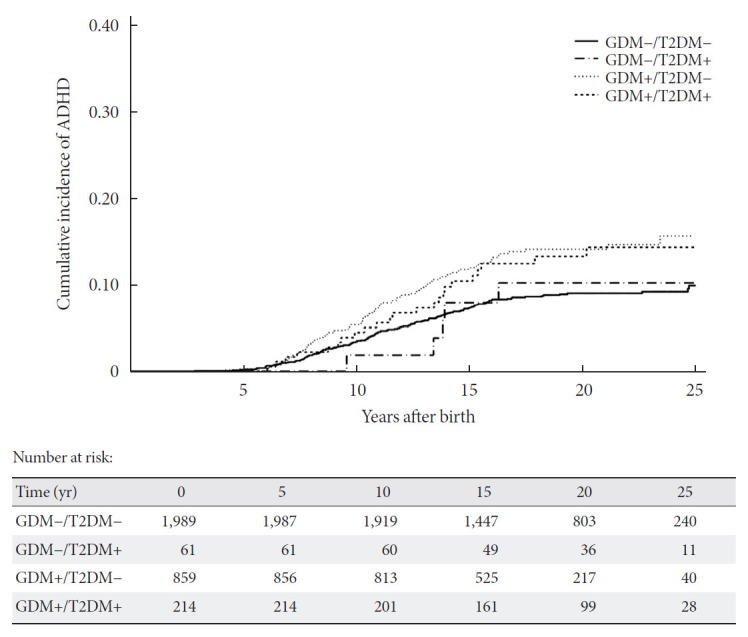
Children (n=3,123) were included (1,073 GDM; 2,050 control group). The median follow-up was 18.2 years (interquartile range, 14.2 to 22.3) (n=323 with ADHD, n=36 with ASD, and n=275 from women who developed T2DM). GDM exposure was associated with ADHD (hazard ratio [HR]crude, 1.67; 95% confidence interval [CI], 1.33 to 2.07) (HRadjusted, 1.64; 95% CI, 1.31 to 2.05). This association remained significant regardless of the treatment (diet or insulin) and diagnosis after 26 weeks of gestation. Children of mothers who developed T2DM presented higher rates of ADHD (14.2 vs. 10%, P=0.029). However, no interaction was found when T2DM was included in the GDM and ADHD models (P>0.05). GDM was not associated with an increased risk of ASD (HRadjusted, 1.46; 95% CI, 0.74 to 2.84).
Prenatal exposure to GDM increases the risk of ADHD in offspring, regardless of GDM treatment complexity. However, postnatal exposure to maternal T2DM was not related to the development of ADHD.
本研究旨在评估母源性糖尿病在产前和产后时期对子代神经发育障碍的风险影响。
本队列研究纳入了 1991 年至 2008 年间大于 22 周妊娠的单胎妊娠糖尿病(GDM)孕妇,并随访其活产儿。对照组随机选择,并按照母亲年龄、孕周和出生年份进行 1:2 匹配。Cox 回归模型评估了 GDM 对子代注意力缺陷/多动障碍(ADHD)、自闭症谱系障碍(ASD)和母亲 2 型糖尿病(T2DM)发病风险的影响。此外,还评估了母亲 T2DM 与 GDM-ADHD 关系之间的交互作用。
共纳入 3123 名儿童(GDM 组 1073 例,对照组 2050 例)。中位随访时间为 18.2 年(四分位间距为 14.2 至 22.3)(ADHD 患儿 323 例,ASD 患儿 36 例,母亲 T2DM 患儿 275 例)。GDM 暴露与 ADHD 相关(粗 HR1.67,95%CI1.33 至 2.07)(调整后 HR1.64,95%CI1.31 至 2.05)。无论治疗(饮食或胰岛素)和孕 26 周后诊断如何,这种关联均具有统计学意义。母亲发生 T2DM 的儿童 ADHD 发生率更高(14.2% vs. 10%,P=0.029)。然而,当将 T2DM 纳入 GDM 和 ADHD 模型时,未发现交互作用(P>0.05)。GDM 与 ASD 风险增加无关(调整后 HR1.46,95%CI0.74 至 2.84)。
产前 GDM 暴露会增加后代发生 ADHD 的风险,无论 GDM 治疗的复杂程度如何。然而,产后母亲 T2DM 暴露与 ADHD 的发生无关。