Department of Otolaryngology-Head and Neck Surgery, Amsterdam UMC, Vrije Universiteit Amsterdam, P.O. Box 7057, 1007, MB, Amsterdam, the Netherlands.
Cancer Center Amsterdam (CCA), Amsterdam, Netherlands.
Support Care Cancer. 2021 Aug;29(8):4473-4483. doi: 10.1007/s00520-020-05932-w. Epub 2021 Jan 17.
To investigate the course of health-related quality of life (HRQOL) from diagnosis to 2 years follow-up among patients with oropharyngeal cancer (OPSCC), in relation to human papilloma virus (HPV) status.
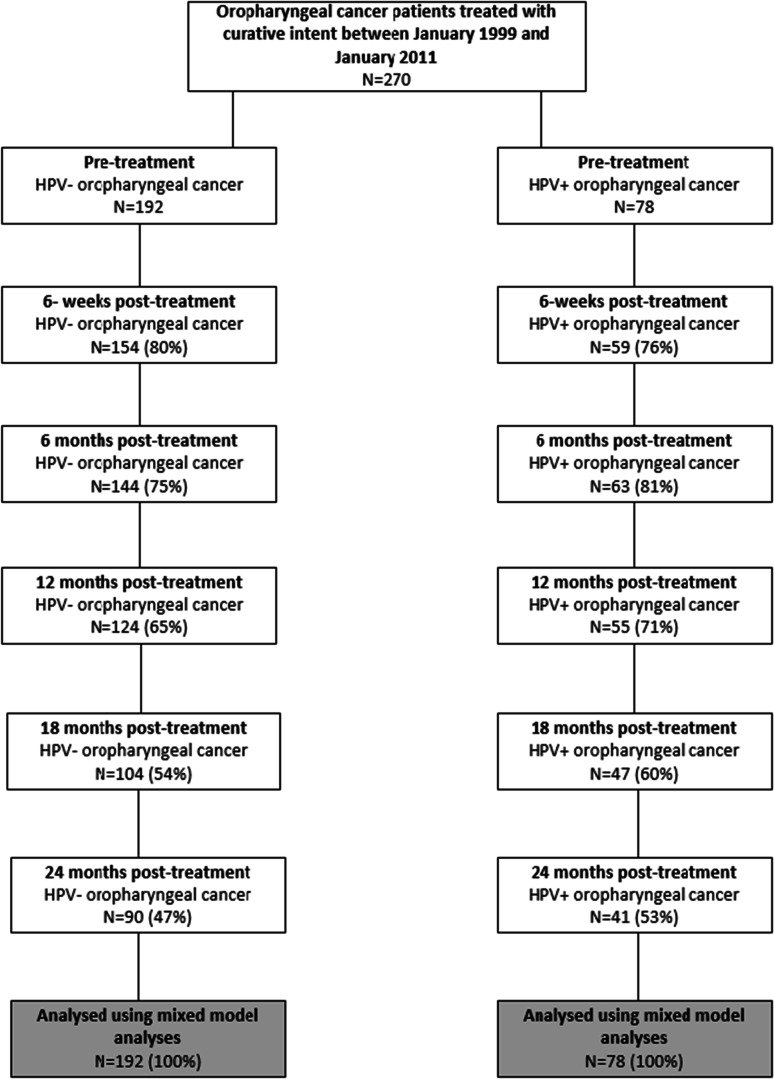
This study included 270 OPSCC patients. Age, sex, tumor sublocation, tumor stage, HPV status, treatment modality, comorbidity, smoking, and alcohol use were retrieved from medical records. HPV status was positive when p16 and HPV DNA tests were both positive. HRQOL was assessed using the EORTC QLQ-C30/QLQ-H&N35 pretreatment and at 6 weeks, 6, 12, 18, and 24 months after treatment. To compare the course of HRQOL between patients with an HPV-positive versus HPV-negative tumor, linear and logistic mixed models were used.
Patients with an HPV-positive tumor (29%) were more often male, diagnosed with a tumor of the tonsil or base of the tongue, treated with single treatment, had fewer comorbidities, were less often current smokers and had lower alcohol consumption. Adjusted for confounders, the course of global quality of life, physical, role, and social functioning, fatigue, pain, insomnia, and appetite loss was significantly different: patients with an HPV-positive tumor scored better before treatment, worsened during treatment, and recovered better and faster at follow-up, compared to patients with an HPV-negative tumor. The course of emotional functioning and oral pain was also significantly different between the two groups, but with other trajectories.
The course of HRQOL is different in patients with an HPV-positive tumor versus an HPV-negative tumor, adjusted for sociodemographic, clinical, and lifestyle confounders.
调查 HPV 状态与口咽癌(OPSCC)患者从诊断到 2 年随访期间健康相关生活质量(HRQOL)的变化过程。
本研究纳入了 270 例 OPSCC 患者。从病历中提取了年龄、性别、肿瘤亚部位、肿瘤分期、HPV 状态、治疗方式、合并症、吸烟和饮酒情况。HPV 状态为 p16 和 HPV DNA 检测均阳性时为阳性。采用 EORTC QLQ-C30/QLQ-H&N35 量表在治疗前、治疗后 6 周、6、12、18 和 24 个月时评估 HRQOL。采用线性和逻辑混合模型比较 HPV 阳性和 HPV 阴性肿瘤患者的 HRQOL 变化过程。
HPV 阳性肿瘤患者(29%)更常见于男性、诊断为扁桃体或舌根肿瘤、采用单一治疗、合并症较少、当前吸烟者较少、饮酒量较低。调整混杂因素后,全球健康状况、身体、角色和社会功能、疲劳、疼痛、失眠和食欲丧失的 HRQOL 变化过程显著不同:与 HPV 阴性肿瘤患者相比,HPV 阳性肿瘤患者在治疗前得分更高,治疗期间恶化更快,随访时恢复更好更快。情绪功能和口腔疼痛的变化过程在两组之间也有显著差异,但轨迹不同。
调整社会人口学、临床和生活方式混杂因素后,HPV 阳性肿瘤患者的 HRQOL 变化过程与 HPV 阴性肿瘤患者不同。