Department of Psychology, Faculty of Science, Memorial University, St. John's, Newfoundland, Canada.
Discipline of Oncology, Faculty of Medicine, Memorial University, St. John's, Newfoundland, Canada.
Cancer Med. 2021 Feb;10(4):1191-1200. doi: 10.1002/cam4.3715. Epub 2021 Jan 16.
Women with breast cancer are more likely to develop cognitive impairment (CI), insomnia, fatigue, and mood disturbance than individuals with other cancers. The main objectives of this study were to establish the prevalence of CI and examine the relationships between CI, insomnia, fatigue, and mood over the first year of breast cancer treatment.
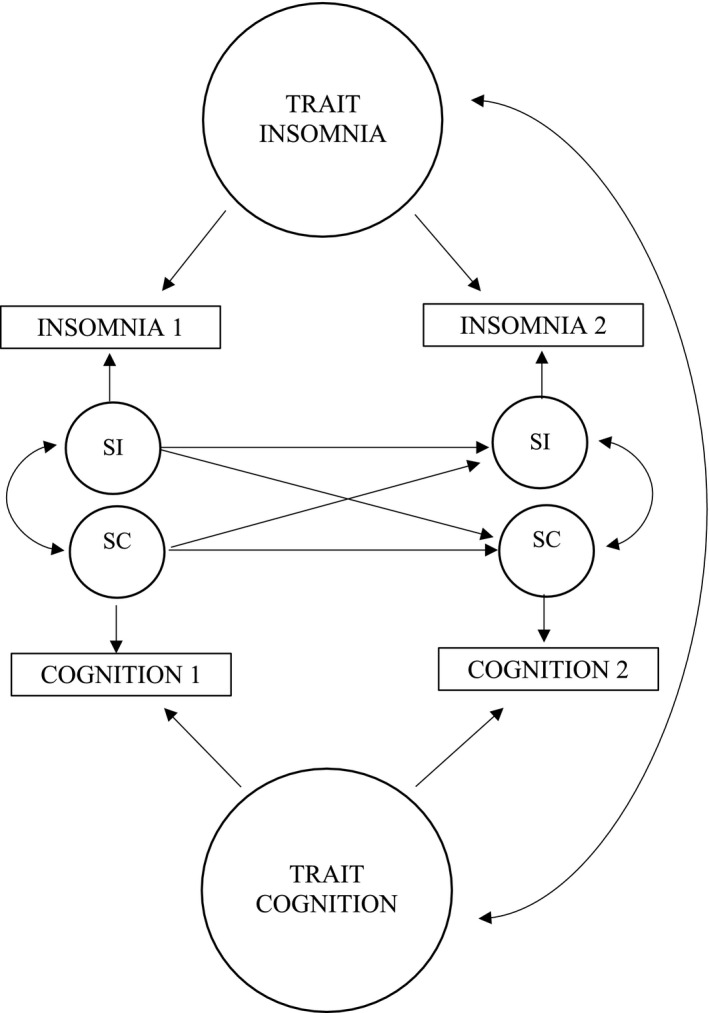
Participants were recruited after diagnosis and completed validated measures of insomnia, objective and perceived CI, fatigue, and mood disturbance at four time points during the first year of treatment. A random intercepts cross-lagged panel model assessed relationships among symptoms over time.
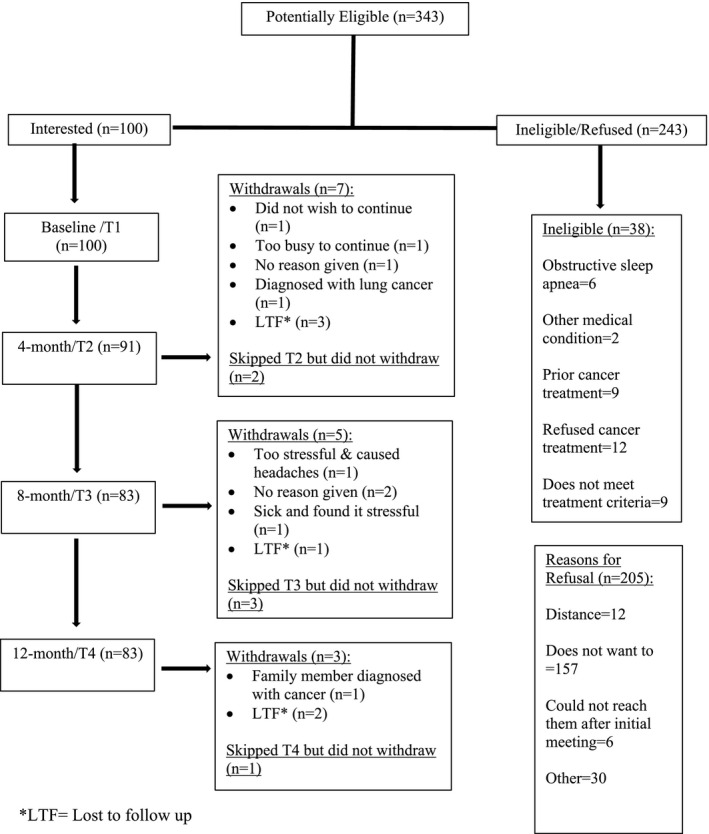
The sample included 98 women. Prevalence of objective CI ranged from 3.1% to 8.2% throughout the year, whereas 36.7% demonstrated a clinically meaningful decline in perceived CI from baseline to 4 months, which remained relatively stable. Greater perceived CI was associated with more fatigue (β = -0.78, z = 17.48, p < .01) and symptoms of insomnia (β = -0.58, z = 5.24, p < .01). Short-term fluctuations in perceived CI (p < .05), but not fatigue or insomnia, predicted future perceived CI. Fatigue (p < .001) was a significant predictor of future reported symptoms of fatigue and insomnia.
Subjective CI is more prevalent than objective impairments. Fatigue, insomnia, and perceived CI remain stable and are associated during the first year of treatment. Changes in insomnia and fatigue may have little effect on future perceived cognition. Women with breast cancer likely require targeted intervention for these side effects.
相较于其他癌症患者,乳腺癌女性更易出现认知障碍(CI)、失眠、疲劳和情绪紊乱。本研究的主要目的是确定 CI 的流行率,并研究 CI、失眠、疲劳和情绪在乳腺癌治疗的第一年中彼此之间的关系。
参与者在确诊后入组,并在治疗开始后的一年内的四个时间点完成失眠、客观和主观 CI、疲劳和情绪紊乱的有效评估量表。随机截距交叉滞后面板模型评估了各症状随时间的关系。
该样本共纳入 98 名女性。在治疗期间,客观 CI 的患病率从 3.1%至 8.2%不等,而 36.7%的患者从基线到 4 个月时表现出明显的主观 CI 下降,此后该值相对稳定。更大程度的主观 CI 与更多的疲劳(β=-0.78,z=17.48,p<.01)和失眠症状(β=-0.58,z=5.24,p<.01)相关。主观 CI 的短期波动(p<.05)而非疲劳或失眠,可预测未来的主观 CI。疲劳(p<.001)是未来报告的疲劳和失眠症状的显著预测因素。
主观 CI 比客观损伤更为常见。疲劳、失眠和主观 CI 在治疗的第一年保持稳定并相互关联。失眠和疲劳的变化可能对未来的认知功能影响较小。乳腺癌女性可能需要针对这些副作用进行有针对性的干预。