Legatowicz-Koprowska Marta, Nitek Stanisław, Czerwińska Jolanta
Department of Pathology, National Institute of Geriatrics, Rheumatology and Rehabilitation, Warsaw, Poland.
Department of Otolaryngology, Medical University of Warsaw, Poland.
Reumatologia. 2020;58(6):357-366. doi: 10.5114/reum.2020.102000. Epub 2020 Dec 23.
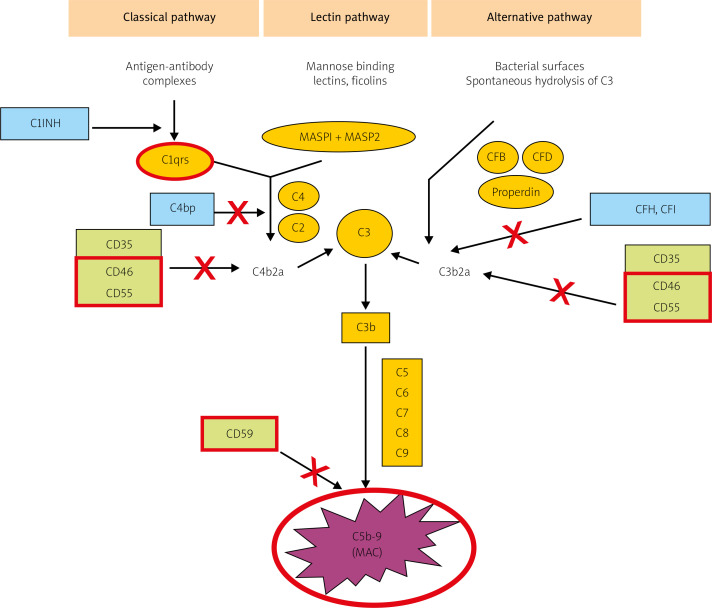
The complement cascade and regulatory proteins are involved in the pathogenesis of the Sjögren's syndrome and other autoimmune diseases. The complement activation via the alternative pathway was recognized as a major pathogenic mechanism in autoimmune conditions. The aim of this study was to assess expression of complement cascade components and regulatory proteins in minor salivary glands in patients with primary Sjögren's syndrome (pSS).
The expression of C1q and C5b-9 - membrane attack complex and regulatory proteins such as: membrane cofactor protein (MCP), decay-accelerating factor (DAF) and protectin were examined using immunochemistry method in specimens from biopsy of minor salivary glands in pSS patients. The biopsy material was obtained from 20 pSS patients, 5 patients with non-specific sialadenitis and from 5 patients with suspicion of dryness syndrome without sialadenitis confirmation.
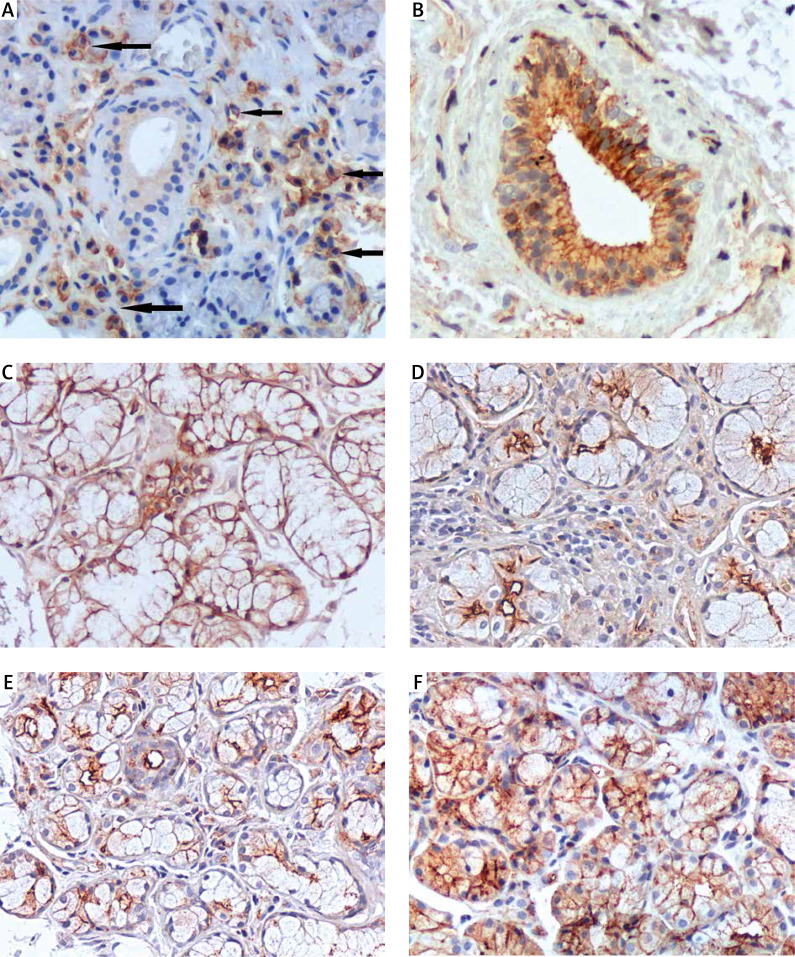
None of the examined samples showed the expression of C1q or the effector C5b-9. Membrane cofactor protein expression was lower in pSS group than in both non-specific sialadenitis and noninflamed salivary glands. The inflammatory cells in pSS samples partially expressed MCP. There were differences in the sites and intensity of membrane protectin expression exclusively on the luminal surfaces in pSS; on the luminal and, partially, antiluminal surface in non-specific inflammation, and on the entire cell surface in unaffected salivary glands. There were no DAF expression in salivary gland tissue in biopsy specimens in all studied subjects.
The study demonstrated the absence of complement-cascade proteins (C1q, MAC) in the salivary glands of pSS patients, which may indicated a lack of local complement activation via the classical pathway and the observed gland tissue damage being due to a mechanism other than MAC-induced cytolysis. The differences in the expression of complement regulatory proteins between pSS, non-specific sialadenitis, and normal salivary glands may indicate that alternative functions of these regulatory proteins may be of greater significance in pSS. Low MCP expression in pSS in comparison with non-specific sialadenitis and normal salivary glands, may suggest altered modulation of cell-mediated immunity in pSS. The differences in the location and intensity of protectin (CD59) expression indicates a possibility of reducing the proinflammatory effect of protectin in pSS.
补体级联反应和调节蛋白参与干燥综合征及其他自身免疫性疾病的发病机制。通过替代途径的补体激活被认为是自身免疫性疾病中的主要致病机制。本研究的目的是评估原发性干燥综合征(pSS)患者小唾液腺中补体级联成分和调节蛋白的表达。
采用免疫化学方法检测pSS患者小唾液腺活检标本中C1q和C5b - 9(膜攻击复合物)以及调节蛋白如膜辅助蛋白(MCP)、衰变加速因子(DAF)和保护素的表达。活检材料取自20例pSS患者、5例非特异性涎腺炎患者以及5例疑似干燥综合征但未经涎腺炎确诊的患者。
所有检测样本均未显示C1q或效应分子C5b - 9的表达。pSS组中膜辅助蛋白的表达低于非特异性涎腺炎组和未发炎的唾液腺组。pSS样本中的炎性细胞部分表达MCP。pSS中保护素表达的部位和强度存在差异,仅在管腔表面表达;在非特异性炎症中在管腔和部分反管腔表面表达,而在未受影响的唾液腺中在整个细胞表面表达。所有研究对象的活检标本唾液腺组织中均未检测到DAF表达。
该研究表明pSS患者唾液腺中不存在补体级联蛋白(C1q、MAC),这可能表明缺乏通过经典途径的局部补体激活,且观察到的腺体组织损伤是由MAC诱导的细胞溶解以外的机制引起的。pSS、非特异性涎腺炎和正常唾液腺之间补体调节蛋白表达的差异可能表明这些调节蛋白的其他功能在pSS中可能具有更重要的意义。与非特异性涎腺炎和正常唾液腺相比,pSS中MCP表达较低,这可能提示pSS中细胞介导免疫的调节发生了改变。保护素(CD59)表达的位置和强度差异表明pSS中保护素的促炎作用可能降低。