Hwang Nicky, Ban Haiqun, Chen Junjun, Ma Julia, Liu Hui, Lam Patrick, Kulp John, Menne Stephan, Chang Jinhong, Guo Ju-Tao, Du Yanming
Baruch S. Blumberg Institute, 3805 Old Easton Road, Doylestown, PA 18902 USA.
Renji Hospital Affiliated to Shanghai Jiaotong University School of Medicine, 1630 Dongfang Road, Shanghai, 200127 Pudong New District China.
Med Chem Res. 2021;30(2):459-472. doi: 10.1007/s00044-020-02677-3. Epub 2021 Jan 11.
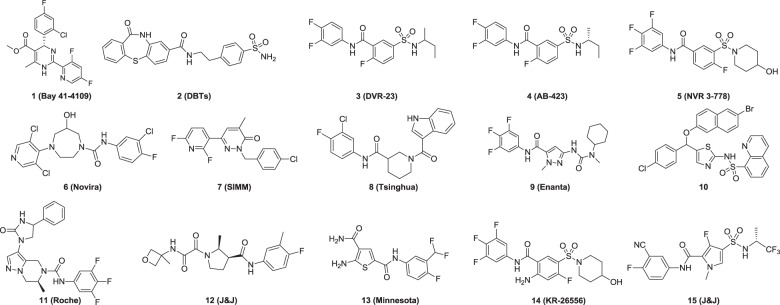
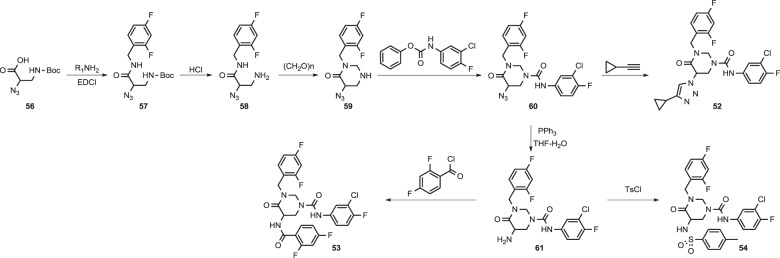
We report herein the synthesis and evaluation of phenyl ureas derived from 4-oxotetrahydropyrimidine as novel capsid assembly modulators of hepatitis B virus (HBV). Among the derivatives, compound () and several analogs showed an activity of submicromolar EC against HBV and low cytotoxicities (>50 μM). Structure-activity relationship studies revealed a tolerance for an additional group at position 5 of 4-oxotetrahydropyrimidine. The mechanism study indicates that compound () is a type II core protein allosteric modulator (CpAMs), which induces core protein dimers to assemble empty capsids with fast electrophoresis mobility in native agarose gel. These compounds may thus serve as leads for future developments of novel antivirals against HBV.
我们在此报告了源自4-氧代四氢嘧啶的苯基脲类化合物的合成及评估,这些化合物作为新型乙型肝炎病毒(HBV)衣壳组装调节剂。在这些衍生物中,化合物()及几种类似物对HBV表现出亚微摩尔级的半数有效浓度(EC)活性且细胞毒性较低(>50 μM)。构效关系研究表明,4-氧代四氢嘧啶5位上可耐受一个额外基团。机制研究表明化合物()是一种II型核心蛋白变构调节剂(CpAMs),其可诱导核心蛋白二聚体在天然琼脂糖凝胶中组装成具有快速电泳迁移率的空衣壳。因此,这些化合物可能成为未来开发新型抗HBV药物的先导化合物。