Thadchanamoorthy V, Thirukumar Markandu, Dayasiri Kavinda, Thamilvannan N, Jeyakumar Judy
Faculty of Health Care Sciences, Eastern University, Sri Lanka.
Base Hospital, Mahaoya, Sri Lanka.
Case Rep Dermatol Med. 2020 Dec 8;2020:6615250. doi: 10.1155/2020/6615250. eCollection 2020.
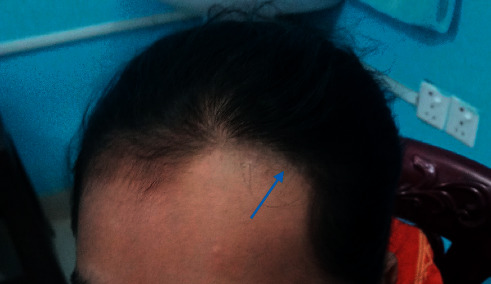
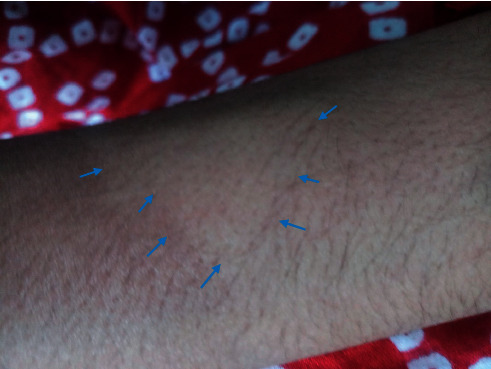
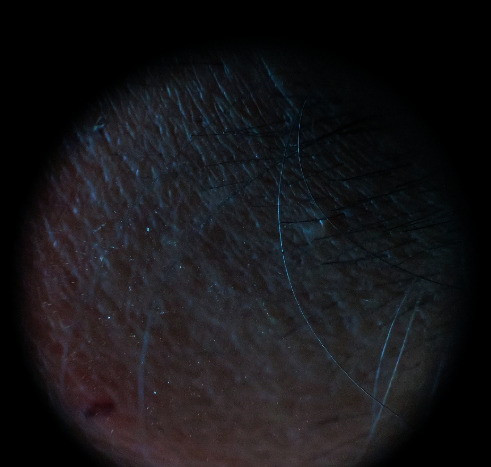
Trichotemnomania (TT) refers to cutting or shaving of one's own hair as a compulsive act. This condition is reported rarely and may be indicative of an underlying obsessive-compulsive disorder. TT may be misdiagnosed with trichotillomania or other disorders such as alopecia areata, tinea capitis, and postinflammatory scars. The diagnosis of trichotemnomania is confirmed by dermoscopic assessment, histopathological changes of hair, and correlation of these findings with clinical history. A fourteen-year-old adolescent girl presented with focal hair loss over forehead for duration of two-weeks and periodic abnormal breathing and poor sleep for 2-month duration. Besides, she had also lost some of pubic hair and hair on the forearm over preceding 24 hours. This patient was assessed by a team including a paediatrician, gynecologist, dermatologist, and psychiatrist to gather focused medical history and to perform physical examination, laboratory investigations, and dermoscopic assessment. It was revealed that she used to shave or cut regularly following stressful situations across various aspects of her life and hyperventilate as a means of relieving her stress. Eventually, she was diagnosed to have trichotemnomania and was started oral sertraline 50 mg/day for one month. Clinical features and her behaviour improved with regular cognitive behavioural therapy, and hairs were demonstrated to grow up normally with change in behaviour. Currently, she does well at school and is off medications and being followed up at the child guidance clinic. Trichotemnomania is a very rare disorder which is characterised by cutting or shaving of one's own hairs as a compulsive habit. The condition needs careful and detailed assessment by a team of specialists to identify coexisting psychiatric disorders and offer treatment.
拔毛癖(TT)是指将自己的头发剃掉或剪掉作为一种强迫行为。这种情况很少被报道,可能提示存在潜在的强迫症。TT可能会被误诊为拔毛症或其他疾病,如斑秃、头癣和炎症后瘢痕。拔毛癖的诊断通过皮肤镜评估、毛发的组织病理学变化以及这些发现与临床病史的相关性来确定。一名14岁的青春期女孩前额出现局部脱发两周,并有周期性异常呼吸和睡眠不佳两个月。此外,在之前的24小时内,她还掉了一些阴毛和前臂上的毛发。该患者由包括儿科医生、妇科医生、皮肤科医生和精神科医生在内的团队进行评估,以收集详细的病史并进行体格检查、实验室检查和皮肤镜评估。结果显示,她在生活的各个方面遇到压力情况后,经常会剃毛或剪发,并通过过度换气来缓解压力。最终,她被诊断为拔毛癖,并开始每天口服50毫克舍曲林,持续一个月。通过定期的认知行为疗法,临床症状和她的行为得到改善,毛发也随着行为的改变而正常生长。目前,她在学校表现良好,已停药,并在儿童指导诊所接受随访。拔毛癖是一种非常罕见的疾病,其特征是将自己的头发剃掉或剪掉作为一种强迫习惯。这种情况需要由一组专家进行仔细和详细的评估,以识别并存的精神疾病并提供治疗。