Stathi Afroditi, Withall Janet, Agyapong-Badu Sandra, Barrett Eva, Kritz Marlene, Wills Debbie, Thogersen-Ntoumani Cecilie, Fox Kenneth R
School of Sport, Exercise and Rehabilitation Sciences, University of Birmingham, Birmingham, UK.
Department for Health, University of Bath, Bath, UK.
BMC Public Health. 2021 Jan 18;21(1):150. doi: 10.1186/s12889-020-10136-2.
Successful peer volunteering is central to many community-based, active ageing initiatives. This study synthesises the perspectives of a range of stakeholders involved in peer volunteering initiatives and provides recommendations as to how peer volunteers can be effectively mobilised as community assets.
An evidence synthesis of qualitative data from (a) the evaluation of ACE (Active, Connected, Engaged), a feasibility trial of a peer volunteering active ageing intervention, and (b) interviews with volunteers and managers of third sector organisations providing peer volunteering programmes. Data were analysed using directed content analysis.
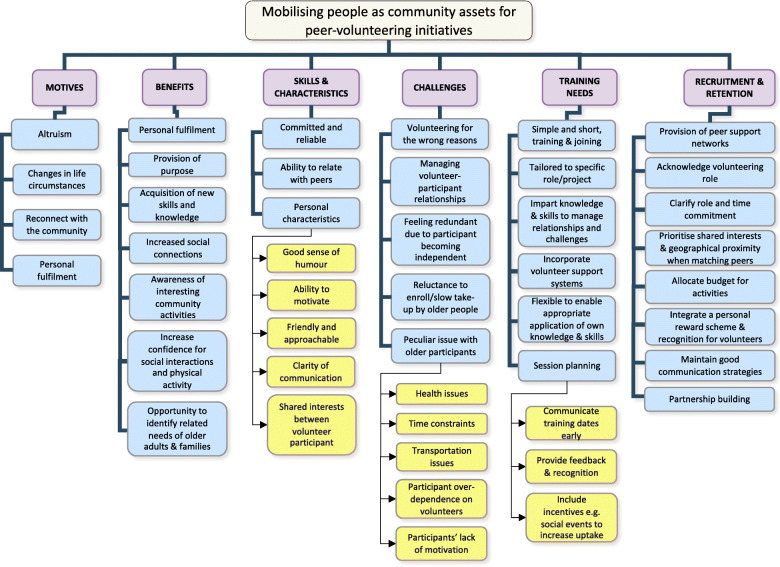
Ten managers, 22 volunteers and 20 ACE participants were interviewed. The analysis identified six main themes, 33 higher and 22 sub themes. Main themes were: (i) Motives, (ii) Benefits, (iii) Skills and Characteristics, (iv) Challenges, (v) Training Needs, (vi) Recruitment and Retention. Altruism, changes in life circumstances, opportunities to reconnect with the community and personal fulfilment were the main reasons for volunteering. Volunteering was described as being personally rewarding, an avenue to acquire new skills and knowledge, and an opportunity for increased social connections and physical activity. Good peer volunteers are committed, reliable, have a good sense of humour, good interpersonal skills and are able to relate to participants. When pairing volunteers with participants, shared interests and geographical proximity are important to consider. Clarity of role, level of time commitment, regular feedback, recognition of effort and strong networks for on-going support are important strategies to facilitate volunteer retention.
The findings of this study support the value of peer volunteering as a strategy for mobilising community assets in promoting active ageing. To ensure success and longevity, these schemes require appropriate funding and efficient administrative support.
成功的同伴志愿服务是许多基于社区的积极老龄化倡议的核心。本研究综合了参与同伴志愿服务倡议的一系列利益相关者的观点,并就如何有效调动同伴志愿者作为社区资产提供了建议。
对以下定性数据进行证据综合:(a)对ACE(积极、有联系、有参与度)的评估,这是一项同伴志愿服务积极老龄化干预的可行性试验;(b)对提供同伴志愿服务项目的第三部门组织的志愿者和管理人员的访谈。使用定向内容分析法对数据进行分析。
采访了10名管理人员、22名志愿者和20名ACE参与者。分析确定了六个主要主题、33个更高层次主题和22个子主题。主要主题为:(i)动机;(ii)益处;(iii)技能和特征;(iv)挑战;(v)培训需求;(vi)招募和留用。利他主义、生活环境的变化、与社区重新建立联系的机会和个人成就感是志愿服务的主要原因。志愿服务被描述为个人有回报的、获得新技能和知识的途径,以及增加社交联系和体育活动的机会。优秀的同伴志愿者有奉献精神、可靠、有良好的幽默感、良好的人际交往能力,并且能够与参与者建立联系。在将志愿者与参与者配对时,共同兴趣和地理位置接近是重要的考虑因素。角色明确、时间投入程度、定期反馈、对努力的认可和持续支持的强大网络是促进志愿者留用的重要策略。
本研究结果支持同伴志愿服务作为一种在促进积极老龄化中调动社区资产的策略的价值。为确保成功和长期实施,这些计划需要适当的资金和高效的行政支持。