Vector Biology Department, Liverpool School of Tropical Medicine, Pembroke Place, Liverpool, L3 5QA, UK.
Institute of Biodiversity, Animal Health and Comparative Medicine, University of Glasgow, Glasgow, UK.
Malar J. 2021 Jan 18;20(1):44. doi: 10.1186/s12936-020-03538-5.
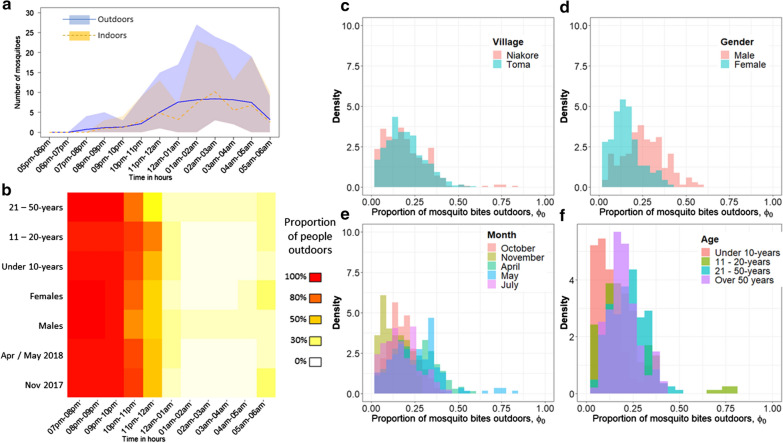
The Cascades region, Burkina Faso, has a high malaria burden despite reported high insecticide-treated mosquito net (ITN) use. Human and vector activities outside the hours when indoor interventions offer direct protection from infectious bites potentially increase exposure risk to bites from malaria-transmitting Anopheles mosquitoes. This work investigated the degree of variation in human behaviour both between individuals and through time (season) to quantify how it impacts exposure to malaria vectors.
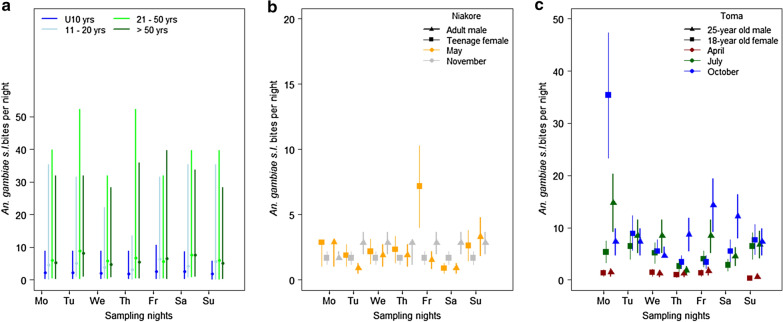
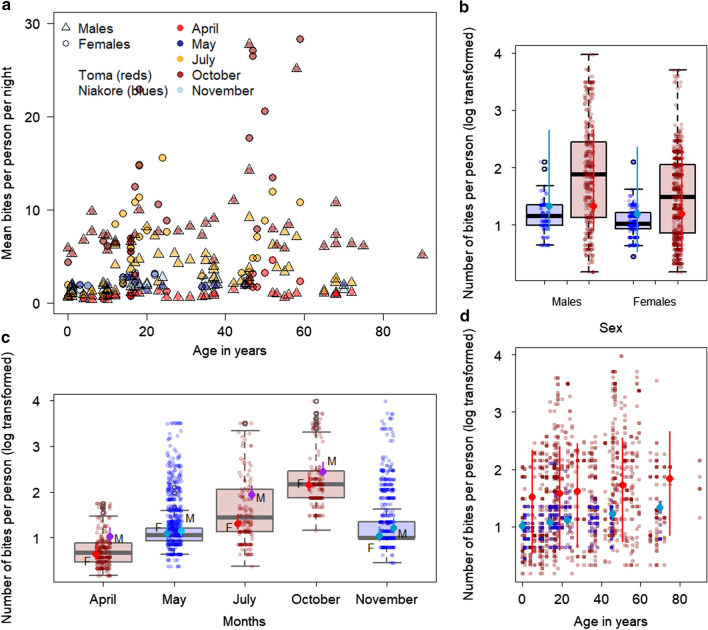
Patterns in human overnight activity (18:00-06:00) to quantify time spent using an ITN across 7 successive nights in two rural communities, Niakore (N = 24 participants) and Toma (71 participants), were observed in the dry and rainy seasons, between 2017 and 2018. Hourly human landing Anopheles mosquito catches were conducted in Niakore specifically, and Cascades region generally, between 2016 and 2017. Data were statistically combined to estimate seasonal variation in time spent outdoors and Anopheles bites received per person per night (bpppn).
Substantial variability in exposure to outdoor Anopheles bites was detected within and between communities across seasons. In October, when Anopheles densities are highest, an individual's risk of Anopheles bites ranged from 2.2 to 52.2 bites per person per night (bpppn) within the same week with variable risk dependent on hours spent indoors. Comparably higher outdoor human activity was observed in April and July but, due to lower Anopheles densities estimated, bpppn were 0.2-4.7 and 0.5-32.0, respectively. Males and people aged over 21 years were predicted to receive more bites in both sentinel villages.
This work presents one of the first clear descriptions of the degree of heterogeneity in time spent outdoors between people and across the year. Appreciation of sociodemographic, cultural and entomological activities will help refine approaches to vector control.
布基纳法索的 Cascades 地区疟疾负担很高,尽管报告称使用了大量经杀虫剂处理的蚊帐(ITN)。在室内干预措施提供免受传染性叮咬的直接保护之外的时间,人和蚊子的活动可能会增加感染疟疾传播的按蚊的叮咬风险。这项工作调查了个人之间以及随时间(季节)变化的人类行为变化程度,以量化其对疟疾媒介暴露的影响。
在 2017 年至 2018 年期间,在两个农村社区 Niakore(N=24 名参与者)和 Toma(71 名参与者)中观察了干季和雨季中 7 个连续夜晚的人类夜间活动(18:00-06:00)模式,以量化每晚使用 ITN 的时间。特别是在 Niakore 进行了每小时人类降落的按蚊捕获,并且在 Cascades 地区进行了一般捕获,时间为 2016 年至 2017 年。将数据进行统计学组合,以估计每人每晚户外和按蚊叮咬的时间(bpppn)的季节性变化。
在季节内和社区之间,检测到户外按蚊叮咬的暴露存在很大差异。在 10 月,当按蚊密度最高时,同一周内,一个人的按蚊叮咬风险范围为每人每晚 2.2 至 52.2 次(bpppn),取决于室内停留时间,风险各不相同。4 月和 7 月观察到更高的户外人类活动,但由于估计的按蚊密度较低,bpppn 分别为 0.2-4.7 和 0.5-32.0。在两个哨点村庄中,男性和年龄超过 21 岁的人预计会收到更多的叮咬。
这项工作首次清楚地描述了人与人之间以及全年户外时间的异质性程度。对社会人口学、文化和昆虫学活动的了解将有助于改进蚊虫控制方法。