
蚊虫的取食行为及其对非洲各地疟疾残留传播的影响。
Mosquito feeding behavior and how it influences residual malaria transmission across Africa.
机构信息
MRC Centre for Global Infectious Disease Analysis, Department of Infectious Disease Epidemiology, Imperial College London, W2 1PG London, United Kingdom;
MRC Centre for Global Infectious Disease Analysis, Department of Infectious Disease Epidemiology, Imperial College London, W2 1PG London, United Kingdom.
出版信息
Proc Natl Acad Sci U S A. 2019 Jul 23;116(30):15086-15095. doi: 10.1073/pnas.1820646116. Epub 2019 Jul 8.
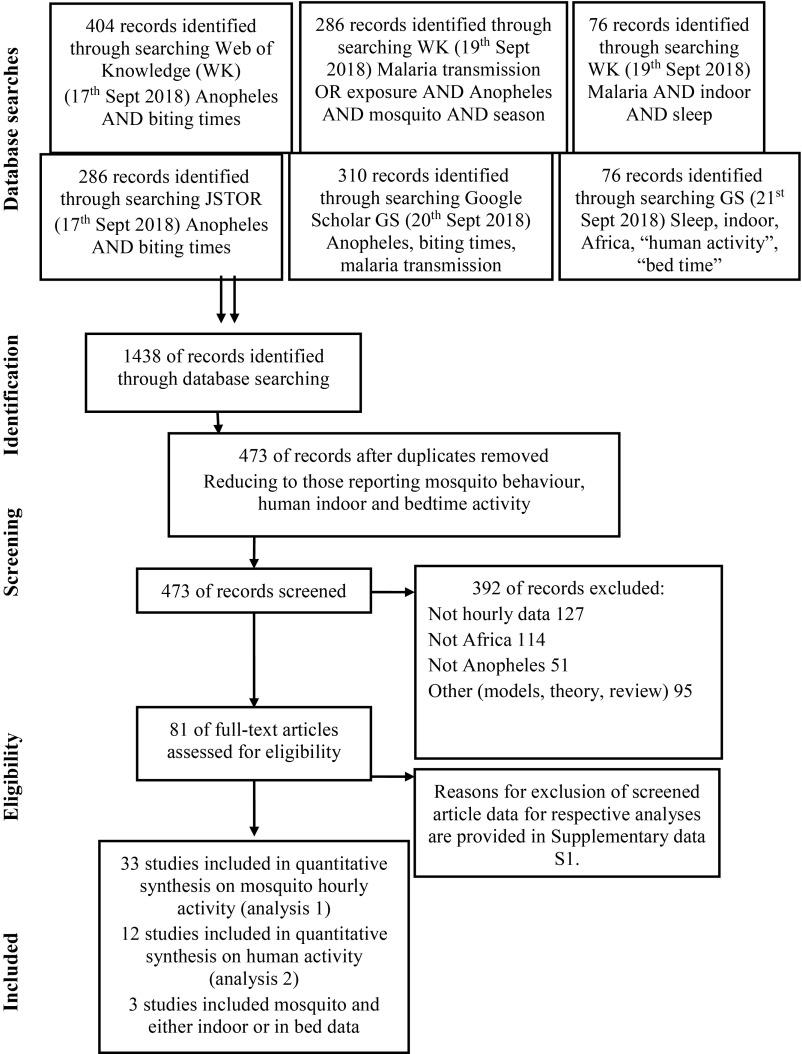
The antimalarial efficacy of the most important vector control interventions-long-lasting insecticidal nets (LLINs) and indoor residual spraying (IRS)-primarily protect against mosquitoes' biting people when they are in bed and indoors. Mosquito bites taken outside of these times contribute to residual transmission which determines the maximum effectiveness of current malaria prevention. The likelihood mosquitoes feed outside the time of day when LLINs and IRS can protect people is poorly understood, and the proportion of bites received outdoors may be higher after prolonged vector control. A systematic review of mosquito and human behavior is used to quantify and estimate the public health impact of outdoor biting across Africa. On average 79% of bites by the major malaria vectors occur during the time when people are in bed. This estimate is substantially lower than previous predictions, with results suggesting a nearly 10% lower proportion of bites taken at the time when people are beneath LLINs since the year 2000. Across Africa, this higher outdoor transmission is predicted to result in an estimated 10.6 million additional malaria cases annually if universal LLIN and IRS coverage was achieved. Higher outdoor biting diminishes the cases of malaria averted by vector control. This reduction in LLIN effectiveness appears to be exacerbated in areas where mosquito populations are resistant to insecticides used in bed nets, but no association was found between physiological resistance and outdoor biting. Substantial spatial heterogeneity in mosquito biting behavior between communities could contribute to differences in effectiveness of malaria control across Africa.
长效驱虫蚊帐(LLINs)和室内滞留喷洒(IRS)等最重要的病媒控制干预措施的抗疟效果主要是在蚊子叮咬人们睡觉时和在室内时提供保护。在这些时间之外被蚊子叮咬会导致残留传播,这决定了当前疟疾预防的最大效果。人们对蚊子在 LLINs 和 IRS 无法保护人们的时间之外叮咬的可能性知之甚少,并且在长期病媒控制之后,户外叮咬的比例可能更高。对蚊子和人类行为的系统审查用于量化和估计非洲各地户外叮咬对公共卫生的影响。平均而言,主要疟疾传播媒介的叮咬有 79%发生在人们在床上的时候。这一估计值大大低于以前的预测,结果表明,自 2000 年以来,在人们使用 LLIN 下的时间里,叮咬的比例几乎降低了 10%。在整个非洲,如果普遍实现 LLIN 和 IRS 覆盖率,这一更高的户外传播预计每年将导致额外 1060 万例疟疾病例。户外叮咬率较高会降低病媒控制避免的疟疾病例数。这种 LLIN 效果的降低似乎在蚊子种群对用于蚊帐的杀虫剂具有生理抗性的地区更为严重,但在生理抗性与户外叮咬之间没有发现关联。社区之间蚊子叮咬行为的大量空间异质性可能导致非洲各地疟疾控制效果的差异。



 Zotero 插件