Esayas Endashaw, Gowelo Steven, Assefa Muluken, Vajda Elodie A, Thomsen Edward, Getachew Asefaw, Ashine Temesgen, Mekonnen Getachew, Ntuku Henry, Bennett Adam, Golassa Lemu, Lobo Neil F, Gadisa Endalamaw
Aklilu Lemma Institute of Pathobiology, Addis Ababa University, Addis Ababa, Ethiopia.
Malaria and Neglected Tropical Diseases Research Division, Armauer Hansen Research Institute, Addis Ababa, Ethiopia.
Parasit Vectors. 2024 Dec 18;17(1):520. doi: 10.1186/s13071-024-06607-9.
Ethiopia continues to grapple with a persistent malaria burden, characterized by ongoing transmission and recurrent outbreaks. Human behavior influences both malaria exposure and the effectiveness of vector interventions, complicating malaria control efforts. Implementing tailored strategies that account for the complex interplay between human activities and vector behavior remains a challenge in both high- and low-transmission areas in Ethiopia, particularly for vulnerable highland populations and temporary labor migrants, due to lack of data. The aim of this study was to examine the spatiotemporal patterns of human-mosquito interactions and evaluate the effectiveness and suitability of long-lasting insecticidal nets (LLINs) in settings involving lowland resident populations, seasonal migrant workers and highland communities.
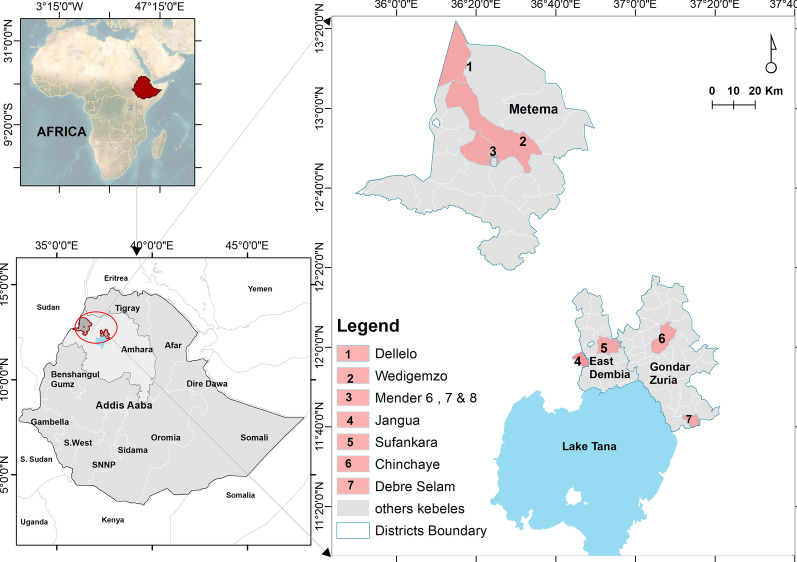
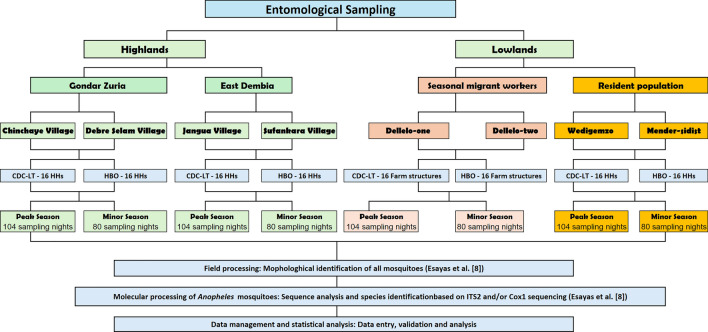
Concurrent human and vector behavior data were collected from high-transmission lowlands (residents and temporary migrant workers) and vulnerable highlands populations. Hourly human behavior observations (HBOs), which examined LLIN use, indoor versus outdoor human presence and sleeping patterns, were paired in a crossover design with mosquito sampling using US Centers for Disease Control light traps (CDC LT) as a proxy for mosquito biting behavior. The study was conducted during the peak (October-December 2022) and minor (March-May 2023) malaria transmission seasons ('peak' and 'minor') for a total of 368 nights. In the highlands, four villages consisting of eight households per village were selected for surveillance; in the lowlands, four villages consisting of two resident villages and two farm sites with migrant workers, with eight households/structures per village or farm, were used for data collection. CDC LT and HBO data were integrated to evaluate HBO-adjusted human biting rates (HBO-adjusted HBR) of Anopheles mosquitoes.
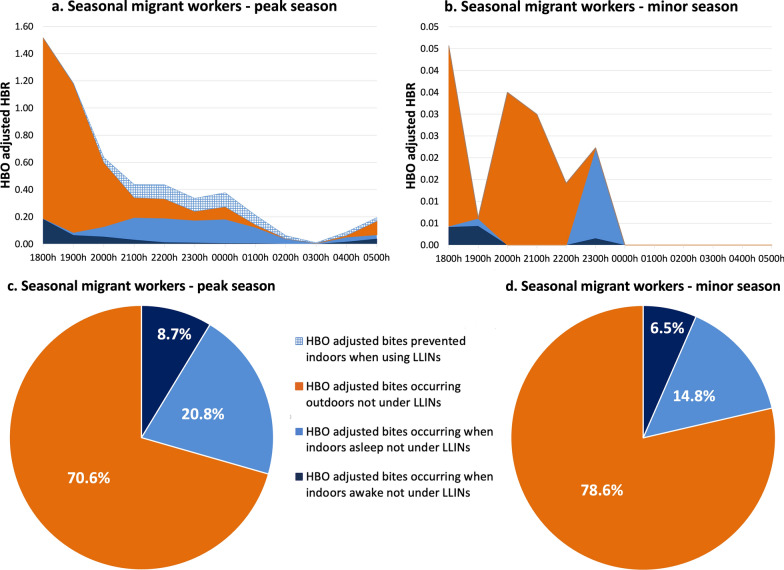
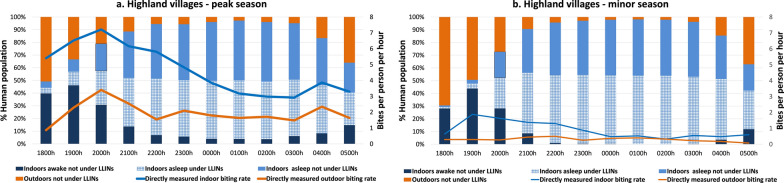
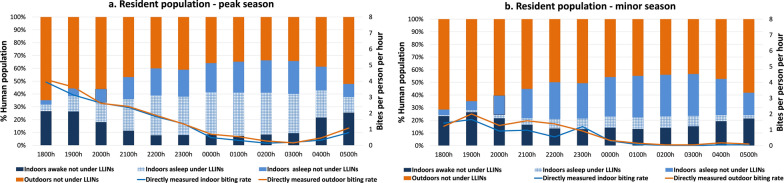
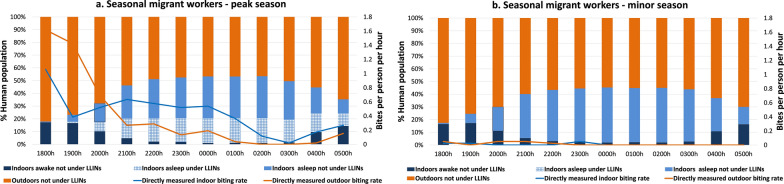
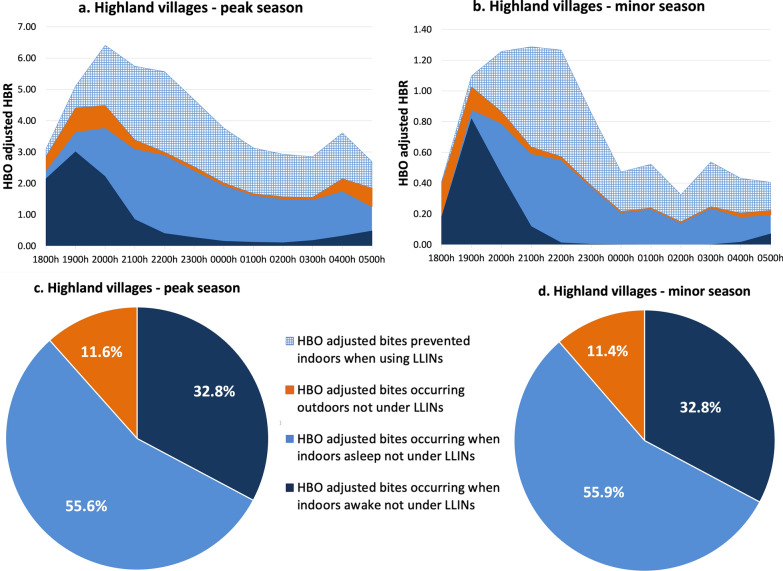
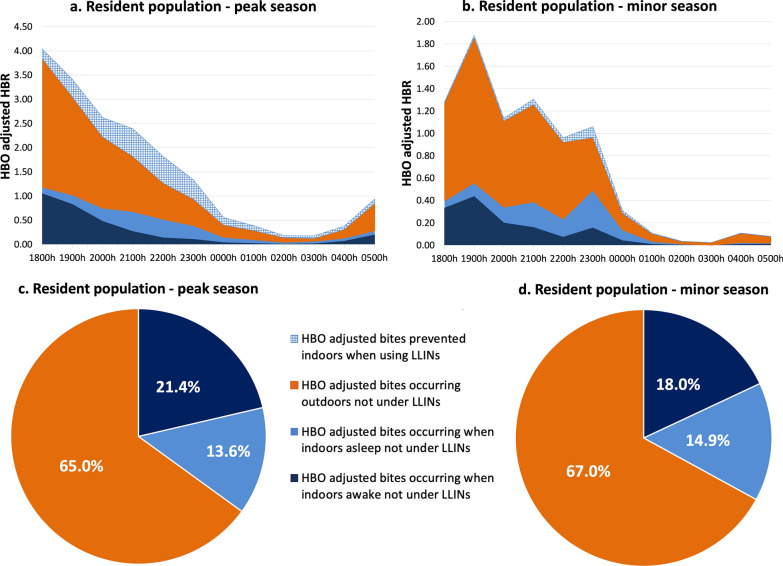
In the highland villages, residents predominantly engaged in indoor activities, with their peak activity overlapping with the peak biting hours (1800-2200 hours). A substantial proportion of inhabitants slept indoors without LLINs in the peak and minor seasons (42.8% and 39.2%, respectively). Highland residents were significantly more exposed to malaria vectors indoors (88.4% peak, 88.6% minor) than outdoors during both transmission seasons. In lowland villages, both resident and seasonal migrant worker populations exhibited predominantly outdoor activity, particularly during peak biting hours (1800-2300 hours). Both residents and temporary migrants were significantly more exposed to Anopheles mosquitoes outdoors (resident: 65.0% peak, 67.1% minor; migrant: 70.5% peak, 80.0% minor) than indoors during both transmission seasons. LLIN usage was minimal and offered limited protection, with < 16.63% of person-time spent under nets by resident populations and 10.7% by migrant workers.
Malaria control in Ethiopia requires context-specific strategies tailored to diverse ecological settings that consider the impact of human behavior on exposure to Anopheles mosquitoes. Limited LLIN effectiveness, human activities coinciding with peak biting times and minimal LLIN usage create significant protection gaps. Comprehensive control necessitates supplemental tools addressing exposure in all locations and times. In the Ethiopian highlands, where indoor activities predominate, increased LLIN usage combined with targeted indoor residual spraying could reduce transmission. In lowland areas, both residents and seasonal migrant workers face relatively higher outdoor exposure risks, requiring additional measures, such as topical and spatial repellents. We recommend implementing data-driven, hyperlocal approaches based on specific human-vector interactions to enhance malaria control effectiveness across the Ethiopian highlands and lowlands.
埃塞俄比亚持续面临着顽固的疟疾负担,其特点是疟疾传播持续存在且疫情反复爆发。人类行为既影响疟疾暴露情况,也影响病媒干预措施的效果,这使得疟疾防控工作变得复杂。由于缺乏数据,在埃塞俄比亚的高传播地区和低传播地区,制定考虑人类活动与病媒行为之间复杂相互作用的针对性策略仍然是一项挑战,特别是对于脆弱的高地人群和临时劳务移民而言。本研究的目的是研究人类与蚊子相互作用的时空模式,并评估长效驱虫蚊帐(LLINs)在涉及低地常住人口、季节性流动工人和高地社区的环境中的有效性和适用性。
从高传播低地(居民和临时流动工人)以及脆弱的高地人群中收集人类和病媒行为的同步数据。每小时的人类行为观察(HBOs),即检查LLIN的使用情况、室内与室外的人员存在情况以及睡眠模式,与使用美国疾病控制中心的诱蚊灯(CDC LT)进行蚊子采样配对,以交叉设计的方式作为蚊子叮咬行为的替代指标。该研究在疟疾传播高峰期(2022年10月至12月)和低谷期(2023年3月至5月)进行,共持续368个夜晚。在高地,选择了四个村庄,每个村庄有八户人家进行监测;在低地,选择了四个村庄,包括两个常住人口村庄和两个有流动工人的农场,每个村庄或农场有八户人家/建筑用于数据收集。整合CDC LT和HBO数据,以评估按HBO调整的按蚊人类叮咬率(HBO调整后的HBR)。
在高地村庄,居民主要在室内活动,其活动高峰期与叮咬高峰期(18:00 - 22:00)重叠。在高峰期和低谷期,相当一部分居民(分别为42.8%和39.2%)在没有使用LLIN的情况下在室内睡觉。在两个传播季节,高地居民在室内感染疟疾媒介的几率(高峰期88.4%,低谷期88.6%)显著高于室外。在低地村庄,常住人口和季节性流动工人都主要在室外活动,尤其是在叮咬高峰期(18:00 - 23:00)。在两个传播季节,常住人口和临时流动工人在室外接触按蚊的几率(常住人口:高峰期65.0%,低谷期67.1%;流动工人:高峰期70.5%,低谷期80.0%)均显著高于室内。LLIN的使用率极低,提供的保护有限,常住人口在蚊帐下度过的时间占比不到16.63%,流动工人为10.7%。
埃塞俄比亚的疟疾防控需要针对不同生态环境制定因地制宜的策略,同时考虑人类行为对接触按蚊的影响。LLIN效果有限、人类活动与叮咬高峰期重合以及LLIN使用率极低造成了显著的保护缺口。全面防控需要补充工具,以应对所有地点和时间的暴露风险。在以室内活动为主的埃塞俄比亚高地,增加LLIN的使用率并结合有针对性的室内滞留喷洒可以减少传播。在低地地区,常住人口和季节性流动工人都面临相对较高的室外暴露风险,需要采取额外措施,如局部和空间驱避剂。我们建议实施基于特定人类与病媒相互作用的数据驱动的超本地化方法,以提高埃塞俄比亚高地和低地的疟疾防控效果。