Institute of Applied Physics and Linz Institute of Technology (LIT), Johannes Kepler University Linz, Altenberger Straße 69, 4040, Linz, Austria.
University of Applied Sciences, Upper Austria School of Medical Engineering and Applied Social Sciences, Garnisonstraße 21, 4020, Linz, Austria.
J Nanobiotechnology. 2021 Jan 18;19(1):23. doi: 10.1186/s12951-020-00762-8.
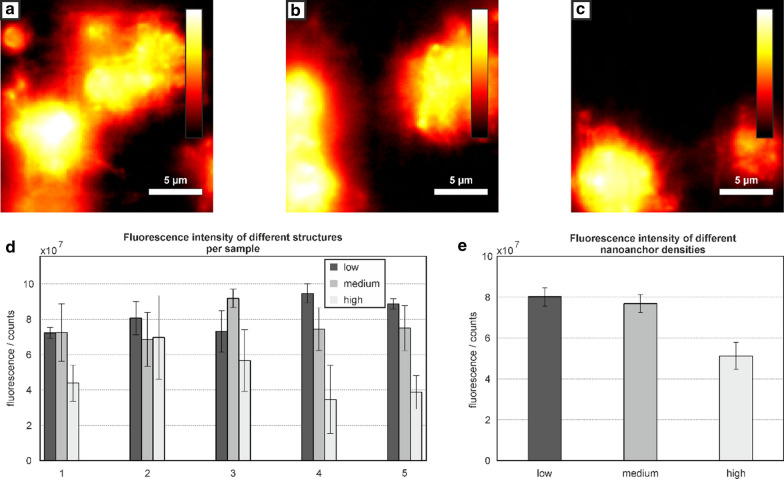
Three-dimensional photopolymerization techniques such as multiphoton polymerization lithography (MPL) and stimulated emission depletion (STED) lithography are powerful tools for fabricating structures in the sub-µm range. Combining these techniques with microfluidics enables us to broaden the range of their applications. In this study, we show a microfluidic device enhanced with MPL structures carrying STED-lithographically written nanoanchors that promote binding of the von Willebrand factor (vWF). The density of vWF is adjusted by varying the number of the nanoanchors on the 3D structures. This allows us to study the impact of the density of vWF on the activation of thrombocytes. The activation of the thrombocytes seems to decrease with the density of vWF on the 3D scaffolds inside the microfluidic channels.
三维光聚合技术,如多光子聚合光刻(MPL)和受激发射损耗(STED)光刻,是在亚微米范围内制造结构的有力工具。将这些技术与微流控相结合,使我们能够拓宽它们的应用范围。在这项研究中,我们展示了一种微流控装置,该装置增强了 MPL 结构,带有 STED 光刻书写的纳米锚,促进了 von Willebrand 因子(vWF)的结合。通过改变三维结构上纳米锚的数量,可以调节 vWF 的密度。这使我们能够研究 vWF 密度对血小板激活的影响。血小板的激活似乎随着微流道内三维支架上 vWF 的密度的增加而降低。