Medical Imaging Center, University Medical Center Groningen, University of Groningen, Hanzeplein 1, 9713GZ, Groningen, The Netherlands.
Stratingh Institute for Chemistry, University of Groningen, Nijenborgh 4, 9747AF, Groningen, The Netherlands.
Angew Chem Int Ed Engl. 2020 Nov 23;59(48):21663-21670. doi: 10.1002/anie.202008700. Epub 2020 Sep 23.
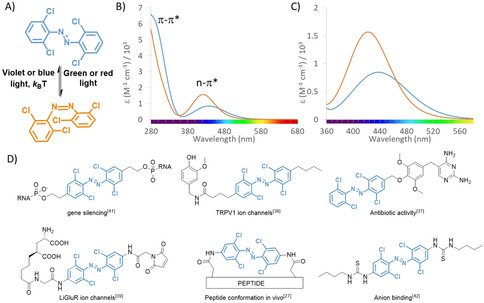
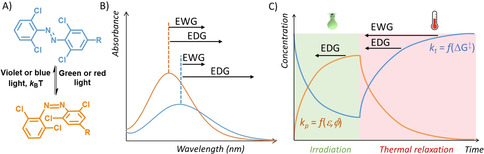
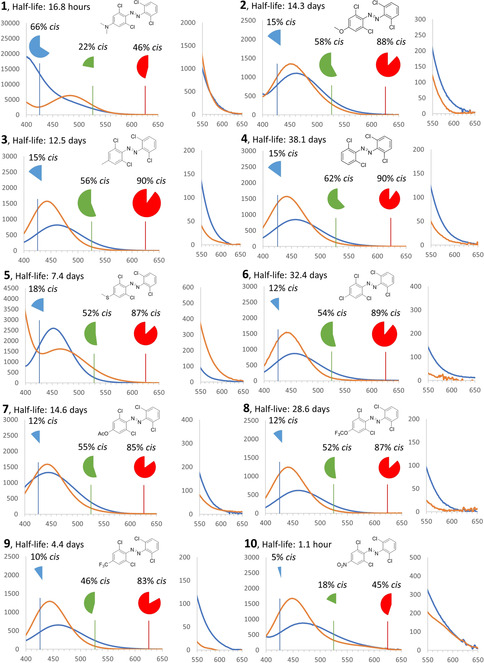
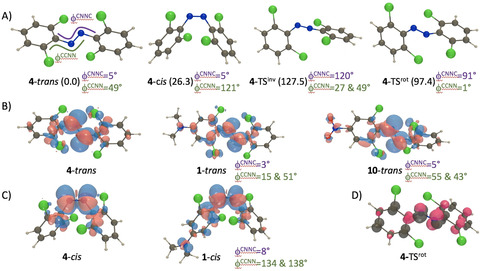
Molecular photoswitches enable reversible external control of biological systems, nanomachines, and smart materials. Their development is driven by the need for low energy (green-red-NIR) light switching, to allow non-invasive operation with deep tissue penetration. The lack of clear design principles for the adaptation and optimization of such systems limits further applications. Here we provide a design rulebook for tetra-ortho-chloroazobenzenes, an emerging class of visible-light-responsive photochromes, by elucidating the role that substituents play in defining their key characteristics: absorption spectra, band overlap, photoswitching efficiencies, and half-lives of the unstable cis isomers. This is achieved through joint photochemical and theoretical analyses of a representative library of molecules featuring substituents of varying electronic nature. A set of guidelines is presented that enables tuning of properties to the desired application through informed photochrome engineering.
分子光开关使生物系统、纳米机器和智能材料的外部控制能够实现可逆。它们的发展是由对低能量(绿-红-近红外)光开关的需求驱动的,这使得可以用具有深组织穿透能力的非侵入式操作来进行。缺乏对这些系统的适应性和优化的明确设计原则限制了进一步的应用。在这里,我们通过阐明取代基在定义其关键特性(吸收光谱、能带重叠、光致开关效率和不稳定顺式异构体的半衰期)方面所起的作用,为四邻氯偶氮苯(一种新兴的可见光响应光致变色化合物)提供了设计规则手册。这是通过对具有不同电子性质取代基的代表性分子库进行联合光化学和理论分析来实现的。提出了一组准则,通过明智的光致变色体工程,可以根据所需的应用来调整性能。