Centre for Diet and Activity Research and MRC Epidemiology Unit, University of Cambridge.
Bennett Institute for Public Policy, University of Cambridge.
Milbank Q. 2021 Mar;99(1):126-170. doi: 10.1111/1468-0009.12498. Epub 2021 Jan 19.
Policy Points This analysis finds that government obesity policies in England have largely been proposed in a way that does not readily lead to implementation; that governments rarely commission evaluations of previous government strategies or learn from policy failures; that governments have tended to adopt less interventionist policy approaches; and that policies largely make high demands on individual agency, meaning they rely on individuals to make behavior changes rather than shaping external influences and are thus less likely to be effective or equitable. These findings may help explain why after 30 years of proposed government obesity policies, obesity prevalence and health inequities still have not been successfully reduced. If policymakers address the issues identified in this analysis, population obesity could be tackled more successfully, which has added urgency given the COVID-19 pandemic.
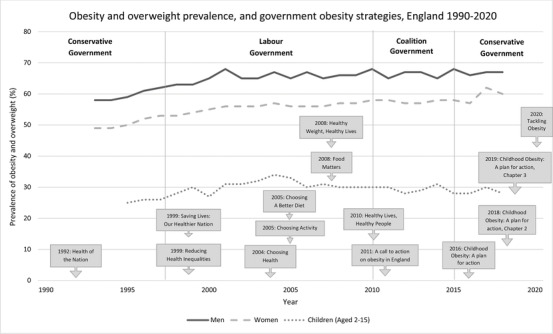
In England, the majority of adults, and more than a quarter of children aged 2 to 15 years live with obesity or excess weight. From 1992 to 2020, even though the government published 14 obesity strategies in England, the prevalence of obesity has not been reduced. We aimed to determine whether such government strategies and policies have been fit for purpose regarding their strategic focus, nature, basis in theory and evidence, and implementation viability.
We undertook a mixed-methods study, involving a document review and analysis of government strategies either wholly or partially dedicated to tackling obesity in England. We developed a theory-based analytical framework, using content analysis and applied thematic analysis (ATA) to code all policies. Our interpretation drew on quantitative findings and thematic analysis.
We identified and analyzed 14 government strategies published from 1992 to 2020 containing 689 wide-ranging policies. Policies were largely proposed in a way that would be unlikely to lead to implementation; the majority were not interventionist and made high demands on individual agency, meaning that they relied on individuals to make behavior changes rather than shaping external influences, and are thus less likely to be effective or to reduce health inequalities.
The government obesity strategies' failure to reduce the prevalence of obesity in England for almost 30 years may be due to weaknesses in the policies' design, leading to a lack of effectiveness, but they may also be due to failures of implementation and evaluation. These failures appear to have led to insufficient or no policy learning and governments proposing similar or identical policies repeatedly over many years. Governments should learn from their earlier policy failures. They should prioritize policies that make minimal demands on individuals and have the potential for population-wide reach so as to maximize their potential for equitable impacts. Policies should be proposed in ways that readily lead to implementation and evaluation.
在英格兰,大多数成年人,以及超过四分之一的 2 至 15 岁儿童超重或肥胖。自 1992 年以来,尽管政府在英格兰发布了 14 项肥胖战略,但肥胖率并未降低。我们旨在确定政府的这些战略和政策在其战略重点、性质、理论和证据基础以及实施可行性方面是否符合目的。
我们进行了一项混合方法研究,涉及对英国专门用于解决肥胖问题的政府战略的文件审查和分析。我们制定了一个基于理论的分析框架,使用内容分析和应用主题分析(ATA)对所有政策进行编码。我们的解释借鉴了定量发现和主题分析。
我们确定并分析了 1992 年至 2020 年间发布的 14 项政府战略,其中包含 689 项广泛的政策。这些政策大多是以不太可能导致实施的方式提出的;大多数政策都不是干预性的,对个人机构提出了很高的要求,这意味着它们依赖个人来改变行为,而不是塑造外部影响,因此不太可能有效或减少健康不平等。
政府在过去近 30 年未能降低英格兰肥胖症的发病率,这可能是由于政策设计上的弱点导致缺乏有效性,但也可能是由于实施和评估的失败。这些失败似乎导致了政策学习的不足或没有,以及政府多年来反复提出类似或相同的政策。政府应该从早期的政策失败中吸取教训。他们应该优先考虑那些对个人要求最低、有潜力在整个人群中推广的政策,以最大限度地发挥其公平影响的潜力。政策应以易于实施和评估的方式提出。