School of Medicine, Autonomous University of the State of Mexico, Toluca, State of Mexico, Mexico.
Computational Genomics Department, National Institute of Genomic Medicine, Mexico City, Mexico.
PLoS One. 2021 Jan 19;16(1):e0244384. doi: 10.1371/journal.pone.0244384. eCollection 2021.
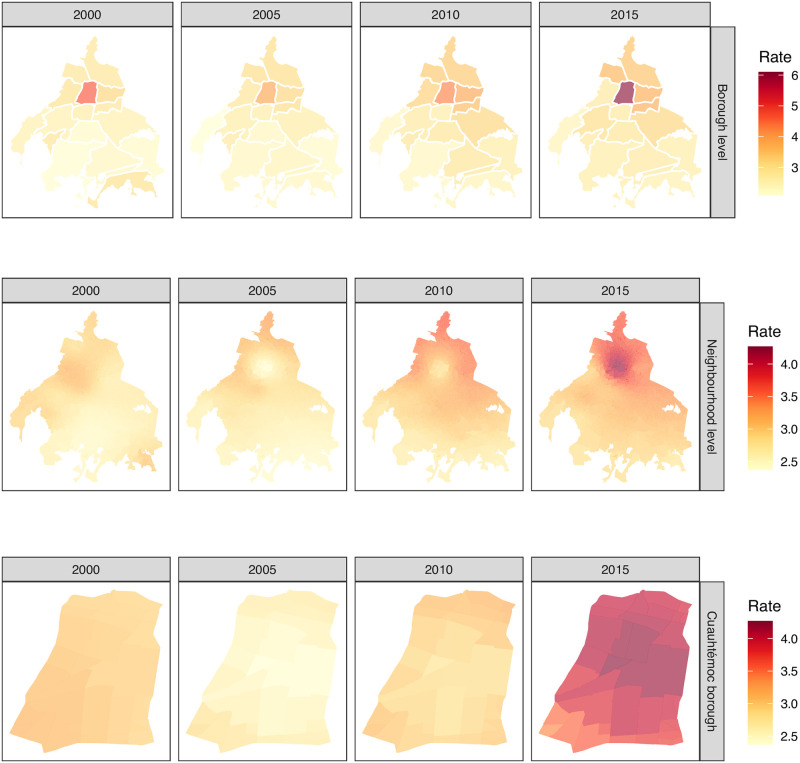
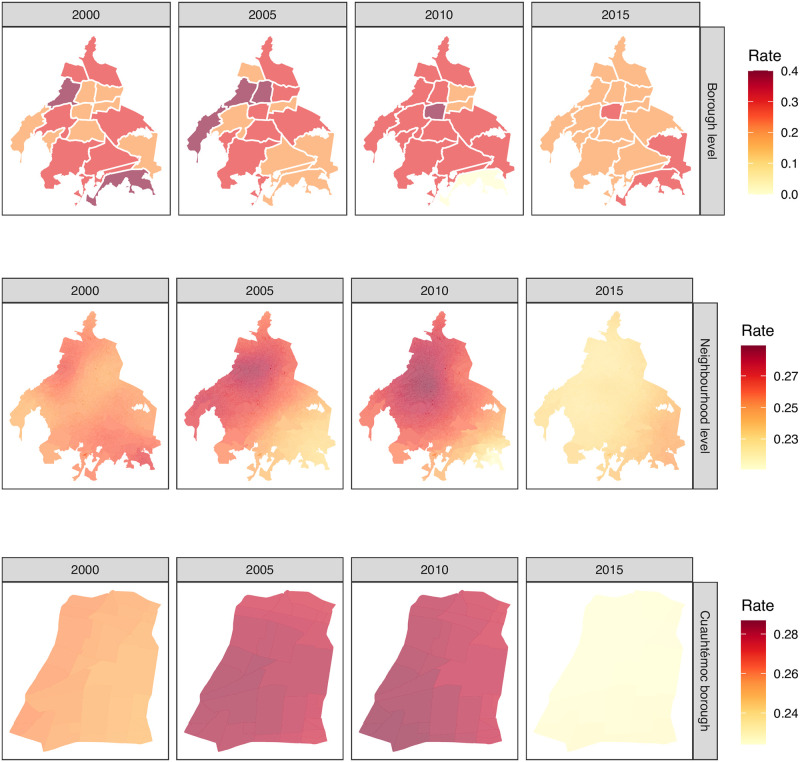
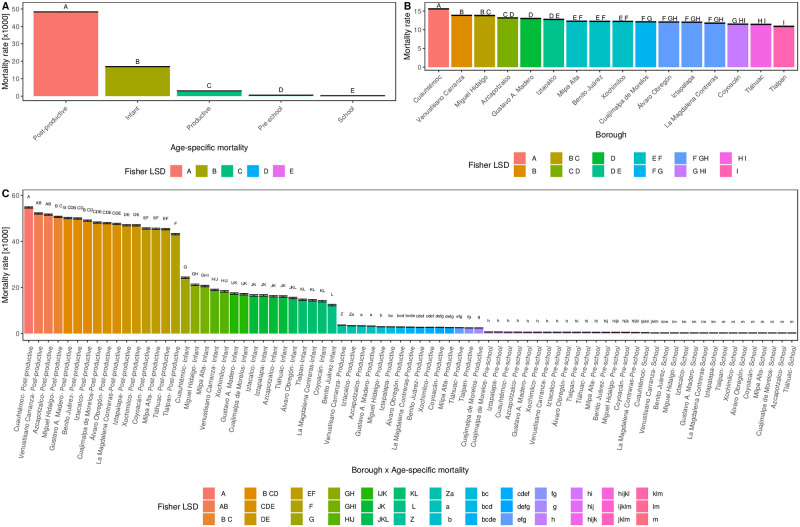
Understanding the spatial and temporal patterns of mortality rates in a highly heterogeneous metropolis, is a matter of public policy interest. In this context, there is no, to the best of our knowledge, previous studies that correlate both spatio-temporal and age-specific mortality rates in Mexico City. Spatio-temporal Kriging modeling was used over five age-specific mortality rates (from the years 2000 to 2016 in Mexico City), to gain both spatial (borough and neighborhood) and temporal (year and trimester) data level description. Mortality age-specific patterns have been modeled using multilevel modeling for longitudinal data. Posterior tests were carried out to compare mortality averages between geo-spatial locations. Mortality correlation extends in all study groups for as long as 12 years and as far as 13.27 km. The highest mortality rate takes place in the Cuauhtémoc borough, the commercial, touristic and cultural core downtown of Mexico City. On the contrary, Tlalpan borough is the one with the lowest mortality rates in all the study groups. Post-productive mortality is the first age-specific cause of death, followed by infant, productive, pre-school and scholar groups. The combinations of spatio-temporal Kriging estimation and time-evolution linear mixed-effect models, allowed us to unveil relevant time and location trends that may be useful for public policy planning in Mexico City.
了解高度异质大都市的死亡率的时空模式,是公共政策关注的问题。在这方面,据我们所知,以前没有研究将墨西哥城的时空和特定年龄死亡率相关联。本文使用时空克里金建模方法,对五个特定年龄死亡率(墨西哥城 2000 年至 2016 年)进行了研究,以获得空间(行政区和街区)和时间(年份和季度)数据水平描述。使用纵向数据分析的多层次建模对特定年龄死亡率模式进行了建模。进行了后验检验,以比较地理空间位置之间的死亡率平均值。死亡率相关性在所有研究组中都存在,最长可达 12 年,最远可达 13.27 公里。死亡率最高的行政区是科约特佩克行政区,即墨西哥城的商业、旅游和文化中心。相反,在所有研究组中,死亡率最低的行政区是特拉尔潘行政区。生育后死亡率是第一个特定年龄的死亡原因,其次是婴儿、生育期、学前和学生群体。时空克里金估计和时间演变线性混合效应模型的组合,使我们能够揭示可能对墨西哥城公共政策规划有用的相关时间和地点趋势。