Departamento de Microbiología Molecular, Instituto de Biotecnología, Universidad Nacional Autónoma de México (UNAM), Cuernavaca, Morelos, Mexico.
Department of Entomology, Instituto Aggeu Magalhães-FIOCRUZ, Recife-PE, Brazil.
PLoS Pathog. 2021 Jan 19;17(1):e1009199. doi: 10.1371/journal.ppat.1009199. eCollection 2021 Jan.
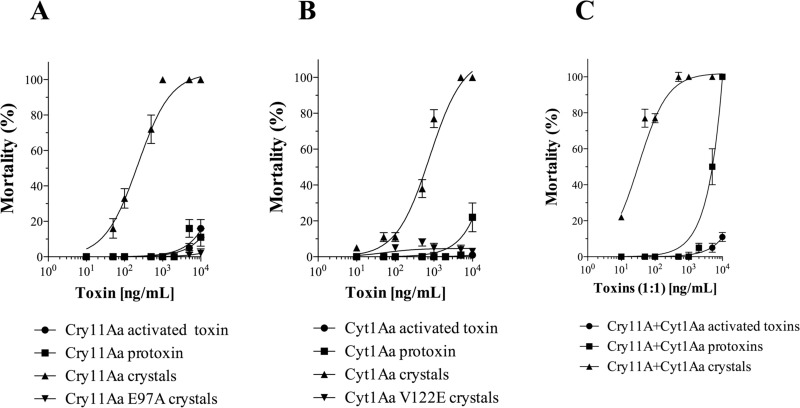
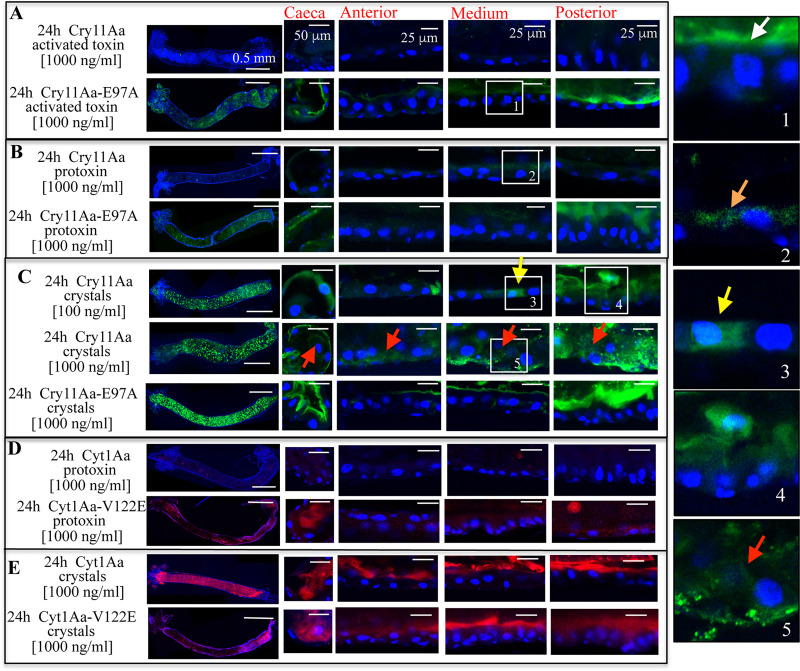
The insecticidal Cry11Aa and Cyt1Aa proteins are produced by Bacillus thuringiensis as crystal inclusions. They work synergistically inducing high toxicity against mosquito larvae. It was proposed that these crystal inclusions are rapidly solubilized and activated in the gut lumen, followed by pore formation in midgut cells killing the larvae. In addition, Cyt1Aa functions as a Cry11Aa binding receptor, inducing Cry11Aa oligomerization and membrane insertion. Here, we used fluorescent labeled crystals, protoxins or activated toxins for in vivo localization at nano-scale resolution. We show that after larvae were fed solubilized proteins, these proteins were not accumulated inside the gut and larvae were not killed. In contrast, if larvae were fed soluble non-toxic mutant proteins, these proteins were found inside the gut bound to gut-microvilli. Only feeding with crystal inclusions resulted in high larval mortality, suggesting that they have a role for an optimal intoxication process. At the macroscopic level, Cry11Aa completely degraded the gastric caeca structure and, in the presence of Cyt1Aa, this effect was observed at lower toxin-concentrations and at shorter periods. The labeled Cry11Aa crystal protein, after midgut processing, binds to the gastric caeca and posterior midgut regions, and also to anterior and medium regions where it is internalized in ordered "net like" structures, leading finally to cell break down. During synergism both Cry11Aa and Cyt1Aa toxins showed a dynamic layered array at the surface of apical microvilli, where Cry11Aa is localized in the lower layer closer to the cell cytoplasm, and Cyt1Aa is layered over Cry11Aa. This array depends on the pore formation activity of Cry11Aa, since the non-toxic mutant Cry11Aa-E97A, which is unable to oligomerize, inverted this array. Internalization of Cry11Aa was also observed during synergism. These data indicate that the mechanism of action of Cry11Aa is more complex than previously anticipated, and may involve additional steps besides pore-formation activity.
苏云金芽胞杆菌产生的杀虫 Cry11Aa 和 Cyt1Aa 蛋白作为晶体包含体。它们协同作用,对蚊子幼虫表现出高毒性。据推测,这些晶体包含体在肠道腔中迅速溶解并激活,随后在中肠细胞中形成孔,杀死幼虫。此外,Cyt1Aa 作为 Cry11Aa 的结合受体发挥作用,诱导 Cry11Aa 寡聚化和膜插入。在这里,我们使用荧光标记的晶体、原毒素或激活的毒素进行体内定位,达到纳米级分辨率。我们表明,幼虫摄取溶解的蛋白后,这些蛋白不会在肠道内积累,幼虫也不会死亡。相比之下,如果幼虫摄取可溶性无毒突变蛋白,这些蛋白会在肠道内与肠道微绒毛结合。只有喂食晶体包含体才会导致幼虫高死亡率,这表明它们在最佳中毒过程中起作用。在宏观水平上,Cry11Aa 完全降解了胃盲囊结构,并且在 Cyt1Aa 存在的情况下,这种效应在较低的毒素浓度和较短的时间内观察到。标记的 Cry11Aa 晶体蛋白在中肠加工后,与胃盲囊和后中肠区域结合,也与前肠和中肠区域结合,在这些区域内,它以有序的“网状”结构内化,最终导致细胞破裂。在协同作用下,Cry11Aa 和 Cyt1Aa 毒素都在顶端微绒毛表面显示出动态分层排列,Cry11Aa 位于更靠近细胞质的下层,而 Cyt1Aa 则分层在 Cry11Aa 之上。这种排列依赖于 Cry11Aa 的孔形成活性,因为不能寡聚化的无毒性突变体 Cry11Aa-E97A 会使这种排列反转。在协同作用下也观察到 Cry11Aa 的内化。这些数据表明,Cry11Aa 的作用机制比以前预期的更为复杂,并且可能涉及除孔形成活性之外的其他步骤。