Department of Medicine, Division of Hematology and Medical Oncology, Weill Cornell Medicine, New York, USA.
Department of Urology, Weill Cornell Medicine, New York, USA.
Prostate. 2021 Apr;81(5):279-285. doi: 10.1002/pros.24104. Epub 2021 Jan 19.
Prostate-specific membrane antigen (PSMA)-targeted radionuclide therapy (TRT) has demonstrated efficacy and tolerability with a dose-response effect in phase I/II trials in men with metastatic castration-resistant prostate cancer (mCRPC). The need for positive PSMA imaging before PSMA-TRT to select patients is largely practiced, but its utility is not proven. Given target heterogeneity, developing a biomarker to identify the optimal patient population remains an unmet need. The aim of this study was to assess PSMA uptake by imaging and response to PSMA-TRT.
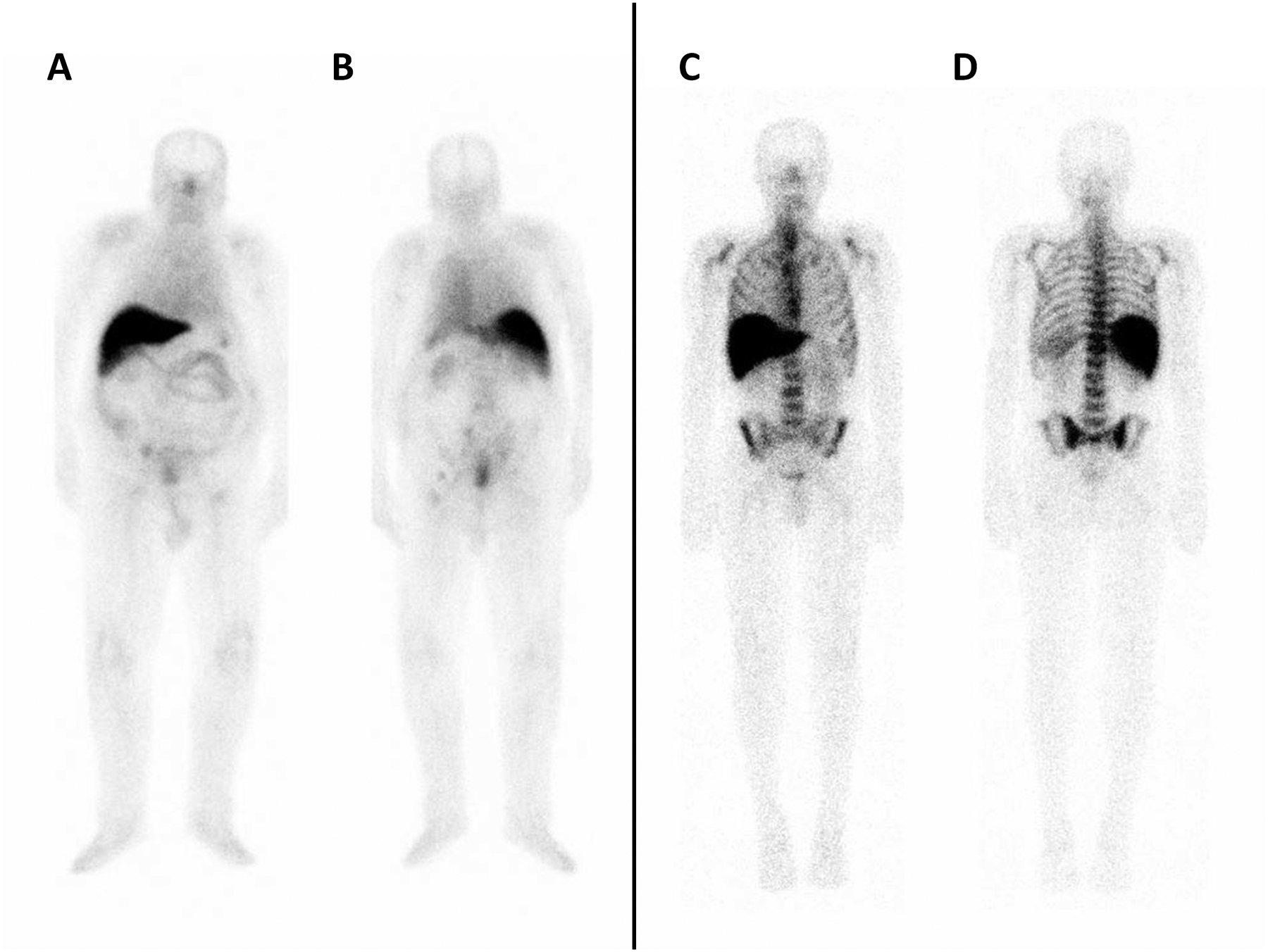
We performed an analysis of men with mCRPC enrolled in sequential prospective phase I/II trials of PSMA-TRT. Each patient had baseline PSMA imaging by planar In and/or Lu SPECT (N = 171) or Ga-PSMA-11 PET/CT (N = 44), but the results were not used to include/exclude treatment. Semiquantitative imaging scores (IS) on a 0-4 scale were assigned based on PSMA uptake in tumors compared to liver uptake. We compared the ≥50% PSA decline response proportions between low (0-1) and high (2-4) PSMA IS using the χ -test. We used multivariable logistic regression analysis to understand the relationship between independent and dependent variables, including IS, radionuclide activity (dose) administered, CALGB (Halabi) prognostic risk score, prior taxane use.
215 men with progressive mCRPC received PSMA-TRT as follows: Lu-J591 (n = 137), Lu-PSMA-617 (n = 44), Y-J591 (n = 28), Lu-J591 + Lu-PSMA-617 (n = 6). High PSMA expression (IS 2-4) was found in 160 (74.4%) patients and was significantly associated with more frequent ≥ 50% PSA reduction (26.2 vs. 7.3%, p = .006). On multivariate logistic regression analysis, higher IS was associated with a ≥50% decrease in PSA, even after accounting for CALGB (Halabi) prognostic score, the dose administered, and previous taxane use (OR, 4.72; 95% CI, 1.71-16.85; p = .006). Patients with low PSMA expression (N = 55, 24.7%) were less likely to respond. Thirteen of 26 (50%) with no PSMA uptake (IS = 0) had post-PSMA-TRT PSA decline with 2 (7.7%) having ≥ 50% PSA declines.
Collectively, the data provide evidence in favor of the hypothesis that patients with high PSMA uptake and high administered radionuclide dose correlate with a higher chance of response.
在转移性去势抵抗性前列腺癌(mCRPC)男性的 I/II 期试验中,前列腺特异性膜抗原(PSMA)靶向放射性核素治疗(TRT)已显示出疗效和耐受性,并具有剂量反应效应。在进行 PSMA-TRT 之前,需要进行阳性 PSMA 成像来选择患者,这在很大程度上已经得到实践,但其实用性尚未得到证实。鉴于靶标异质性,开发一种生物标志物来识别最佳患者人群仍然是未满足的需求。本研究旨在评估 PSMA 摄取情况和对 PSMA-TRT 的反应。
我们对纳入连续前瞻性 PSMA-TRT I/II 期试验的 mCRPC 男性进行了分析。每位患者均进行了基线 PSMA 成像,采用平面 In 和/或 Lu SPECT(N=171)或 Ga-PSMA-11 PET/CT(N=44),但结果并未用于纳入/排除治疗。根据肿瘤与肝脏摄取相比的 PSMA 摄取情况,对肿瘤摄取进行了 0-4 分的半定量成像评分(IS)。我们使用卡方检验比较了低(0-1)和高(2-4)PSMA IS 之间 ≥50% PSA 下降反应的比例。我们使用多变量逻辑回归分析来了解独立和因变量之间的关系,包括 IS、放射性核素活性(剂量)、CALGB(Halabi)预后风险评分、先前使用紫杉醇。
215 名进展性 mCRPC 男性接受了 PSMA-TRT,具体如下:Lu-J591(n=137)、Lu-PSMA-617(n=44)、Y-J591(n=28)、Lu-J591+Lu-PSMA-617(n=6)。160 名(74.4%)患者表达高 PSMA(IS 2-4),且与更频繁的 ≥50% PSA 降低显著相关(26.2% vs. 7.3%,p=0.006)。在多变量逻辑回归分析中,即使考虑到 CALGB(Halabi)预后评分、给予的剂量和先前使用紫杉醇,较高的 IS 仍与 PSA 下降 ≥50%相关(OR,4.72;95%CI,1.71-16.85;p=0.006)。表达低 PSMA(N=55,24.7%)的患者不太可能有反应。26 名(50%)无 PSMA 摄取(IS=0)的患者在接受 PSMA-TRT 后 PSA 下降,其中 2 名(7.7%)的 PSA 下降 ≥50%。
总的来说,这些数据提供了支持以下假设的证据,即高 PSMA 摄取和高放射性核素剂量与更高的反应机会相关。