Microbiologie Adaptation et Pathogénie, Univ Lyon, Université de Lyon 1, UMR5240 CNRS, Villeurbanne, France; Microbiologie Adaptation et Pathogénie, Univ Lyon, INSA Lyon, UMR5240, Villeurbanne, France.
Microbiologie Adaptation et Pathogénie, Univ Lyon, Université de Lyon 1, UMR5240 CNRS, Villeurbanne, France.
J Biol Chem. 2021 Jan-Jun;296:100305. doi: 10.1016/j.jbc.2021.100305. Epub 2021 Jan 16.
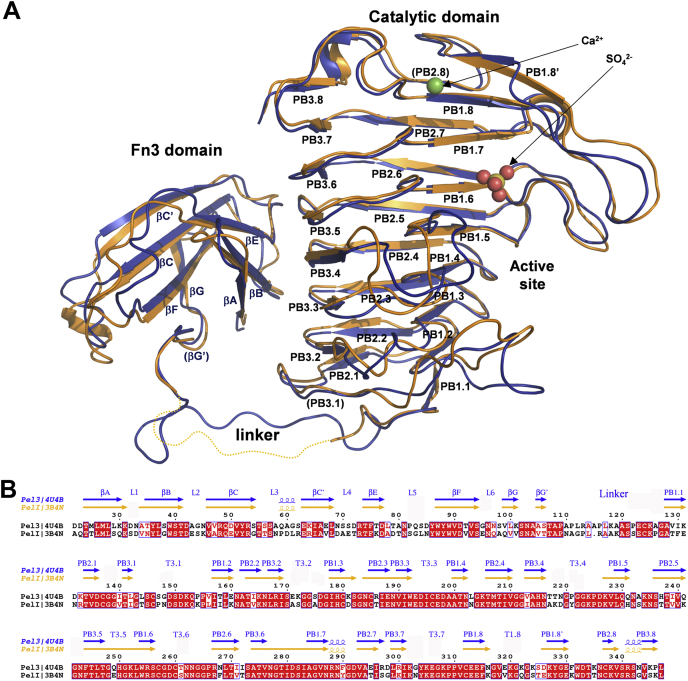
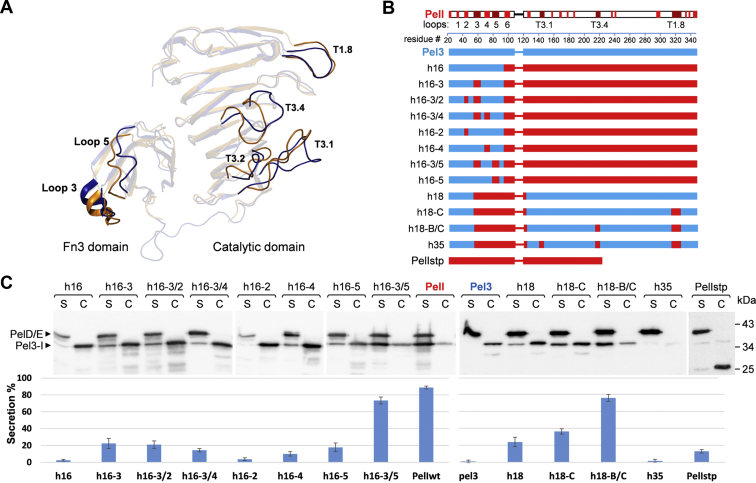
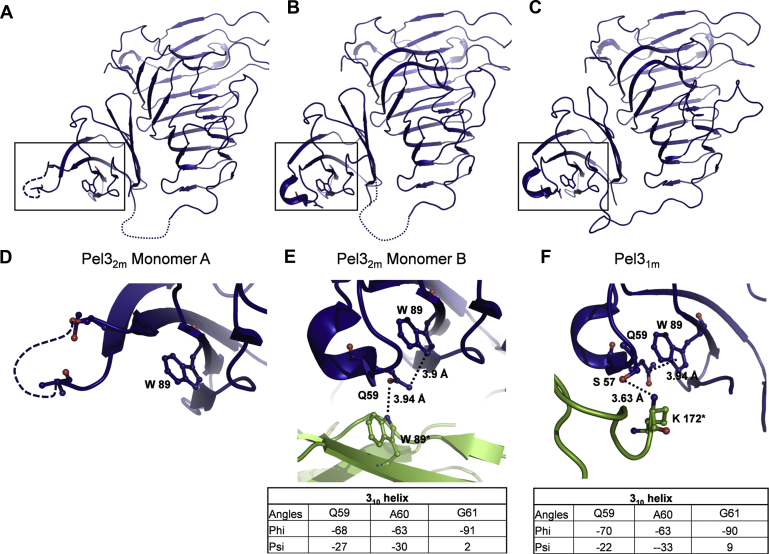
The type II secretion system (T2SS) transports fully folded proteins of various functions and structures through the outer membrane of Gram-negative bacteria. The molecular mechanisms of substrate recruitment by T2SS remain elusive but a prevailing view is that the secretion determinants could be of a structural nature. The phytopathogenic γ-proteobacteria, Pectobacterium carotovorum and Dickeya dadantii, secrete similar sets of homologous plant cell wall degrading enzymes, mainly pectinases, by similar T2SSs, called Out. However, the orthologous pectate lyases Pel3 and PelI from these bacteria, which share 67% of sequence identity, are not secreted by the counterpart T2SS of each bacterium, indicating a fine-tuned control of protein recruitment. To identify the related secretion determinants, we first performed a structural characterization and comparison of Pel3 with PelI using X-ray crystallography. Then, to assess the biological relevance of the observed structural variations, we conducted a loop-substitution analysis of Pel3 combined with secretion assays. We showed that there is not one element with a definite secondary structure but several distant and structurally flexible loop regions that are essential for the secretion of Pel3 and that these loop regions act together as a composite secretion signal. Interestingly, depending on the crystal contacts, one of these key secretion determinants undergoes disorder-to-order transitions that could reflect its transient structuration upon the contact with the appropriate T2SS components. We hypothesize that such T2SS-induced structuration of some intrinsically disordered zones of secretion substrates could be part of the recruitment mechanism used by T2SS.
II 型分泌系统(T2SS)通过革兰氏阴性菌的外膜运输各种功能和结构的完全折叠蛋白。T2SS 底物募集的分子机制仍然难以捉摸,但流行的观点是,分泌决定因素可能具有结构性质。植物病原γ-变形菌,果胶杆菌和迪凯亚·达丹蒂(Dickeya dadantii)通过类似的称为 Out 的 T2SS 分泌类似的同源植物细胞壁降解酶,主要是果胶酶。然而,来自这些细菌的同源果胶裂解酶 Pel3 和 PelI 虽然具有 67%的序列同一性,但并未被每种细菌的对应 T2SS 分泌,这表明对蛋白质募集进行了精细的调控。为了鉴定相关的分泌决定因素,我们首先使用 X 射线晶体学对 Pel3 与 PelI 进行了结构表征和比较。然后,为了评估观察到的结构变异的生物学相关性,我们对 Pel3 进行了loop 替换分析,并结合了分泌测定。我们表明,不是一个具有确定二级结构的元素,而是几个距离较远且结构灵活的环区对于 Pel3 的分泌是必不可少的,并且这些环区作为一个复合分泌信号一起作用。有趣的是,根据晶体接触,这些关键分泌决定因素之一会发生无序到有序的转变,这可能反映了其与适当的 T2SS 成分接触时的瞬时结构。我们假设,T2SS 诱导的分泌底物某些固有无序区的这种结构可能是 T2SS 所使用的募集机制的一部分。